The report for the National Lotteries Commission (NLC) coincides with the beginning of the 6th administration of the democratic South Africa.
The focus of the new administration is to boost economic growth and enable deeper levels of economic inclusion and transformation.
A new Department of Trade, Industry and Competition has been established, through a merger of the dti and Economic Development Department, which will drive the implementation of a more focused, high-impact industrial strategy.
Over the next five years, the focus will be on practical actions and improved governance, to pull our economy onto the higher growth levels we require to create decent work and entrepreneurial opportunities for many more South Africans, particularly young people. There are no quick fixes if we want to build this high-growth, high-employment, high-inclusion economy.
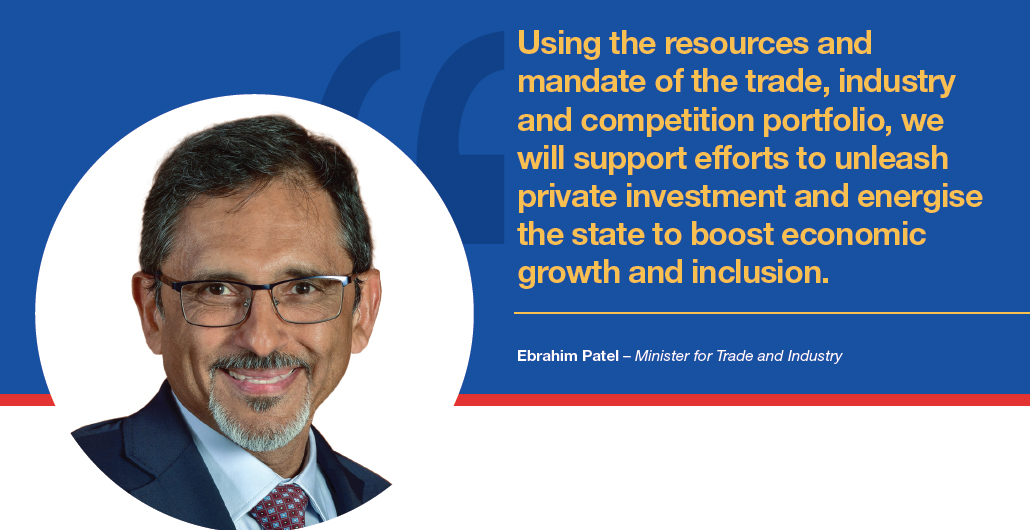
Using the resources and mandate of the trade, industry and competition portfolio, we will support efforts to unleash private investment and energise the state to boost economic growth and inclusion. This is an essential part of building confidence and the platform for job-creation.
As priorities for the new Administration we have outlined six focus areas in the trade, industry and competition portfolio:
These include developing Master Plans in priority sectors to help create conducive conditions for industries to grow, improve their industrial capacities and sophistication, focus more on export orientation and reclaim domestic market space lost to imports.
The Master Plans will be action-oriented, developed and carried out in partnership with business and labour and implemented in stages, so that we can move expeditiously.
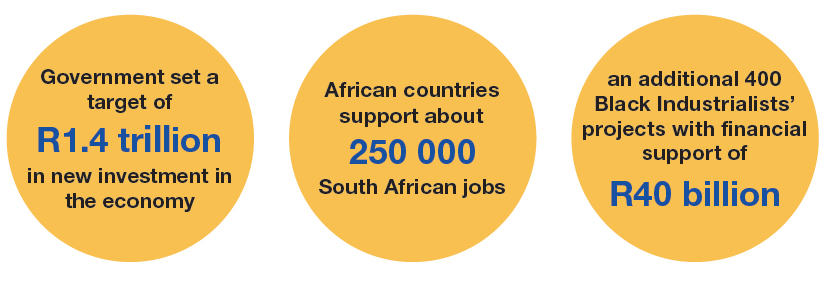
Over the five-year period from 2018/19, Government set a target of R1.4 trillion in new investment in the economy. The vast bulk of this must come from the private sector.
The state’s role will be to enable higher levels of fixed investment (both domestic and foreign), through addressing infrastructure and skills gaps; and by partnering with the private sector through a range of incentives and financial packages.
The single biggest initiative is the African Continental Free Trade Area (AfCFTA) which will connect 1.2 billion people into a single bloc where local products will be traded between countries, with minimal tariffs. These agreements lay the basis for increased intra-African trade and can cement the continent’s position as the next growth frontier.
The implementation phase was launched on 7 July 2019, at a Special African Union Summit meeting in Niger, with the intention to come into effect on 1 July 2020.
The Agreement will fundamentally change and reshape the South African economy. Already, exports to other African countries support about 250 000 South African jobs and it is the fastest-growing market for our manufactured exports.
This means opening up and changing our market structure, to bring more young people, women and Black Industrialists into the economy.
To enhance the growth of Black Industrialists, we will combine the efforts of the Department and its agencies into a seamless and coordinated programme. Over the next 5 years, we will support an additional 400 Black Industrialists’ projects with financial support of R40 billion, through identifying sustainable businesses and promoting both industrialists, new enterprise formation and worker involvement in the enterprises, using a combination of private and public sector resources.
A pillar of our industrial policy is to develop new investment clusters through special economic zones, revitalisation of industrial sites and support for business and digital hubs.
This means being more responsive to the needs of South Africa’s entrepreneurs, moving faster in making decisions and carrying out functions, coordinating better between departments and agencies and creating a business-encouraging environment in which more investment and more job creation can take place.
Part of a smart state is partnering with domestic businesses to invest more in innovation and R&D, as new techniques, new products and new distribution platforms can move South Africa up the value-chain and enhance job creation.
All public entities will have to work with a greater sense of urgency to support government in achieving its ambitions for the new administration. This is what has been called the spirit of khawuleza, and it must define our approach both within Government and public entities to addressing the structures in the economy which impede growth, economic inclusion and job creation.
I wish to acknowledge the work of the NLC Chairperson, the Board of the NLC and staff over the last year and wish them well in their efforts to carry out their public mandate.
|