Operations at a glance
Regulatory compliance is the cornerstone of the NLC, with the primary mandate of the organisation being that of a regulator.
The division is charged with the responsibility of protecting the public against prohibited lotteries through identifying, investigating
and closing down activities, as well as implementing the participant protection strategy.
The division continues to ensure that the regulator is central to shaping policy direction through engagement with stakeholders and policymakers and ensuring that lotteries and sports pools are conducted with due proprietary, that lottery participants are protected, and lotteries provide contributions to good causes.
| Operations division | |||
| Monitoring and evaluation |
Marketing and communications |
Research and development (R&D) |
Provincial offices |
Measures the impact |
Rooted in the vision – to be a catalyst for social upliftment and includes strategies and activities within the area of stakeholder relations. Marketing and communications are geared at catalysing action to fulfil the dual mandate of the NLC. |
Based overseas, the R&D unit co-ordinates the research activities of the NLC. The team develops an annual research agenda and conducts relevant research to support evidence-based decision-making with a primary focus on the two core mandates of the NLC of regulation and grant funding. |
The NLC provincial offices are aimed at improving accessibility to the NLC’s service offering. Provincial offices are capacitated to carry out the NLC’s mandates of regulatory compliance and grant funding. |
Outcomes detailed on here |
Outcomes detailed on here |
Outcomes detailed on here |
Outcomes detailed on here |
| Information, communications and technology division |
ICT continues to be an enabler of conducting business more efficiently. The implementation of an integrated ERP yielded favourable results in enhancing the operational capacity of the entire organisation. The ERP platform is characterised by five The ERP platform is available to all NLC employees across the country by means of a modern Multiprotocol Label Switching (MPLS) data network. This network enables seamless transmission of multiple data technology-based services such as email, internet, telephonic and video conferencing applications. The ICT governance framework serves as a guideline in realising the upkeep and optimal operation of the ICT environment in terms of the solutions implemented. ICT continues to put in place the relevant service level agreements (SLAs), MOUs and standard operating procedures (SOPs). ICT continues to enhance cybersecurity management, explore cloud services and architectures, as well as expand interconnectivity with other entities |
| Human capital division |
The human capital division represents the heartbeat of the organisation, in that it ensures the organisation gains knowledge, talents, skills, abilities, experience and intellectual capital through NLC’s most valued asset, its employees. Organisational growth has resulted in the NLC increasing its workforce to support regulatory and operational requirements. Outcomes detailed on here (Human Capital) of the report |
| Legal services and forensic division |
The strategic objective of the legal services division is to render legal support and advisory services to the NLC in executing its functions as detailed in legislation. The legal division supports strategic objective one of the Annual Performance Plan. The role of the legal services division has been integrated with that of the forensic unit, and as such, it has transformed into the legal services and forensic division. Such a role encapsulates the appreciation of pressure points, strategy, objectives of the Commission and the need to communicate these risks and legal issues effectively. Besides the rendering of general legal services, the division continues to ensure legislative awareness on the implementation of the Amended Lotteries Act (Act 32 of 2013); otherwise referred to as the Lotteries Act 57 of 1997 (as amended), including its regulations. |
Regulatory value chain
The NLC’s regulatory compliance value chain is based on core regulatory activities of well-functioning lotteries and sports pools regulator.
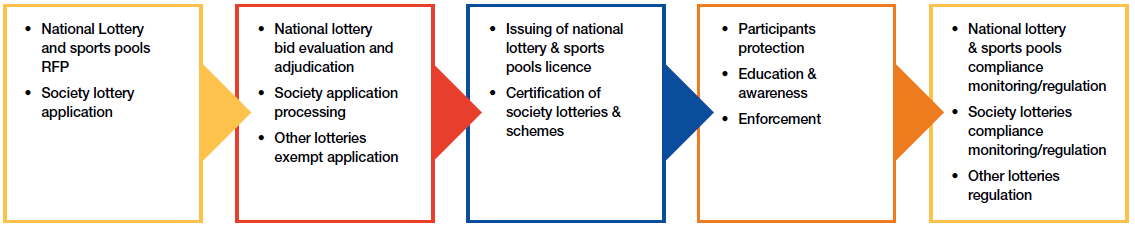
Our regulatory activities
The NLC’s mandate to regulate all lotteries and sports pools with integrity and ensure the protection of all participants is realised through the activities of the regulatory compliance division. The NLC’s regulatory mandate continues to be one of the organisation’s main priority areas, focusing on regulating and monitoring compliance and performance of the operator with the Amended Lotteries Act and Licence Agreement. The NLC ensures optimum and balanced regulation of lottery operators through the regulatory compliance model depicted below.
In accordance with the Board’s directive to ensure that the NLC is positioned and recognised as a regulator, the following must be implemented:
| – | Develop a strategy that will influence the direction of the legislation by advising the Minister. |
| – | Align the structure to the Regulatory mandate of the NLC. |
| – | Introduce programmes that give effect to section 2B that stipulates that the Commission must ensure the interests of participants in the National Lottery are adequately protected. |
| – | Explore and recommend to the Minister innovative ways to combat illegal lotteries, including licensing certain illegal lotteries, i.e. Fafi and online activities. |
| – | Explore opportunities in private lotteries as contemplated in the Lotteries Act. |
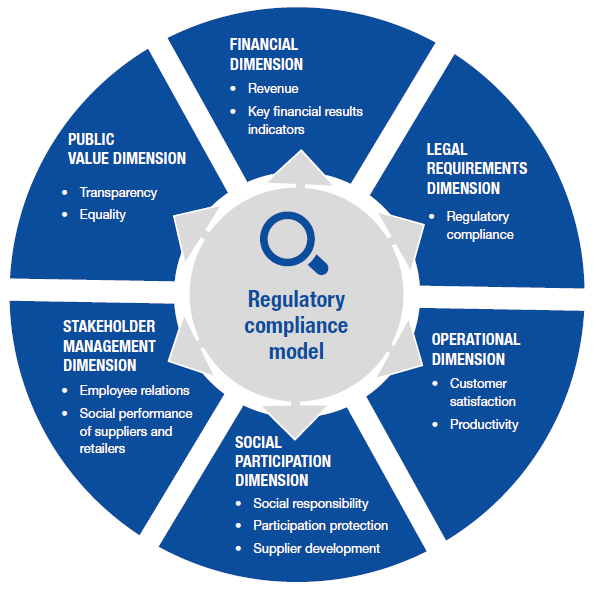
Source: Dr Lea Meyer, 2013
Regulating the National Lottery and Sports Pools operator
The National Lottery comprises of various games of chance. The main objective of our regulatory work is to ensure that the integrity and reputation of the National Lottery and Sports Pools is maintained. The protection of lottery participants further remains top of our agenda to ensure agreements by Ithuba adherence to the Act and licence agreement by.
| The NLC’s legislative mandate outlined in the Act to ensure that: | Outcome | ||||||||||||
|
|
||||||||||||
|
|
||||||||||||
|
|
National Lottery and sports pools game design
The NLC further ensures that measures are in place to mitigate the negative social impact of gaming in the design and development of any National Lottery and sports pools game, with particular emphasis on preventing underage play, curbing excessive play and not over-stimulating the lottery industry.
Outcome
| – | Refreshed game design. |
| – | Launched six new EAZiWin online games. |
| – | Adoption of the DAILY LOTTO game. |
| – | Launched SPORTSTAKE 8. |
Reinvigorating of the National Lottery and Sports Pools
Apart from generating revenue for good causes, the operator has focused on the reinvigoration of the National Lottery and Sports Pools by regularly communicating on various media channels. In addition to raising funds for good causes and paying prizes to lottery winners, the operator is required to pay commission to retailers who sell lottery tickets and payout prizes.
Outcome
Participant protection
We continue to create lottery participant awareness regarding game rules and the claim period for prizes to ensure that winners claim their prizes promptly. We also assist participants with lost or stolen tickets using the verification processes of the operator, as well as reporting such theft to the relevant law enforcement agencies. Based on the Board’s directive to give impetus to player protection, the following activities are continually reinforced:
| – | Ensuring that the operator pays prizes promptly by conducting regular reviews of payments to prize winners. |
| – | Protecting players against possible fraud by checking that the operator implements appropriate security measures to verify the identity of winners who claim prizes. |
| – | Conducting reviews to ensure that the operator protects the anonymity of winners, in line with the licence requirements. |
| – | Approving and monitoring descriptions and procedures for critical processes. |
| – | Ensuring that clear information is available to players, including information on games available, how to play and how to claim prizes. |
| – | Handling complaints from players should they be unhappy with the service they have received from either a retailer or the operator, after having exhausted the operator’s complaints handling procedures. |
| – | Making certain that there are controls in place to protect players against excessive play. |
| – | Ensuring that there are controls in place to protect against underage play. |
Regulating society lotteries
With the introduction of the Lotteries Act in 1997, the Fund-Raising Act was repealed and introduced a new method for NPOs to raise funds through conducting society lotteries (which must be authorised by the NLC), private lotteries and lotteries incidental to exempt entertainment.
Regulatory compliance assesses applications for societies and lottery schemes. As part of our campaign to promote the sustainability of NPOs, we encourage civil society organisations to register society lotteries for the purpose of fundraising to support their various community-based initiatives. Through our education and awareness initiatives, we have noted an increase in organisations registering as societies. The Act allows an NPO to operate up to six schemes in a year, raising a maximum of R2 million per scheme.
Regulating betting on the outcome of the National Lottery
Betting on the outcome of the National Lottery was allowed as a form of bookmaking for betting operators registered with respective provincial gambling boards. This is a significant concern both for the operator and the regulator as it is seen to be in direct competition with the National Lottery. At face value, prize payouts from these games offered by bookmakers are far greater than those won when playing the National Lottery.
The proposed National Gaming Amendment Bill 2017 amends the definition of permissible “Bets and wagers” in Section 44. It expressly excludes bets on the National Lottery, foreign lottery, lottery results and sports pools. It further goes on to explicitly confirm the NLC’s regulatory responsibility for both numbers betting and sports pools. Going forward, bets on the outcome of the National Lottery and other lotteries will be the jurisdiction of the NLC and these provisions need to be captured in the Lotteries Act.
Enforcement against illegal lotteries and sports pools
There is consensus that business innovation is always advancing at lightning speed, and regulation is often-times playing catch-up. It emerged that regulation was not seen as the complete solution to deal with illegal lotteries, and alternative approaches to restrict illegal lotteries had to be identified through conducting research. The comprehensive “Impact of Illegal Lotteries” (2016) study documented the proliferation of illegal lotteries in the country. It included an analysis of totalisators offering sports pools, Fafi, bookmakers offering fixed odds bets on the outcome of a lottery, some promotional competitions, bets placed on international lotteries and lottery scams. According to the study, the amount typically lost to the economy equates to R6 billion per annum.
Historically, the NLC took punitive action against the operators of these illegal lottery schemes. However, the organisation has considered the possibility of legalising and licensing some additional lottery schemes. In this way, to adapt the famous US anti-prohibition saying to our current purpose, we hope to bring popular but illegal games “out of the underground and into the sunlight” where they can be appropriately monitored and regulated. Through this endeavour, the reputation and integrity of the National Lottery can best be protected, while revenues for the National Lottery and good causes are maximised.
This subsequently led to the “Feasibility Study on the Regulation of Illegal Lotteries”. In essence, the study gives rise to several recommendations, including amending the current legislation; addressing blurred lines of regulatory responsibility and jurisdiction between the lotteries and gaming legislation;
and the consideration of new regulatory approaches.
Investigations of Lottery Schemes
Promotional competitions which are regulated under the Consumer Protection Act, taking the form of lotteries, have been the subject of investigations. Operators of these activities who are found to be in contravention of the Lotteries Act are issued warning letters, letters of demand, and mostly signed undertakings to cease with their operations and properly register their lotteries, where applicable.
Promotional competitions are challenging to regulate, as they are both a form of lottery and a tool to promote business. Section 36 of the Consumer Protection Act defines promotional competitions as “any competition, game, scheme, arrangement, system, plan or device for distributing prizes by lot or chance”. This definition applies regardless of whether participants need to demonstrate any skill or ability to win a prize. Due to the element of chance, promotional competitions are often categorised as lotteries or gambling.
The massive expansion in social media in South Africa has made promotional competitions an increasingly popular way for businesses to interact with potential customers. Promotional competitions may not charge a consideration or subscription as a condition of entry. As such, they are not supposed to compete with the National Lottery and are not intended to be money-making schemes in their own right. The Impact of Illegal Lotteries study confirmed that this does not always occur and that many promotional competitions “either charge too high an entry fee, sell more than the allowed number of tickets or have a prize where the value exceeds a prescribed limit as a result, these promotional competitions are being run more for commercial gain than for promotional purposes” (NLC 2016: 38). It is clear that promotional competitions are abused, and that many illegal schemes are offered under the guise of promotional competitions. Some form of regulation is needed to protect consumers from this abuse.
The Lotteries Amendment Act, 2013 removed the definition of a promotional competition from the Lotteries Act, although the term is still used in sections 1, 56, and 57 of the Lotteries Act. This means that promotional competitions that meet the conditions of a lottery cannot be authorised in terms of the Act. The argument in favour of the NLC regulating promotional competitions directly is that the NLC has a better understanding of the workings of lottery schemes and is therefore better placed to regulate this particular game of chance and to protect the consumer. From this perspective, the Lotteries Act should be amended to make provision for both the authorisation and the regulation of promotional competitions.
Grant funding model
The grant funding department is responsible for ensuring that grants are administered efficiently and economically. The grant funding model is designed to promote and support the NLC’s strategic mandate by responding to socio-economic problems and leveraging opportunities through strategic funding. The fundamental principle of the NLC’s funding model is to utilise NLC capitals to create opportunities for communities to realise their potential. The funding model is driven by an overall objective to fund for impact to maximise return on limited resources.
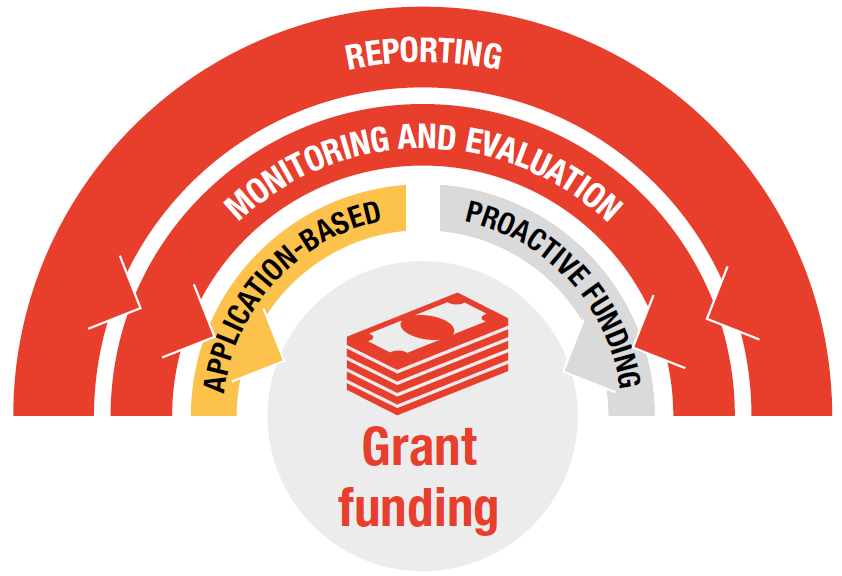
The outcomes of the NLC's grant funding model are detailed under here (Operations Section: Operations) of the report
Our grant funding activities
The funding of grants to good causes is the second mandate of the NLC.
Funding for impact
For some time, the revenue received from the operator has been stagnant while the number of NPOs has grown considerably since 2010. The NLC therefore finds itself in a place where it is required to do more with less, as demand for funding outstrips what is available. In response, we have revised the underpinning philosophy of our funding model to be based on funding for impact. This calls for a more systematic and deliberate approach to grantmaking that enables the NLC to fund more effectively. It is the provision of funding to targeted projects and programmes that are catalytic in nature that lead to measurable, positive social change and community upliftment.
Pursuing beneficiary-centrism
Apart from developing a better understanding of local needs, the NLC is committed to the optimisation of beneficiary support. To achieve impact in funding organisational capabilities such as a programmatic approach, as well as results-based management are being developed. A programme approach recognises that development takes place through interconnected actions within a specified geographical location. It further recognises that there may be multiple needs that are often better addressed by multiple actors.
Development is not a linear occurrence but a cross-pollination of multivariate factors coalescing to produce the desired change. A programme approach is better positioned to impact various socio-economic and political factors, which produce a “defective” social system in a specific environment. Adopting a programming approach goes someway in unearthing the underlying factors that enable the social conditions that grant funding aims to address.
The conceptual relationship between funding for impact and beneficiary-centricity is a causal one. Beneficiary-centricity is one of the critical interventions, that, if undertaken successfully, will enable more impactful funding in the context of the NLC. Beneficiary-centricity is therefore one of the strategic and operational capabilities that should be developed by the NLC to achieve impact in funding. The NLC’s vision is to be a catalyst for social upliftment with a brand promise of changing lives. The broad societal impact that we aim to achieve extends beyond financially sustaining the organisations that we fund to changing the lives of the beneficiaries that benefit from our funding, as well as the communities in which they live.
Proactive funding
One of the strategies introduced to address the shortcomings in priority areas, in general, is the introduction of the funding model, which aims to respond to social problems and opportunities through a strategic and evidence-based mixed funding model. The amended legislation made provision for proactive funding (research-based funding), which can emanate from three sources, namely the Minister, the Board or the Commission. The NLC has already successfully implemented several proactive funding projects.
Education and awareness
Education and awareness constitute a critical component in NLC’s strategy to empower beneficiaries holistically. The primary aim of the programme is to develop informational measures to educate the public about lotteries and provisions of the Lotteries Amendment Act No 32 of 2013 and to explain the process, requirements and qualifications for grants.
Stakeholder engagements
The National Stakeholder Engagement Indaba is a flagship project of the organisation. The inaugural Indaba took place in 2011 followed by events in 2013, 2014, 2015 and 2017. The overall objectives of the National Indaba have always been to reiterate the NLC’s commitment to work closely with the beneficiaries and various other key stakeholders, including the following:
| – | Understand stakeholder realities and challenges to enable the NLC to improve the service delivery of its mandate. |
| – | Educate the NLC’s stakeholders regarding its regulatory mandate and for funding good causes aligned to government’s priorities of poverty alleviation and job creation. |
| – | Encourage and ensure beneficiaries’ sustainability by facilitating effective corporate governance, as well as the development and implementation of norms and standards for funding for the NLC’s beneficiaries. |
| – | Ensure beneficiaries uphold effective risk management and fraud prevention. |
| – | Continue to recognise beneficiaries complying with corporate governance through beneficiary awards. |