Operations divisional outcomes
During the year under review, the operations division served as an enabler for the running of the organisations’ operations with the ultimate goal of ensuring that set organisational objectives are accomplished efficiently and economically.
The operations division is headed by the Chief Operations Officer and comprises all nine provincial offices; grant funding; stakeholder relations, marketing and communications; and business development. The operations division is a cornerstone of the organisation that serves as a strategic enabler for the effective running of the organisations’ operations.
Research and development
The NLC Board resolved, at its meeting of 09 March 2017, that an R&D unit should be established as required by the Lotteries Amendment Act to “conduct research on appropriately deserving worthy causes that may be funded or recipients that may be funded without lodging an application”1. Additionally, the Board of the NLC may “determine or direct or order the performance of research intended to enhance the optimum functioning of the Board and the distribution of grants”2.
The R&D unit was created within the operations division of the NLC and is charged with overseeing and coordinating the research activities of the NLC, including the commissioning of research projects. The unit develops an annual research agenda and conducts relevant research to support evidence-based decision-making with a primary focus on the two core mandates of the organisation, namely regulation and grant funding.
Grant funding
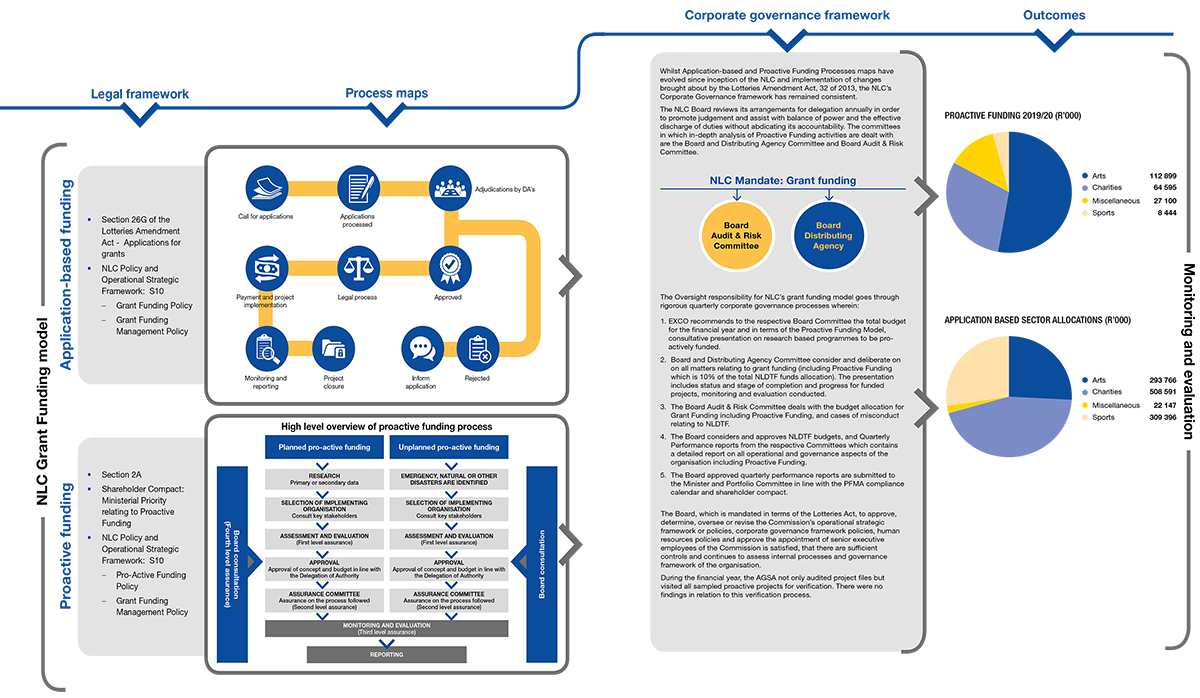
The grant funding department is responsible for ensuring that grants are administered efficiently and economically. Like many international development agencies, public sector organisations, and grantmaking organisations across the globe, the NLC currently finds itself in a place where it is required to do more with less as demand for funding outstrips what is available. In the context of the NLC, the organisation has noted a decline in revenue from the National Lottery operator. This required a much more systematic and considered approach to grantmaking. Furthermore, the role of the NLC as a player in the development space continuously seeks to measure and improve its performance, asking the questions: Are we making the right investments? And if so, how will we know?
In answering these questions, the NLC revised the philosophy underpinning its funding model. This revised philosophy and the strategic positioning of the organisation was based on the core concept of funding for impact. This marked a strategic shift in the NLC’s positioning in the development sector. It moved the NLC from merely focusing on the distribution of funds to being more broadly and deeply involved and engaged in managing and understanding the impact that its funding has on funded communities and grant holders. It repositioned the NLC to become more purposeful in ensuring that it is indeed a catalyst for social upliftment, changing lives for the better and contributing to the development of the most impoverished and most marginalised communities. The NLC also enhanced the experience of beneficiaries by improving the operational efficiency of the NLC, making it easier and less burdensome to access grants. Beneficiary-centricity was not limited only to the operational indicators of the beneficiary experience but also extended to the respect and humanity with which the NLC engaged applicants, grant holding organisations and communities at large.
| 1 | Act 32 of 2013, Article 10. (e) (4) |
| 2 | Ibid. Section 26F (b) |
Grant funding
During the 2019/20 financial year, we continued to enhance the experience of applicants and beneficiaries by improving the operational efficiencies throughout the grant funding with the aim of making it easier and less burdensome to access grants. Beneficiary centricity was not limited only to the operational indicators of the beneficiary experience, but also extended to the respect and humanity with which the NLC engaged applicants, grant holding organisations and communities at large.
Monitoring and evaluation
The monitoring and evaluation unit was established in 2014 as one of the functions under the regulatory compliance division. The primary purpose of the unit is to measure the impact of funding. Over the past five years, the unit has conducted two impact evaluation studies, two data quality assessments and has collected a significant volume of impact monitoring statistics. Since its inception, the unit has conducted over 8 000 monitoring site visits, during which data collection included information on job creation, skills development and secondary beneficiaries reached by primary beneficiaries as they implement various projects and programmes. Over and above, while onsite, the officials also capacitated the beneficiaries to report as per NLC templates, to understand the grant agreement and ensure accurate record-keeping, as well as and any other areas as per identified gaps.
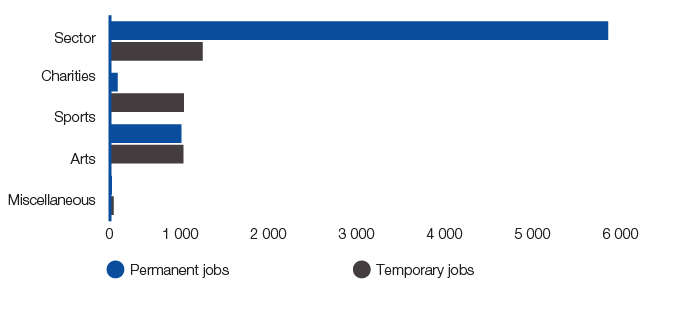
THE SITE VISITS CONDUCTED PER FINANCIAL YEAR PER SECTOR |
TOTAL NO. OF SECONDARY BENEFICIARIES2019/20 |
|
|
|
JOBS CREATED/RETAINED2019/20 |
|
|
|
|
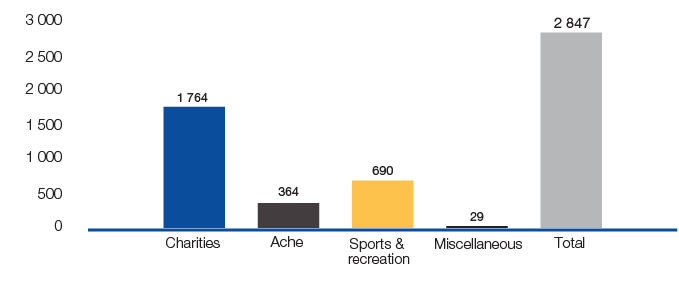
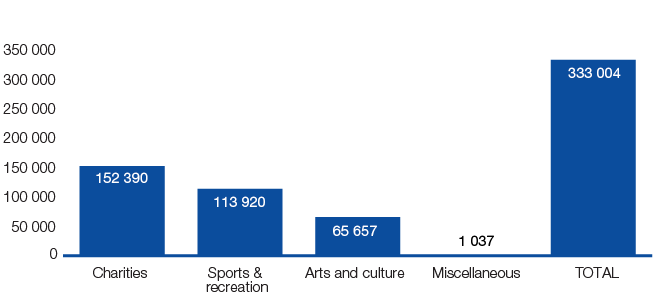
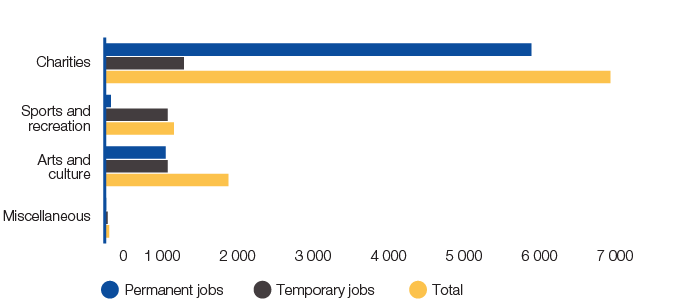
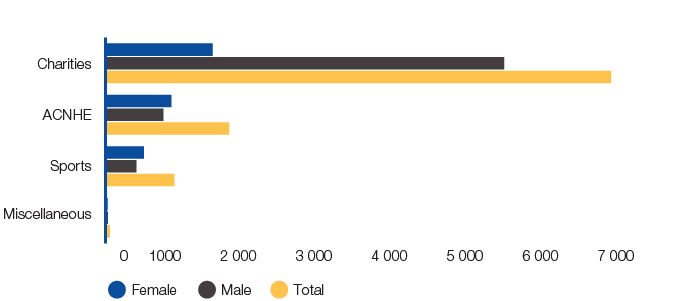
The table below shows the distribution of job creation amongst the four sectors during the financial year under review. More jobs were created under the Charities sector, followed by ACHE, then Sports and Recreation and lastly Miscellaneous.
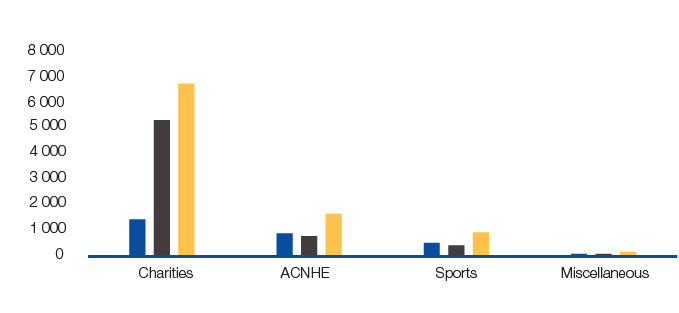
THE NUMBER OF JOBS THAT WERE CREATED DURING THE YEAR UNDER REVIEW PER JOB TYPE |
THE NUMBER OF PEOPLE WHO BENEFITTED FROM SKILLS DEVELOPMENT PROGRAMMES THAT WERE FUNDED IN 2019/20. |
|
|
|