The NLC aims to ensure that the needs of its stakeholders are satisfied effectively, efficiently and economically. The development, implementation and maintenance of a performance management policy for the NLC is critical in meeting the above need.
Performance Management (PM) within the NLC is an integrated management strategy that seeks to:
The performance management process comprises planning, budgeting, monitoring and reporting of performance. The diagram below clearly shows the relationship between the processes and also highlights the executive authority’s accountability for the process to Parliament.
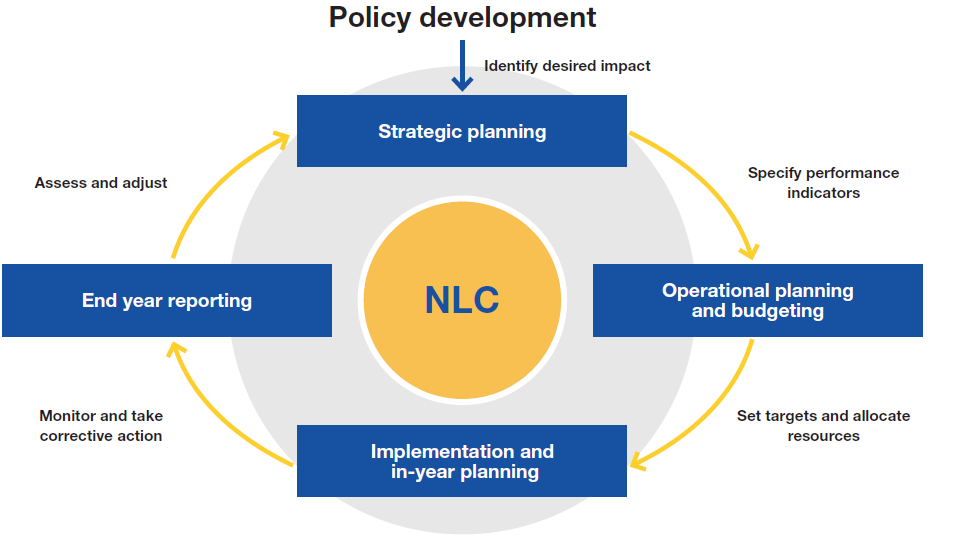
Summary of reporting legislative requirements are tabled below:
| Performance management process | NLC |
| Strategic planning | Treasury Regulations – chapter 30 |
| Budgeting and implementation planning | Treasury Regulations – chapter 30 |
| Implementation | Treasury Regulations – chapter 30 |
| Reporting (in-year and annual reporting) | PFMA, Section 55(2)(a) and Treasury |
The NLC’s planning aims to undertake the following:
 |
To identify gaps in the capacity of the NLC and to address them |
Performance and capacity are interrelated concepts. Organisational performance arises from the use of capacity. Assessing performance information therefore identifies areas where capacity needs building. The NLC will ensure that where gaps in its institutional or human resources capacity are identified, that those gaps will be filled.
 |
To improve the effectiveness, sustainability and efficiency of service delivery |
Effectiveness is the degree to which a service, project or programme (activity) undertaken or delivered by or on behalf of the NLC supply the needs of the stakeholders in quantitative and qualitative terms. In order to improve the effectiveness of service delivery, the NLC will seek to continuously improve:
i. the Strategic Plan includes SMART (specific, measurable, achievable, relevant and time-bound) objectives, key performance areas (KPA) and key performance indicators (KPI);
ii everybody in the NLC knows what those objectives, KPAs and KPIs are;
iii. standards to measure the achievement of objectives and the use of resources exist;
iv. continuous actions to improve efficiency are undertaken; and
v. employees are committed and have the skills and other attributes necessary for continuous improvement of performance.
 |
To ensure effective, economical and efficient use of resources |
Effective use of resources requires that resources are used in such a manner to supply the real needs of stakeholders. In order to ensure the effective use of resources, the NLC will improve its information gathering system to provide accurate and complete information to all stakeholders which will address the needs and priorities of all stakeholders and that those needs are quantified.
Efficient use of resources requires that the quantum of the human, financial and other resources consumed and, where applicable, time taken to deliver a service, project and programme at the specified quality and in the specified quantity must be known and continuously reduced. To ensure efficient use of resources the entity will:
| a. | set standards to measure the achievement of objectives and the use of resources; |
| b. | continuously undertake actions to improve efficiency; and |
| c. | promote the commitment of people within the organisation and that they have the skills and other attributes necessary for continuous improvement. |
 |
To promote the loyalty, morale and performance of employees |
The performance of the NLC will only improve if all its employees work smarter and better. Therefore, an important component of performance management is an employee performance appraisal system which must be developed in such a way that employees know exactly what would be expected of them and that employees would be involved in setting their own performance objectives.

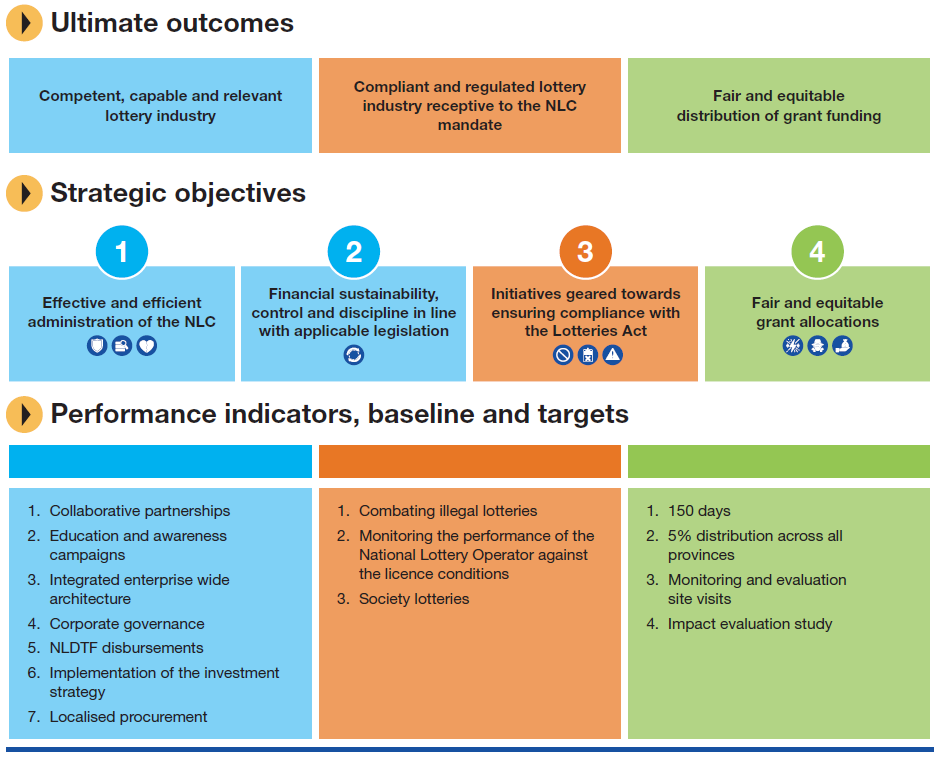
The strategic goals were achieved through the implementation of the following programmes:
Programme 1: Administration and support servicesThe purpose of the programme is to provide leadership and support to the entire organisation, particularly the core business for effective service delivery. It focuses on general administration and provision of support services to ensure compliance and governance.
| Office of the Commissioner | |
| Description |
|
|
|
|
|
|
|
|
|
|
|
|
|
|
The office of the Executive is constituted by Strategic Planning and Reporting; Internal Audit; Risk Management; Company Secretary; Legal Services and Human Capital Management.
| Finance | |
| Description |
|
|
|
|
|
|
|
|
|
|
The Finance division is constituted by Financial Accounting (NLC & NLDTF), Supply Chain Management, Facilities and Management Accounting Departments.
| Information communication technology | |
| Description |
|
|
|
|
|
|
|
|
|
|
|
|
|
|
The Information Technology division is constituted by Application and Development; Infrastructure and Network, Business Analyses and the Support/Solutions Delivery departments.
Programme 2: Compliance and regulation
The purpose of this programme is to ensure compliance and to regulate the entire lottery industry in line with the NLC mandate. It ensures that mechanisms are instituted to ensure compliance with applicable laws and regulations as they relate to the lotteries environment. The programme also plays a role in ensuring adequate monitoring, regulation and policing of lotteries.
| Regulatory compliance | |
| Description |
|
|
|
|
|
|
|
|
|
|
|
|
The Compliance Division is constituted by the Lotteries Compliance and Compliance Enforcement departments.
Programme 3: Grant funding and service delivery
The purpose of this programme is to provide administrative support to the distributing agencies and to ensure that the grant funding is distributed according to the legislated mandate. It is responsible for the management of grant funding processes and ensures evaluation of the distribution impact of grants.
| Grant funding | |
| Description |
|
|
|
|
|
|
|
|
|
|
|
|
| Service delivery and support | |
| Description |
|
|
|
|
|
|
|
|
The Grant Funding and Service Delivery programme is constituted by grant funding operational support, the nine provincial offices, business development and organisational monitoring and evaluation departments.