Regulatory compliance is the cornerstone of the NLC organisation, holding in custody the primary mandate of the organisation. During the period under review, the Division increased efforts in protecting the public against illegal lotteries through identifying, investigating and closing down of these activities as well as adoption of the Participant Protection Strategy. The Division continues to ensure that the Regulator is central to shaping policy direction through engagement with stakeholders and policy makers.
Over and above delivering on the Annual Performance Targets, significant efforts have been made to enhance regulatory education and awareness through provincial workshops targeted at the general public and lottery participants, in order to achieve better participant protection and prevent under-age and excessive play/problem gambling.
Certain regulatory functions were decentralised to provinces (i.e. education and awareness, complaints handling and general regulatory advice, certain monitoring inspections) to ensure the reach of the division is felt countrywide.
– Our regulatory role (i.e. media releases, information dissemination on website, fliers/brochures, and on Operator Point of Sale devices).
The National Lottery has to be South Africa’s most valued asset, which not only comes with the promise, but has changed millions of ordinary South Africans’ lives. The National Lottery has been entrusted and licenced to Ithuba Holdings (RF) (Pty) Ltd for a period of eight years. With half of the licence period behind us, the central tenets of Licensing the National Lottery and Sports Pool are:
| Central Tenets of Third National Lottery Licence and Licence to conduct a National Sports Pool |
Outcomes | |
| Ensure that the National Lottery is conducted with all due proprietary | We have monitored the National Lottery website and other media to ensure integrity of the National Lottery information displayed therein. We also verified that Trade Marks, Copyright and National Lottery logos properly appear on all National Lottery materials displayed or made available to the public. This is to ensure that players are able to tell the difference between the National Lottery and other gambling products available in the market.
Retailer inspections were regularly conducted to ensure that Retailers comply with regulatory requirements, which include, amongst others, the following:
|
|
|
|
|
|
|
|
|
|
|
|
|
|
|
|
|
|
|
|
|
|
|
|
|
|
|
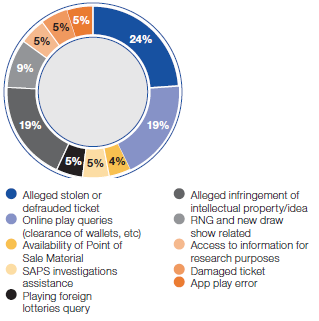
National Lottery complaints statistics
|
|
Protection and payment of prize winners
|
|
|
|
|

National Lotteries Participants Trust
A regulatory instrument pursuant to protection of National Lottery Participants prize monies and advance plays.
The National Lotteries Participants Trust is established in terms of the Trust Property Control Act 57 of 1998. The NLPT was founded by Ithuba Holdings (RF) Proprietary Limited, in accordance with the third Licence to Operate the National Lottery. The licence is a regulatory instrument provided for, under the Lotteries Act to enable the NLC to fulfil its regulatory mandate of monitoring Ithuba’s operations and Ithuba’s obligations to procure a Trust for the purposes of protecting, amongst other, prize monies payable to National Lottery participants who have 365 days to claim their prizes. The duty of procuring the Trust is a key element of the regulatory function of the NLC as set out in section 10(1)(j) of the Lotteries Act.
The NLC Board, in its capacity as Regulator, exercises regulatory oversight in accordance with provisions of the Lotteries Act, licence and principles contained in the King IV Code. The NLPT complied with all reporting requirements through the submission of quarterly reports, management accounts, income and expenditure statements, annual financial statements within the stipulated periods as indicated by the Board of the NLC.
Appointment of trustees
The Board of Trustees comprises of two nominee Trustees, who are representatives of the NLC and Ithuba respectively, and three independent Trustees. The NLC, with consent from Ithuba, appoints a maximum of three independent Trustees. Trustees hold office for a period of three years and are eligible for re-appointment at the expiry of the three-year period.
Independence
All independent and nominee trustees are deemed to be independent, having adhered to King IV Code principles of independence and criteria for connected persons as defined in the Income Tax Act. The majority of the trustees are independent as they have no material interest in the NLC, the national lottery operator, beneficiaries or suppliers. Trustees of the NLPT have fiduciary duties to the Trust and its beneficiaries. The primary beneficiaries of the NLPT are participants in the lottery whose prize money is secured of their prize money as well as the NLDTF as a secondary beneficiary of interest on the funds that are paid to the NLPT as well as unclaimed and expired prize money.
Trustees are required to complete an annual disclosure of interest and are required to disclose any interest at every meeting to ensure that circumstances that may give rise to conflict of interest are managed and monitored effectively. There were no conflicts of interest identified during the reporting period.
Trust administrator
The Trust administrator is appointed to service the Trust for the duration of the third Licence to Operate the National Lottery. The Trust administrator is accountable to the NLPT Board of Trustees for the performance of all financial, administrative, secretariat and clerical functions, as well as any duties which may be delegated by the Board of Trustees.
Members and attendance
The Board of Trustees comprises of five members, including the chairperson, Adv Nevondwe. The Deed of Trust makes provision for a minimum of four meetings per year. During the financial year ended 31 March 2019, the Board of Trustees met on 12 occasions.
The table below shows the attendance at these meetings:
| Committee member | Role | Qualifications | Date of appointment | Quarterly meetings | Special meetings and workshops |
| Adv LT Nevondwe |
Chairperson | LLB (University of Venda) LLM (University of Venda) LLD (University of Limpopo) |
1 April 2016 | 5/5 | 7/7 |
| Mr PR Letwaba, CA(SA) |
Member – NLC Representative |
BCom Accounting CTA |
28 May 2015 | 5/5 | 7/7 |
| Adv BE Mabuza | Member – Ithuba Representative |
BProc (NWU) LLB (Wits) LLB (Georgetown University) |
22 July 2015 | 3/5 | 5/7 |
| Ms MT Ramuedzisi CA(SA) |
Member | BBusSc (UCT) HDipAcc (Wits) MCom (Computer Auditing) (UJ); RA |
1 April 2016 | 2/5 | 6/7 |
| Mr A Mahlalutye | Member | BSc Quantity Surveying (UCT) Master’s in Business Leadership (UNISA) Master’s in Financial Management (University of London) |
1 February 2018 | 4/5 | 3/7 |
Special Board meeting and workshops include Special Meeting (AFS Approval, National Lottery Participant Trust Workshops, Policy Review Sessions).
The NLPT Chairperson appeared before the NLC Board Audit and Risk Committee to report on the performance and financial information and other relevant matters concerning the Trust.
Society lotteries
The Act permits Non-Profit Organisations (NPOs) to raise funds through lotteries. Interested NPOs are required to register with the NLC. Through our education and awareness initiatives on this opportunity, we have noted an increase in organisations registering as societies. On registration as a society lottery, a society lottery is eligible to submit a lottery scheme to the NLC for registration. The Act allows an NPO to operate up to six schemes in a year raising a maximum of R2 million per scheme.
During the period under review the division developed a model for society lotteries. Revenue from Society Lotteries showed steady growth at R95 million, 6% increase from the prior year.
The Act authorises the NLC to conduct inspections to determine and ensure that society lottery activities are conducted in line with the Act. The summary of society lottery related activities conducted during the year is indicated below:
| Activities | 2018/19 |
| Number of societies registered | 23 |
| Number of schemes registered | 79 |
| Number of exemptions granted | 12 |
| Number of compliance inspections conducted | 83 |
| Number of compliance seminars held | 49 |
Total revenue generated from society lottery registration amounted to R95 million for the year under review.
The summary of revenue generated by the 65 schemes is reflected below:
| Month | Actual proceeds (R) 2018-19 |
Actual proceeds (R) 2017-18 (schemes) |
| April | 29 287 855.00 | 1 509 089.85 |
| May | 1 266 509.57 | 611 700.00 |
| June | 1 256 230.00 | 310 170.00 |
| July | 163 500.00 | 1 795 370.00 |
| August | 941 425.00 | 44 000.00 |
| September | 1 502 354.00 | 591 600.00 |
| October | 8 007 225.00 | 804 910.00 |
| November | 789 150.00 | 3 982 545.00 |
| December | – | 214 718.00 |
| January | 7 206 075.00 | 3 255 138.07 |
| February | 1 475 448.55 | 1 524 450.00 |
| March | 851 600.00 | 5 952 490.60 |
| Total | 52 747 372.12 | 20 596 181.52 |
Our extended efforts in creating awareness has resulted in a record 156% increase in revenue from society lottery registrations and value created is the sustainability of the registered society lottery scheme operators generating an aggregate of R52 million.
| 3.2 Illegal lotteries and schemes | |
We identified and were informed of various forms of schemes that were advertised requiring public participation. It is only through detailed legal analysis that we were able to ascertain whether or not such schemes were lotteries, and if so, whether they were allowable in terms of the Act or were conducted without prior approval of the Board, which would render them illegal. Society lotteries that were non-compliant with the Act were identified. These were mainly run by profit-making companies with the assertion made that some of the proceeds from such schemes would benefit NPOs. We were successful in having such schemes declared illegal as they were contrary to the Act. These schemes were subsequently discontinued. Competitions that were run as promotional competitions, but not in compliance with requirements of the Consumer Protection Act, were also identified as a form of illegal lotteries. Three major companies operating in South Africa had such competitions declared as illegal lotteries and the companies were instructed to discontinue competitions. These are considered to be key achievements for the NLC for the year under review, in delivering on our mandate of monitoring, regulating and enforcing on lotteries. The NLC successfully closed 100% of illegal lotteries investigated. |
|
| 3.3 Research on the National Lottery participant attitudes | |
| The Division commissioned research on the National Lottery participant attitudes. The study was finalised with the following outcomes. The outcomes of the research will aid the NLC in better regulation as we respond to the outcomes of the research. | |
The social and economic circumstances and uncertainty on how these environments are affecting the operations of the National Lottery have contributed to the need to explore the participation and attitudes of the general public of South Africa regarding the National Lottery.
This priority was set by the National Lotteries Commission at the end of 2018 in support of the need to constantly monitor the changing preferences, attitudes and participation levels of lottery players among the general public.
Against this background, the Bureau of Market Research Proprietary Limited (BMR) of the University of South Africa (Unisa) was commissioned by the NLC to conduct a national representative survey on the attitude, behaviour and participation levels of South Africans in lottery activities and sport pools.
In addition, the study aimed to determine the propensity to gamble/play lotteries as well as the extent of household expenditure displaced to gambling/lotteries.
To achieve the study objectives, a hybrid of research methods was applied to collect information from 3 090 households across all nine provinces of South Africa.
These included internal and external secondary and primary data collection methods that were co-designed in a complementary style to address the research objectives of the study.
Whereas the external secondary research was essential to design the survey questionnaire and the sampling plan for the national survey, the internal secondary research largely serves to estimate the propensity and redistributive effect of gambling prizes. In turn, the primary research constituted computer-aided telephonic and face-to-face personal interviews proportionally distributed across all nine provinces of South Africa.
This quantitative study was further complemented by qualitative research, inclusive of four group discussion sessions among judgmentally sampled lottery and non-lottery participants in the Gauteng, Limpopo and North West provinces.
 |
35.0% Percentage of people who participated in lottery activities or sport pools in the 12 months preceding the 2018/19 NLC study. The Licencee has been encouraged to review National Lottery Participants and target marketing campaigns that encourage participation to new entrants in the lotteries and sports pools. Trends have shown that higher jackpots have attracted new participants to the games. |
R156 Average monthly amount spent on lottery and sport pool activities in 12 months preceding the 2018/19 NLC study. The amount set aside for participating in the lottery given the daily limit of R2000 set for each participant. Setting of participants limits is in line with international standards. |
47.7% Percentage of respondents who never participated in lottery or sport pools activities who listed disinterest in lottery/sport pools as major reason for non-participation. The NLC has embarked on a regulatory compliance campaign to raise awareness on the integrity and proprietary of the games in order to improve participation. The Licencee’s marketing spend and campaigns are testament of the commitment to re-invigorating the games to encourage participation. |
|
|
4.3% Percentage of people who participated in Fafi in the 12 months preceding the 2018/19 NLC study. Illegal or prohibited lottery activities remain a challenge in participant protection. Education and awareness campaigns have been rolled out to ensure participants are aware and educated about illegal or prohibited lotteries. Introduction of the Daily Lotto game has been seen as a deterrent and a safer and protected gaming option. |
47.4% Percentage of lottery activity participants who play LOTTO, LOTTO PLUS 1 and LOTTO PLUS 2 on a weekly basis. The Lotto games remain the backbone of the National Lottery. The operator has been encourage to ensure sustainability of Lotto games. |
41.0% Percentage of lottery activity participants who play PowerBall and/or PowerBall PLUS on a weekly basis. PowerBall has presented the highest jackpots and shown to be the preferred game. Mechanisms are in place to ensure participants are protected during peak jackpot periods. |
|
|
77.9% Percentage of lottery activity participants who rate LOTTO, LOTTO PLUS 1 and LOTTOPLUS 2 among the top-3 most preferred lottery activities. The regulator is encouraged by participation in the Lotto games. The operator has been encouraged to ensure sustainability of Lotto games. |
60.8% Percentage of lottery activity participants who rate PowerBall and/or PowerBall PLUS among the top-3 most preferred lottery activities. PowerBall activities remain popular due to higher jackpots. The Licencee has been encouraged to mitigate against over-stimulation and under age play. |
23.2% Percentage of lottery activity participants who regard the chances of winning the LOTTO, LOTTO PLUS 1 and LOTTOPLUS 2 as ‘very good’ and ‘good’. The NLC is encouraged by the confidence shown in the Lotto game. |
|
|
6.7% Percentage of lottery activity participants who are aware of under-aged (<18 years) participation in LOTTO, LOTTO PLUS 1 and LOTTOPLUS 2. The NLC is concerned by this outcome, the NLC approved a participant protection strategy. Central to this strategy and the Licencee is protection against under age play. The NLC and Licencee continue to conduct mystery shopper reviews and Licencee is required to train retailers to ensure under-age play is mitigated. |
27.8% Percentage of lottery activity participants using cell phones to participate in local/ promotional competitions. The Licencee has ensured accessibly to the National Lottery through implementation of the APP and interactive online webpage. |
36.3% Percentage of National Lottery participants who spent between R51 and R150 per month on National Lottery games. The amount set aside for participating in the lottery given the daily limit of R2000 set for each participant. Setting of participants limits is in line with international standards. |
|
|
74.3% Percentage of lottery activity participants citing the ‘need for money’ as a major reason for participating in lottery schemes/activities/ games. With the economic downturn due to unemployment and economic conditions, the Lottery remains a hopeful space for many unemployed South Africans. The NLC continues to monitor activities to ensure fair and safe games. |
|||
|
30.6% Percentage of lottery game participants impulsively purchase lottery tickets regular or occasional basis. The regulator is comfortable that participants utilise their disposable income to participate in the national lottery. |
20.5% Percentage of lottery activity participants who won lottery prizes in the month preceding the 2018/19 NLC study. National lottery games have a minimum prize payout of 45%, in line with international lottery standards. Participants also contribute to worthy good causes as a share of ticket sales is contributed to worthy causes. |
R110 Average monthly amount of winnings on lottery schemes/activities/games. The regulator is encouraged that participants regulate their participation, an indication of no excessive play and over stimulation by the Operator. |
|
|
70.0% Percentage of lottery activity participants who often dream of winning the lottery. The national lottery provides equal opportunities for participants and is accessible to all who wish to realise their dreams. |
53.4% Percentage of lottery game participants who agree that lottery causes health problems, including stress or anxiety. The NLC has approved a Participant Protection Strategy. Lottery games are designed to minimise adverse effect on participants and are scheduled in such a manner that there is no excessive stimulation. |
25.2% Percentage of lottery activities participants who usually spend more money on lotteries than budgeted/planned. National lottery games pricing is inexpensive and there are set play limits per day. |
|
|
21.0% Percentage of lottery activity participants who regard themselves as compulsive/ excessive/problem lottery players. The NLC has approved a Participant Protection Strategy. Lottery games are designed to minimise adverse effect on participants and are scheduled in such a manner that there is no excessive stimulation. |
66.9% Percentage of people agreeing that playing lottery games is addictive. The NLC has approved a Participant Protection Strategy. Lottery games are designed to minimise adverse effect on participants and are scheduled in such a manner that there is no excessive stimulation. |
43.7% Percentage of people agreeing that they are well informed about the NCL and its mandate. The NLC continues to deliver education and awareness programmes on various media platforms and during stakeholder engagements. |
|
|
R34.3 billion Total 2017/2018 household gambling expenditures on ‘games of chance’ (licensed and unlicensed modes). The NCL continues to identify and close down illegal lotteries as well as protect participants of the National Lottery. |
0.09% The propensity to play lottery games in 2017/18. The national lottery is available to participants of all income groups. The NLC continues to ensure that marketing activities are aimed at attracting new participants. |
27.7% Percentage of unemployed national lottery players. The national lottery is available to participants of all income groups. The NLC continues to ensure that marketing activities are aimed at attracting new participants. |
|
|
23.9% Percentage of national lottery players who are recipients of government grants. The national lottery is available to participants of all income groups. The NLC continues to ensure that marketing activities are aimed at attracting new participants in higher income groups. |