| The individual and average ages of the members of the Board revealed that the oldest member is 67 years old (whose second term of service will end within five months); the youngest member is 44 years old (appointed 1 April 2017) and the average age of the Board is 56 years. This age profile is similar to the majority of local and international corporate boards. It does appear that the NLC Board is conscious of enhancing the age diversity of the Board with three of the five members who joined on 1 April 2017 being 55 years or younger. It was also noted that one of the current members who joined in 2013 was 46 years old at the time. |
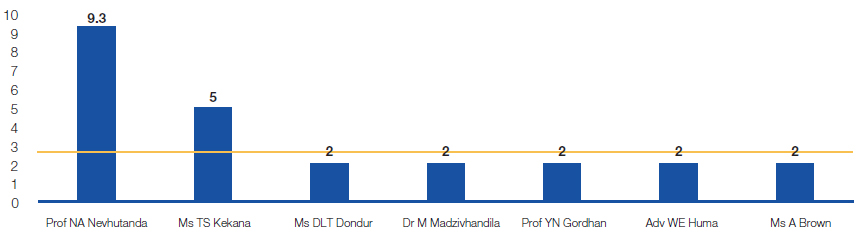
| All seven Board members are independent, non-executive members. None of the Board members have exceeded the legislated tenure. The majority (71%) of the Board members were appointed effective 1 April 2017 resulting in a low average tenure of 3.5 years. This has resulted in a low average tenure of 2.8 years. It is noted that the Chairperson will soon be ending his second term of service. |
The National Lotteries Commission’s corporate governance framework embodies the Lotteries Act, 57 of 1997 as amended, the Public Finance Management Act (PFMA), principles contained in the Companies Act and King IV Code, processes and systems that enable the Commission to meet corporate governance expectations as well as provide direction, control and accountability by the Commission.
The Minister of Trade and Industry, in his capacity as the Executive Authority of the NLC, exercises oversight in accordance with provisions of the PFMA. The NLC complied with all reporting requirements of the PFMA and Treasury Regulations Compliance Schedule through the submission of quarterly reports, management accounts, income and expenditure statements with projections, annual financial statements, budget of estimated revenue and expenditure, strategic and annual performance plans, a fraud prevention plan and a risk management plan within the stipulated periods as indicated under the PFMA and Treasury Regulations. Parliament, through the Portfolio Committee on Trade and Industry (Portfolio Committee), exercises oversight of the service delivery performance and commitments made in terms of the NLC’s strategy and annual performance plan. As part of stakeholder management, the NLC engages with the Minister and the Portfolio Committee. See Stakeholder Analysis here in the report
The Board Charter was reviewed in March 2019. The Board Charter guides the Board with respect to their functions, powers and responsibilities. Over and above the responsibility for setting the strategic direction of the NLC, finance and performance objectives, the Board has applied the principles of openness and transparency in fulfilling its statutory responsibilities to:
Board appointments
All non-executive Board members are appointed by the Minister of Trade and Industry, in accordance with section 3 of the Lotteries Act as amended. The Minister appoints a chairperson, who shall be a person with applicable knowledge or experience with regard to matters connected with the functions of the Board, one member designated by the Minister and not more than five members who have proven business acumen or applicable knowledge or experience with regard to matters connected with the functions of the Board, and of whom at least one should be a legal practitioner admitted to practise in the Republic and at least one a chartered accountant in the Republic. The Lotteries Act further stipulates that at least four members shall be persons who are not in the service of any sphere of government.
During the year under review, the term of office for Ms Kekana came to an end on 31 August 2018, leaving a vacancy on the Board. Ms Kekana was subsequently appointed as an independent expert, with no voting rights.
The Commissioner is an Ex-Officio of the Board and is a member of the Institute of Directors South Africa and does not have other professional commitments. The organisational succession plan was approved during the year under review.
Independence
All non-executive Board members are considered to be independent as they have no material interest in the NLC, the National Lottery Operator, beneficiaries or suppliers. Members are required to complete an annual disclosure of interest and required to disclose any interest at every meeting to ensure that circumstances that may give rise to conflict of interest are managed and monitored effectively. There were no conflicts of interest identified during the reporting period.
Board induction and continuous development
Board workshops were convened during the year to ensure that all Board members are appraised on the functions of the Board and operations of the NLC. The Board developed continuous development programmes that would enhance the skill of the collective Board and assist the Board in its strategic focus and that of the NLC. The Board is satisfied that the arrangements in place for accessing professional corporate governance services are effective as members are subscribed to the Corporate Governance Body of Knowledge® and are full members of the IODSA, SAICA, Law Society of South Africa and The Public-Sector Audit Committee Forum.
The NLC Board comprises of six members, including the chairperson. In terms of Board Charter, the Board must meet at least four times a year. During the financial year ended 31 March 2019, the Board met on twenty-one (21) occasions. The table below shows the attendance of these meeting.
| Board member | Role | Quarterly meetings |
Special meetings and workshops |
| Prof NA Nevhutanda | Chairperson | 4/4 | 17/17 |
| Ms A Brown | Member | 4/4 | 15/17 |
| Ms TS Kekana | Member | 4/4 | 15/17 |
| Ms DLT Dondur | Member | 4/4 | 17/17 |
| Prof YN Gordhan | Member | 4/4 | 17/17 |
| Adv WE Huma | Member | 2/4 | 14/17 |
| Dr MA Madzivhandila | Member | 4/4 | 17/17 |
| * | Ms Kekana – term of office ended 31 August 2018. |
Special Board meeting and workshops include:
The Board reviewed and approach to its arrangements for delegation to promote independent judgement, and assist with balance of power and the effective discharge of duties without abdicating its accountability. Delegation arrangements were in accordance with the Lotteries Act, as amended, which stipulates that the Board may appoint committees to assist it in efficiently and effectively performing its functions and exercising its powers. Committees shall consist of such members of the Board as the Board may designate and the board shall designate the chairperson of every committee. Every committee shall perform its functions in accordance with the provisions of this Act and such directives of the Board that are not in conflict with such provisions. Any delegated function so performed shall be deemed to have been performed by the Board.
As such, the Board had a total of six Committees which included two statutory Committees and five standing Committees as
depicted below:
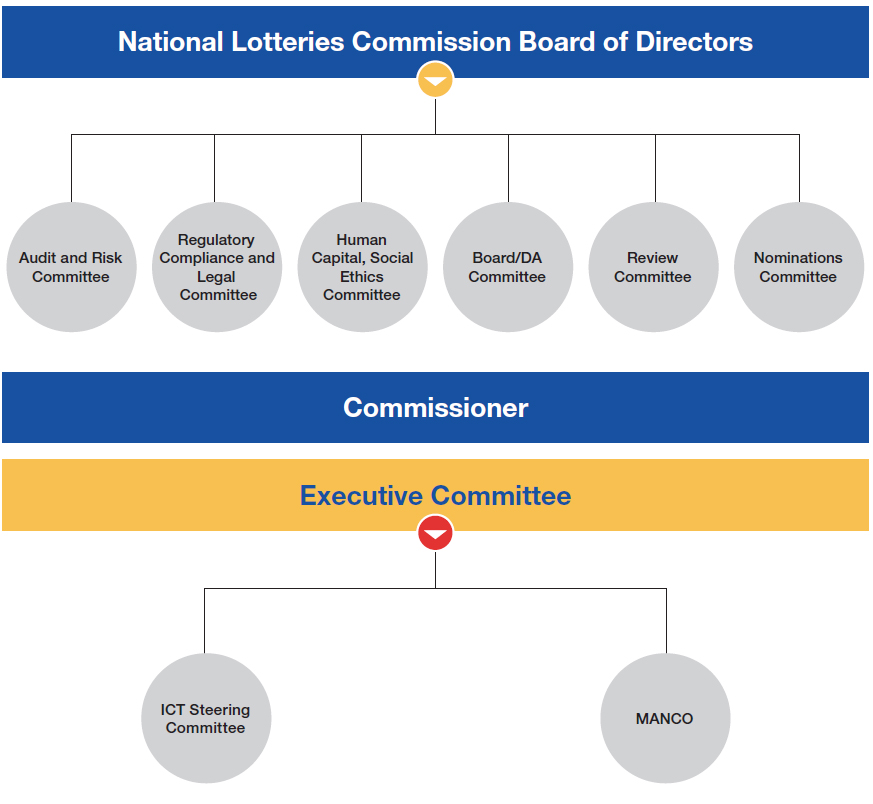
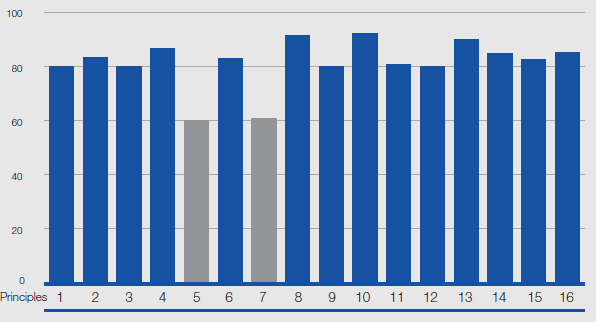
The Board commissioned a King IV Gap Analysis in order to gauge its compliance to King IV and enhance corporate governance in the organisation through implementation of recommendations from the assessment.
This score is based on what management have already implemented and the gaps that were identified. Indicated below is the summary of the scores allocated to each of the principles. No score was allocated to Principle 17 as the NLC is not considered an institutional investor. It will apply to how the organization decides to spend the members’ contributions. King IV evaluation score
Cognisance were given to the fact that some of the aspects prescribed by the principles and practices of KING IV may not be applicable to the NLC but rather recommended practice. The key recommendations identified from the gap analysis include the following:
|
Company Secretary
The Board reviewed and were satisfied that the skills, competence and experience of the Company Secretary adequately support the performance of the required duties in to the Board and that the office of the Company Secretary is empowered and that the position carries the necessary authority. The Company Secretary is not a member of the Board and has unfettered access to the Board whilst maintaining an arm’s length relationship with the Board and its members.
The Review Committee is established in terms of section 26H of the Lotteries Act. The Committee is chaired by the Chairperson of the NLC Board and reviews decisions of the Distributing Agency concerning applications for grants, only on application by an aggrieved applicant in the manner prescribed: Provided that such review shall be adjudicated by a Board committee set up for such purpose without delay.
If the Board overrules the decision of the Distributing Agency, the Board may either order the Distributing Agency to re-evaluate the application taking into consideration matters raised by the Board or set aside the decision of the Distributing Agency and substitute it with an order the Board deems appropriate.
The Board Review Committee comprises of six members, including the chairperson. During the financial year ended 31 March 2019, the Board Review Committee convened on nine (9) occasions. The table below shows the attendance of these meetings.
Board evaluation and effectiveness
The Board and Board committee effectiveness by an independent service provider was expanded, to include Exco evaluation. The board evaluation process was based on a quantitative and qualitative approach. Additionally, members of the Board were provided an opportunity to provide qualitative commentary based on their assessment for each evaluation category.
The board evaluation questionnaire consisted of evaluation questions in the following categories:
|
|
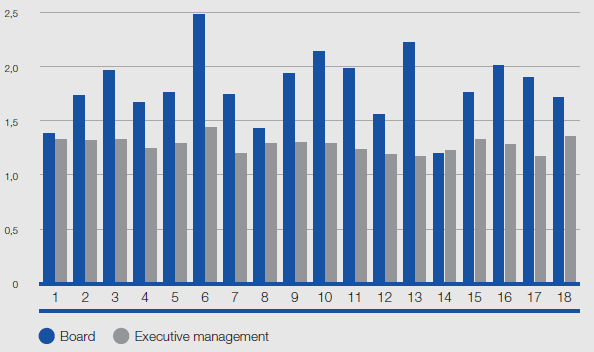
The questionnaires completed and interviews conducted revealed that the Directors were satisfied that good governance is generally practised and that the Board is effective in its functioning as a collective, both with respect to adherence with its mandate as well as its oversight and support role within the Commission.
360° Board evaluation results
|
|
| Key | Assessment | |
| 1 to 1.5 | No, limited or insignificant observations noted. Minor or no adjustments required to processes and practices. | |
| 1.5 to 2.5 | Specific observations noted. Some adjustments required to processes and practices. | |
| 2.5 to 4 | Significant and/or a large number of observations noted. Significant adjustments required to processes and practices. | |
The Board was satisfied that good governance is generally practised and that the Board is effective in its functioning as a collective, both
with respect to adherence with its mandates as well as its oversight and support role within the Commission.
The key observation was that members should adopt a Code of Conduct for Board members. The Board approved the Board code of conduct during the period under review.
The Board has subsequently commenced the process of Self Evaluation assessment. Assessment was underway at the time of reporting. The Board was satisfied that it performed all its functions as required by the Board Charter.
| Committee member | Role | Meetings |
| Prof NA Nevhutanda | Chairperson | 8/9 |
| Ms A Brown | Member | 8/9 |
| Ms TS Kekana | Member | 7/9 |
| Ms DLT Dondur | Member | 8/9 |
| Prof YN Gordhan | Member | 8/9 |
| Adv WE Huma | Member | 8/9 |
| Dr MA Madzivhandila | Member | 9/9 |
| * | Ms Kekana – term of office ended 31 August 2018.. |
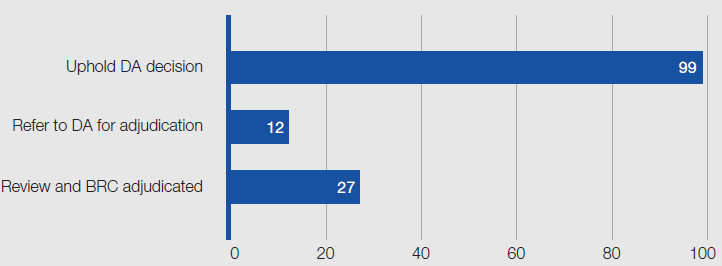
Below are the outcomes of the review applications considered by the Committee
Overall reviews received for FY2018/19
|
The Lotteries Act, as amended, stipulates that Chairpersons of the Distributing Agency are Ex-Officios of the Board with no voting rights and may only attend meetings of the Board per invitation or if matters relating to the adjudication of applications for grants or distribution of grants are to be discussed.
In view of provisions stipulated in section 3(1)(d) of the Lotteries Act and the nature of matters for discussion, the Board and Distributing Agency Committee was constituted to deal with Distributing Agency matters relating to the adjudication of applications for grants, and the operations of the Distributing Agencies as matters relating to the Grant Funding mandate of the NLC.
The Board and Distributing Agency Committee comprises of four members and the Chairpersons of the Distributing Agency. In terms of the Board and Distributing Agency Charter, the Committee must meet at least four times a year during the financial year ended 31 March 2019. The Committee convened on six (6) occasions. The table below shows the attendance of those meetings.
| Committee members | Role | Meetings | Special meetings and workshops |
| Adv WE Huma | Chairperson | 4/4 | 2/2 |
| Ms A Brown | Member | 4/4 | 2/2 |
| Ms TS Kekana | Member | 4/4 | 1/2 |
| Prof YN Gordhan | Member | 4/4 | 2/2 |
| Prof NA Nevhutanda | Member | 3/4 | 2/2 |
| Dr MA Madzivhandila | Board Member (By Invitation) | 0/4 | 1/2 |
| Ms M Letoaba | Ex-Officio Member: Chairperson – ACNHDA | 5/4 | 1/2 |
| Mr T Ramagoma | Ex-Officio: Deputy Chairperson – ACNHDA | 5/4 | 1/2 |
| Ms NP Loyilane | Ex-Officio: Chairperson – CDA | 5/4 | 1/2 |
| Mr E Ncula | Ex-Officio: Chairperson – SRDA | 5/4 | 1/2 |
| Dr J Adams | Ex-Officio: Deputy Chairperson – SRDA | 1/4 | 1/2 |
| Ms I Smith | Ex-Officio: Chairperson – CDA | 1/4 | 0/2 |
| Mr J Du Preez | Ex-Officio: CDA | 2/4 | 0/2 |
| Ms C Mofet-Mubu | Ex-Officio: CDA | 1/4 | 1/2 |
| Ms A Hill | Ex-Officio: SRDA | 1/4 | 1/2 |
| * | Ms Kekana – term of office ended 31 August 2018. |
| Board and Distributing Agency Committee Meetings include Quarterly Meetings and Committee Policy Review Session. |
During their engagements the Committee reviewed its Charter and policy framework. The Committees oversight over the Operations Division and Distributing Agencies ensured the NLC’s strategic objectives and related outcomes were achieved (icons refer to Operations Report, Performance Highlights). The Committee continues to ensure the efficient and effectively performance of the NLC through the Operations Division as well as to ensure the fair and equitable distribution of funds through independent and objective adjudication.
The Committee noted negative media reports as a result of the identified risk of conflicting beneficiaries as well as misunderstanding of the Pro-Active Funding model. The NLC’s funding model ensured that the NLC attains its mandate of equitable distribution and also addresses identified priorities in our communities. (Refer to Operations Report and Performance Highlights). Committee evaluation
Committee evaluation
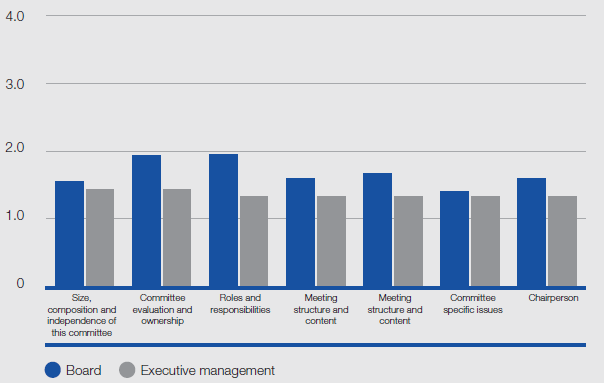
360° Board and distribution agency committee
|
| Key | Assessment | |
| 1 to 1.5 | No, limited or insignificant observations noted. Minor or no adjustments required to processes and practices. | |
| 1.5 to 2.5 | Specific observations noted. Some adjustments required to processes and practices. | |
| 2.5 to 4 | Significant and/or a large number of observations noted. Significant adjustments required to processes and practices. | |
The Committee was satisfied that good governance was practiced and that the Committee was effective in fulfilling its mandate and
providing oversight of the NLC’s operations and grant funding mandate. Members noted that administrator matter should be dealt by
Exco. It was noted that the Full-Time Distributing Agency convenes quarterly and addresses administration related matters.
The Committee has subsequently commenced the process of Self Evaluation assessment. The Committee was satisfied that it had
performed all the functions required by its mandate and approved work plan.
The Regulatory Compliance and Legal Committee is a Committee charged with the duty to ensure that the Board advises the Minister on issuing the licence to conduct the National Lottery, as well as ensure that the National Lottery and sports pools are conducted with all due propriety and strictly in accordance with the Constitution, the Lotteries Act, all other applicable law and the licence for the National Lottery together with any agreement pertaining to that licence. The Committee is also expected to provide assurance to the Board that the NLC is fulfilling its primary regulatory mandate, that is to ensure that the interests of every participant in the National Lottery are adequately protected.
Compliance with laws and regulations
The NLC, as a Schedule 3A Public Entity, is required to comply with various legal and regulatory requirements that are key to the existence and operational requirements of this entity. The Board of the NLC recognises the role that compliance with applicable regulatory requirements plays in the governance and sustainability of the Commission and undertakes to subscribe to fundamental principles to ensure compliance with relevant legislation. In discharging its duties of ensuring that the Commission complies with legislation, the Board has committed that the Commission shall conduct its business in accordance with applicable regulatory requirements and ensure that appropriate policies and frameworks are committed to promote a culture of compliance within the NLC.
Compliance assurance was provided through the NLC’s compliance framework and programmes which seeks to ensure that the Regulatory Universe of the NLC is identified, risk-rated, and monitored for compliance in order to mitigate compliance-related issues that may emanate from non-compliance with applicable rules, regulations, standards, non-binding codes and laws. The Board Regulatory Compliance and Legal Committee is charged with a duty to ensure Organisational Compliance is maintained at an acceptable level and ensure that all instances of non-compliance are adequately followed up and resolved with sound and practical recommendations to business.
During the year under review, the Board sought the services of an independent and external assurance provider who reviewed the compliance programme of the NLC and provided the Board with assurance that the compliance framework of the NLC operates optimally. Organisational Compliance monitoring was conducted whereby controls and processes from departments were assessed for correctness and validity through corroboration of supporting documents such as reports, policies, matrices, etc. and through enquiry with the relevant Act Owners.
Organisational Policies were also reviewed by oversight committees and approved by the Board to ensure that they do not conflict with laws and regulations relevant to the NLC. Organisational processes and operations were carried out in such a way as to ensure compliance with applicable legislation in the areas of grant funding, lotteries compliance and enforcement, human resources management, financial management, organisational performance as well as information and communication technology.
Nlc policy framework has 55 policies
| Significant amendment |
Minor amendment |
No Amendment/ New policy |
| 2 | 39 | 10 |
| 4% | 76% | 20% |
There were no material or repeat regulatory penalties, sanctions or fines for non-compliance with statutory obligations and there were no environmental regulator inspections conducted during the period under review.
The Board Legal and Compliance Committee is satisfied that the NLC has complied with key legislation governing the public entity, which are the Lotteries Act, No. 57 of 1997, as amended, and the Public Finance Management Act, No. 1 of 1999. Other applicable laws, rules, standards, regulations and non-binding rules and codes were complied with during the year under review.
The Board Regulatory Compliance Committee comprises of six members. In terms of Board Regulatory Compliance and Legal Charter, the Committee must meet at least four times a year. During the financial year ended 31 March 2019, the Committee convened on five occasions. During its engagements the Committee reviewed its Charter and policy framework. The Committee’s oversight over Regulatory Compliance, Legal and Organisational Compliance ensured the NLC’s strategic objectives and related outcomes were achieved as detailed in the Regulatory Compliance divisional report and performance highlights. The Committee continues to ensure the better regulation and compliance to laws and applicable rules, standards, regulations and non-binding rules in fulfilment of its mandate.
The Committee remained concerned about regulatory and legislative matters highlighted under material matters.
The table below shows the attendance of these meeting.
| Committee member | Role | Meetings | Special meetings and workshops |
| Ms TS Kekana | Chairperson | 4/4 | 1/1 |
| Ms A Brown | Member | 3/4 | 1/1 |
| Ms DLT Dondur | Member | 4/4 | 1/1 |
| Prof YN Gordhan | Member | 4/4 | 1/1 |
| Dr MA Madzivhandila | Member | 4/4 | 1/1 |
| **Prof NA Nevhutanda | Member | 4/4 | 1/1 |
| WE Huma | Member | 3/4 | 1/1 |
| * | Ms Kekana – term of office ended 31 August 2018. |
| ** | Chairperson of the Committee effective 1 September 2018. |
| Board Regulatory Compliance and Legal Committee Meetings include Quarterly Meetings and Committee Policy Review Session. |
Committee evaluation
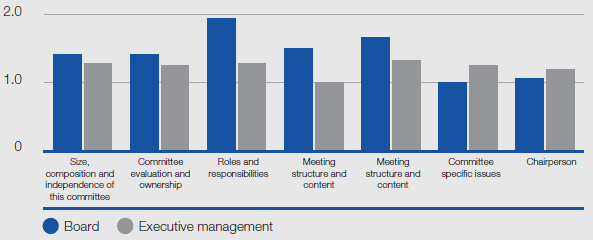
360° Regulatory compliance and legal committee results
|
|
| Key | Assessment | |
| 1 to 1.5 | No limited or insignificant observations noted. Minor or no adjustments required to processes and practices. | |
| 1.5 to 2.5 | Specific observations noted. Some adjustments required to processes and practices. | |
| 2.5 to 4 | Significant and/or a large number of observations noted. Significant adjustments required to processes and practices. | |
The Committee was satisfied that good governance was practiced and that the Committee was effective in fulfilling its mandate and providing oversight of the Regulatory, Legal and Compliance activities. The members observed the need to digitise the National Lottery licence matrix and the continued need to position the NLC as a regulator for safe and sustainable lotteries and sports pools industry.
During the period under review the NLC intensified its education and awareness programmes to be more focused on the regulatory role of the NLC. Development of a digital national lottery compliance matrix is expected to be concluded in the 2019/20 financial period.
The Committee has subsequently commenced the process of Self Evaluation assessment. The Committee was satisfied that it had performed all the functions required by its mandate and approved work plan.
The Board Human Capital, Social and Ethics Committee is constituted to ensure that the NLC has a clearly articulated recruitment and remuneration philosophy and the design and implementation of remuneration structures that are market-related, consistent, fair, legally compliant and equitable and the Board fulfils functions relating to its social and ethical environment, transformation objectives and employment equity as contemplated in relevant legislation and best practice.
Remuneration report
The strategy is built on establishing demanding key performance measures including financial and non-financial measures for executives to drive a performance culture through the business. The strategic plan seeks to position the NLC as the “Employer of Choice”. To attract and retain high-calibre employees and deliver on its mandate, the NLC will offer employees a diverse, challenging and rewarding professional experience by means of competitive conditions of employment as well as opportunities to achieve career goals and develop the full potential of employees.
The intent of the strategy is to:
Overview of the NLC remuneration policy
The NLC is a home for those employees who find fulfilment in contributing towards the socio-economic development of South Africa’s people through poverty alleviation. The NLC will recognise employees that excel in this environment through a holistic and competitive total reward offering, attractive benefits as well as career development opportunities.
Reward philosophy
A reward philosophy consists of a set of beliefs which underpin the reward strategy of the organisation, govern reward policy and provide the foundation for the guiding principles which determine how the reward processes operate. Whilst the reward strategy and programmes can change, the philosophy, like any organisation value system, is much more long-lasting in nature.
Reward principles
The core reward principles are permanent and play a crucial role in guiding reward decisions, policies, processes and practices.
The NLC endeavours to reward its people according to their role, contribution and worth as required by Labour Relations Amendment Act, 2014 (Act No 6 of 2014) EQUAL PAY FOR WORK OF EQUAL VALUE.
The NLC will continuously benchmark with the market to strategically position itself so as to ensure competitive total guaranteed packages for employees within the parameters of affordability.
Where the organisation attracts their skills from and where it can potentially lose its skills to, can be used as an indication of the labour market against which it can benchmark its salaries.
The NLC relative market position will always ensure that it is possible to retain and attract the core competencies required for organisation strategy achievement.
To this extent, the organisation’s pay scales are aligned to the market median/50th percentile benchmarked against the National All Industries sector for executive, management and staff.
CPI, labour market trends, market movements and affordability will be considered to determine the overall salary increase percentage for the organisation. The distribution of the increases will, however, be based on the proficiency, value and performance of the individual, as determined by their contribution.
The NLC endeavours to communicate and translate strategic objectives into earning opportunities for each employee or group of employees (teams) through the implementation of reward schemes, i.e. incentives and recognition schemes.
The NLC believes that its remuneration policy plays an essential and vital role in realising business strategy and therefore should be competitive in the markets in which it operates
Elements of remuneration for executive management
The National Lotteries Commission operates on a total cost-to-company (CTC) philosophy whereby cash remuneration, benefits (including a provident retirement fund, medical aid and other insured benefits) form part of employees’ fixed total CTC remuneration. Senior management and executive directors also participate in short-term incentives in the form of a performance bonus plan.
The different components of remuneration, their objectives, the policy which governs it and their link to the business strategy are stated in the Remuneration Strategy.
Total guaranteed package approach
The total value of reward is expressed as the total benefit to the individual as well as a cost to the NLC. All elements of remuneration are added up, and the total constitutes the total package. The individual can see the total benefit received from the organisation, it becomes easier to manage from a cost perspective (total picture) and is the only truly equitable way of managing reward because apples are compared with apples and performance impacts on the total package and not on parts thereof, namely the salary only.
| Element | Types | Components | Objectives |
Fixed pay (guaranteed) |
|
|
|
Board responsibility
The Board carries ultimate responsibility for the Remuneration Policy. The Remuneration Committee operates in terms of a board-approved mandate. The Board approves all remuneration-related matters including new and amended salary structure and short-term incentive schemes and their design.
Role of benchmarking
To ensure that the NLC Reward remains competitive in the markets in which it operates, all elements of remuneration are subject to regular reviews against relevant market and peer data. Reviews are performed when required to benchmark the NLC’s remuneration against the national South African market.
The policy aims at positioning the NLC as a preferred employer within the regulatory services. To retain flexibility and ensure fairness when directing human capital to those areas of the Group requiring focused attention, subjective performance assessments are required when evaluating employee contributions.
The Board Human Capital, Social and Ethics Committee is a committee that evaluates and monitors the remuneration philosophy and practices to ensure consistency with governance principles and corporate strategy. The Human Capital division implements the NLC board-approved remuneration policies to ensure:

|
salary structures and policies, cash as well as short-term incentives (STI), motivate superior performance and are linked to realistic performance objectives that support sustainable long-term business sustainability. | |
| – | Stakeholders can make an informed assessment of reward practices and governance processes. | |
| – | Compliance with all applicable laws and regulatory codes. |
Performance bonus
The Board has reviewed and approved the Performance Management Policy which details the elements of the NLC’s performance bonuses. Bonus payments are based on combined value of the employee’s individual performance score and achievements of the NLC as an organisation against its own targets.
A performance bonus of up to 20% of the basic annual salary to employees below management level and 20% of total package to managers and executives.
The qualification criteria is permanent employees of the NLC and employees on fixed-term contract (five-year contract) in the employ of the NLC for the financial year for at least four months and remaining on the same level for the period.
Bonus maybe granted as follows:
| Rating A | Rating B | Rating C | Rating D | Rating E | Rating F | Rating G |
| 3.1 – 3.4 | 3.5 – 3.7 | 3.8 – 3.9 | 4.0 – 4.4 | 4.5 – 4.7 | 4.8 – 4.9 | 5 |
| 5% | 7% | 9% | 13% | 15% | 18% | 20% |
The rating of an employee determines the percentage to be paid from the approved bonus percentage.
| Performance bonus = | Employee Performance rating A/B*C/100 |
| (A- Employee rating) (B-Maximum score in the rating category) and (C-Bonus percentage) |
At the NLC, we aim to preserve the trust of our stakeholders by conducting our business ethically and protecting public funds (received from the National Lottery Operator and distributed to not for profit/non-profit organisations for good causes) against fraud and corruption. We believe that leadership based on ethical foundations results in a culture of ethical and moral behaviour and compliance with laws, rules, codes and standards. The Board exercised their responsibility to establish and maintain a culture of honesty, transparency, fairness, responsibility and accountability to position the NLC as regulator and funder of choice. Our internal stakeholders are guided by policies that facilitate ethical decision-making during the ordinary course of business. The offering of favours to gain unfair commercial advantages is strictly prohibited.
The Ethics Office provides quarterly reports to the Board Human Capital, Social and Ethics Committee.
During the current financial year, the Committee focused on and monitored the NLC’s activities with respect to several matters including Workplace, Employee Wellness, Environment, Preferential Procurement and B-BBEE.
The NLC employees are guided by the NLC Ethics and Conduct Policy and Gift and Donations Policy (code). An abridged version of this is included in all supplier’s contract, grant agreements and the National Lottery Operator licence. The same stakeholders are expected to abide by the same level of ethics. The NLC code is available on the NLC intranet for all employees to access.
The support provided by the Board, Board Committee and Commissioner has enabled the NLC Ethics Office to perform its duties impartially, without fear or favour. It has been a year with many highlights and we must mention the NLC two major internal events, the NLC Employee Indaba and the successful automation of administrative processes.
The last quarter of the period under review motivated and uplifted our employees by conducting the fourth quarter intervention different from the normal practice. The intervention had one objective, to communicate the standardised approach to employee conduct in the NLC as articulated in the NLC core values, Ethics and Conduct Policy and various other policies aimed at assisting employees make ethical decision in the performance of their duties. The intervention was titled the NLC Employee Indaba, loosely translated as an organisation-wide employee induction. The objective of the conference was to promote expected employee conduct. This event was attended by at least 95% of NLC employees.
The second highlight for the period under review was the effective and efficient implementation of the NLC Ethics and Conduct Policy that ensured the structure, systems and processes are in place to familiarise the board, employees and supply chain officials with the organisation’s ethical standards.
The Ethics Office successfully automated administrative repetitive process in fulfilling its mandate:
Management of Disclosures, conflict of interest declaration and Gift Declaration.
99% of NLC employees disclosed their interest on the portal, whilst 1% disclosed their interest using the manual form.
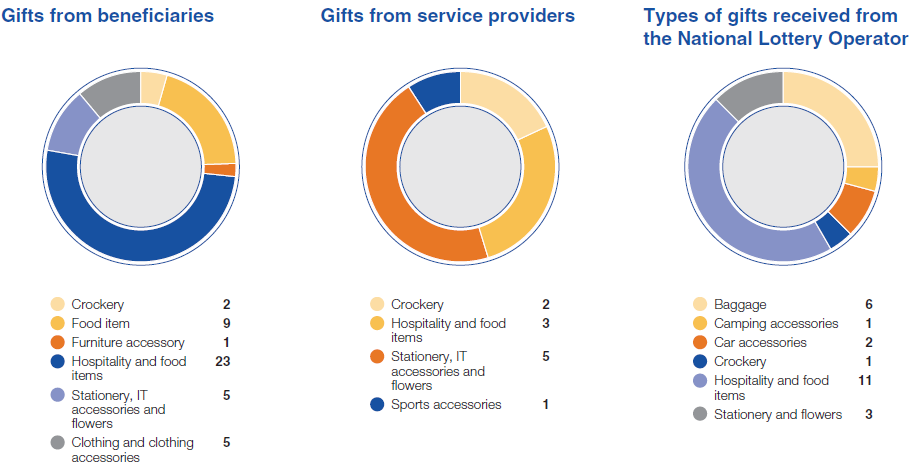
A total of 73 gifts were declared in the period under review, these were received from a diversity of stakeholders.
Policy/Document management
The document management electronic portal ensures that employees have access to and receive policies as they are approved, they can attest to having been received, read, understand and commit to adherence to the NLC Policies including the NLC Ethics and Conduct Policy.
We publish our Ethics and Conduct Policy on various portals for access by all employees including the intranet, electronic document management portal and Policy shared folder.
The planned areas of intervention were approved by the BHCS&EC at the end of the preceding financial year. The NLC conducted more than 50 ethics training and awareness sessions in the period under review.
The topics covered were:
Q1 – Occupational Health and Safety
Q2 – Ethics from an Organisational Compliance Perspective
Q3 – Conflict of Interest
Q4 – Zithande (A collaborative effort with the Human Capital Division)
Communication and constant messaging was aligned to the periodic topics covered each quarter. Divisional heads are provided with quarterly statistics and analysis regarding disclosures and declaration of interest lodged on the electronic portal.
Other services provided by the office included support in the form of evidence and interpretation on the three NLC cases where employees contravened NLC polices. The Ethics Office provided guidance to the NLC board, executive management and employees whenever requested.
The Ethics Office is satisfied with level of compliance to the NLC Ethics and Conduct Policy in the period under review.
In the case that a Distributing Agency member being an employee or serving on the Board or equivalent governing body of an applicant for NLDTF, the application from that applicant will be referred to another Distributing Agency for adjudication. The table of interests declared by the respective Distributing Agency members is indicated here in the report.
In the period under review, all Board members and employees lodged their disclosures of interest and there were no material conflicts of interest identified.
Gift declarations
In terms of the Donations Policy, employees are required to electronically disclose all gifts received from suppliers, and from any person who received a grant or intends to apply or has applied, in terms of section 13, for a licence to conduct the National Lottery.
The Ethics Office recorded that a total of 73 gifts had been lodged in the period under review as follows:
Other services provided by the ethics office included support in the form of evidence and interpretation on three NLC cases where employees contravened NLC policies. The ethics office was satisfied with the level of compliance with the Ethics and Conduct Policy and Gift and Donations Policy.
The NLC whistle-blowing Policy outlines the procedure for reporting suspected instances of corruption and ensures that employees are not victimised for coming forward. The NLC also subscribes to a Deloitte managed hotline for anonymous tip-offs. The CAE report provides further details in this regard.
NLC employees have the freedom to belong to recognised bargaining councils, in accordance with the Labour Relations Act of South Africa. Human rights at the NLC are dealt with in line with its internal policies and relevant legislation.
Information pertaining to the NLC standing on B-BBEE; Transformation, Skills; Health and Safety and Environment is elaborated on our website. The NLC endeavours to contribute to the country’s economic and development indicators through implementation of B-BBEE legislation and codes.
The NLC places utmost importance on the health and safety of its employees and the public. The Committee was satisfied with the assurance of the Compliance Division and Internal Audit that the Commission complied with all the applicable health, safety and environmental laws and regulations. A building condition survey, which included fire rationale and detection, electrical networks reticulation, ceiling condition, internal and external air quality testing, air-conditioning/HVAC condition and hydrocarbon testing and water quality sampling was undertaken to evaluate compliance of the NLC Head Office.
To comply with the provisions of the OHS Act to provide for the health and safety of personnel, visitors, consultants and contractors, the NLC has an approved OHS Policy and OHS Implementation Plan. An OHS Committee was appointed in line with the Act to monitor and foster compliance on health and safety issues and recommend appropriate steps to be taken to address risks and threats. Compliance to the Act has been monitored through a compliance register and risk register, which are presented to the Board periodically. Energy saving and light switching systems were successfully installed. The Board approved the acquisition of provincial office accommodation and the Committee is looking forward to the green initiatives that will emanate from these acquisitions. During the period under review, there were no reported fatalities, and 3 injuries were recorded. The NLC has appointed SHE representatives of which 100% attended SHE representative functions training.
The NLC’s core objectives are the promotion of social upliftment, therefore social responsibility is inherent in the NLC’s daily activities. In fostering the mission statement of being Catalysts for Social Upliftment, NLC employees participated in the Nelson Mandela Blanket Challenge where over 100 blankets were handed over to the Nelson Mandela Foundation.
The Board Human Capital, Social and Ethics Committee comprises of four members, including the chairperson. In terms of the Board Charter, the Committee must meet at least four times a year. During the financial year ended 31 March 2019, the Committee convened on six (6) occasions. The table below shows the attendance of these meetings.
| Committee member | Role | Quarterly | Special meetings and workshops |
| Dr MA Madzivhandila | Chairperson | 4/4 | 2/2 |
| Ms DLT Dondur | Member | 4/4 | 2/2 |
| Prof YN Gordhan | Member | 4/4 | 2/2 |
| Adv WE Huma | Member | 4/4 | 2/2 |
| Board Human Capital, Social and Ethics Committee meetings include Quarterly Meetings and Committee Policy Review Session. |
Committee evaluation
360° Human resources, social and ethics committee
|
| Key | Assessment | |
| 1 to 1.5 | No limited or insignificant observations noted. Minor or no adjustments required to processes and practices. | |
| 1.5 to 2.5 | Specific observations noted. Some adjustments required to processes and practices. | |
| 2.5 to 4 | Significant and/or a large number of observations noted. Significant adjustments required to processes and practices. | |
Members were satisfied that good governance is generally practised and that the Committee is effective in its functioning as a collective, both with respect to adherence with its mandates as well as its oversight and support role within the Commission.
Key observations relate to enhancement remuneration matters with respect to the absence of a long-term incentive scheme and employee relations capacitation. The Board reviewed the Rewards and Performance Management Policy following extensive benchmarking exercise by an independent remuneration specialist. The Commission continued to engage with representative unions to ensure labour peace within the NLC.
The Committee has subsequently commenced the process of Self Evaluation assessment. The Committee was satisfied that it had performed all the functions required by its mandate and approved work plan.
The Board Nominations Committee was established to ensure that the Board comprise of the appropriate balance of knowledge, skills, experience, diversity and independence for it to discharge its governance role and responsibility objectively and independently.
The Board Nominations Committee comprises of six members, including the chairperson. In terms of the Committee Charter, the Board must meet at least twice a year. During the financial year ended 31 March 2019, the Committee convened on three (3) occasions. The table below shows the attendance of these meeting.
| Committee member | Role | Quarterly meetings | Special meetings and workshops |
| Prof YN Gordhan | Chairperson | 2/2 | 1/1 |
| Ms A Brown | Member | 2/2 | 1/1 |
| Ms TS Kekana | Member | 2/2 | 1/1 |
| Ms DLT Dondur | Member | 2/2 | 1/1 |
| Prof NA Nevhutanda | Member | 2/2 | 1/1 |
| Adv WE Huma | Member | 1/2 | 1/1 |
| Dr MA Madzivhandila | Member | 2/2 | 1/1 |
Committee evaluation
360° Nominations committee
|
| Key | Assessment | |
| 1 to 1.5 | No limited or insignificant observations noted. Minor or no adjustments required to processes and practices. | |
| 1.5 to 2.5 | Specific observations noted. Some adjustments required to processes and practices. | |
| 2.5 to 4 | Significant and/or a large number of observations noted. Significant adjustments required to processes and practices. | |
Key observations were that the Committee was performing its function’s well and that greater focus should be placed on development of programmes for Board members. The NLC commenced process for appointment of Corporate Governance Advisory panel to assist members address corporate governance principles. A focal point of this panel is to build capacity to enhance development programmes. It was noted that the Committee should meet frequently to discuss issues related to the role of the Committee. The Committee has a minimum of three scheduled meetings per annum.
The Committee has subsequently commenced the process of Self Evaluation assessment. The Committee was satisfied that it had performed all the functions required by its mandate and approved work plan.
The Board Audit and Risk Committee (audit committee) herewith presents its report for the financial year ended 31 March 2019, as required by section 77 of the Public Finance Management Act, 1999 (Act No. 1 of 1999, as amended by Act No. 29 of 1999) (PFMA) read with treasury regulation 27.1.10.
Members and attendance
The audit committee was established in accordance with sections 51(1)(a)(ii) and 77 of the PFMA. The audit committee charter requires that the audit committee comprises a minimum of three members, the majority of whom should be from outside the public service or the majority of whom should be non-executive members, although committee members need not all be members of the NLC Board. Members’ qualifications are detailed below.
The audit committee comprises four members, including the Chair, Ms Doris Dondur. In terms of section 77(b) of the PFMA, the audit committee must meet at least twice a year. The Committee Charter makes provision for a minimum of four meetings per year. During the financial year ended 31 March 2019, the audit committee met on fifteen (15) occasions. The table below shows the attendance of these meetings.
| Committee member | Role | Date of appointment Qualifications | Quarterly meetings | Workshops and special meetings |
| Ms DLT Dondur | Chairperson | See here | 5/5 | 10/10 |
| Prof YN Gordhan | Member | See here | 5/5 | 10/10 |
| Adv WE Huma | Member | See here | 5/5 | 10/10 |
| Dr MA Madzivhandila | Member | See here | 5/5 | 10/10 |
| Ms K Singh | Representative from the dti |
B.Comt (Hons), CTA (Certificate of theory in Accounting), CIA (Certified Internal Auditor – through IIA Global), Post-graduate Diploma in Executive Development Appointment date : 17 December 2019 |
3/5 | 1/10 |
| Mr D Kekana | Representative from the dti |
Bcom degree Certified Information Systems auditor (CISA) Certified Ethical Hacker (CEH) Computer Hacking Forensics Investigator (CHFI) Appointment date: January 2019 |
1/5 | 1/10 |
| Prof NA Nevhutanda | Board Member (By invitation) |
See here | 0/5 | 5/10 |
| Ms A Brown | Board Member (By invitation) |
See here | 0/5 | 5/10 |
| Ms TS Kekana | Board Member (By invitation) |
See here | 0/5 | 5/10 |
| Adv T Nevondwe | NLPT Chairperson (By invitation) |
See here | 2/5 | 1/10 |
| Nedbank Trust |
The members of the audit committee held meetings with the Board, senior management of the Commission, internal audit function and the external auditors, collectively and individually, on matters related to governance, internal control and risk in the Commission, throughout the reporting period. The Committee Chairperson also participated in the annual Audit Committee Chairpersons Forum with the Minister of Trade and Industry to report on governance, internal control, risk, performance and financial information and other relevant matters concerning the Commission.
Audit Committee’s responsibility
The audit committee has complied with its responsibilities arising from the PFMA and reports that it operated in terms of the audit committee charter read in conjunction with the internal audit charter.
Effectiveness of internal control
The audit committee acknowledges management’s efforts to strengthen internal controls in the Commission. The Committee is satisfied with the current technical support, monitoring and evaluation by the internal audit function.
The audit committee is comfortable matters reported by the external auditors and the internal audit function in prior years have been fully and satisfactorily addressed. Management has provided assurance that effective corrective action has been implemented and that the audit committee will monitor these going forward.
Vacancies will be filled prudently with properly qualified, skilled and experienced personnel and have not impaired the effective functioning of the system of internal control.
The NLC has adopted anti-corruption measures to curb potential fraud and corruption. The audit committee is satisfied with the prevention of fraud. The fraud risks have been tabled to the Committee at each quarterly meeting of the audit committee.
Due to the strategic importance of, and investment in, the modernisation of information and communication technology (ICT) in the Committee, the audit committee has monitored the risk register and progress reports on the respective action plans during the year under review. The audit committee is comfortable that ICT risks are being addressed or mitigated, in implementing the new systems.
The quality of monthly and quarterly reports submitted in terms of the PFMA
The audit committee is satisfied with the content and quality quarterly reports prepared and issued during the year under review in compliance with the statutory framework.
The audit committee has reviewed and commented on the NLC’s annual financial statements and report on performance information and their timely submission to the external auditors by 31 May 2019.
The audit committee has reviewed the reports issued to National Treasury and is comfortable that the Commission is meeting its obligations and have recognised revenue to the extent that conditions have been met.
The audit committee is comfortable that the Minister of Trade and Industry is exercising its oversight responsibilities in terms of PFMA and ensuring that the funds are utilised for the purpose as described in the PFMA, Lotteries Act and Annual Performance Plan.
Internal audit function
The Board is obliged, in terms of the PFMA, to ensure that the entity has a system of internal audit under the control and direction of the audit committee. The audit committee is satisfied that the internal audit function has properly discharged its functions and responsibilities during the year under review.
The capacity of the internal audit function has been enhanced through the investment in an electronic system. The audit committee expects these initiatives to contribute to the internal audit function becoming more efficient, more responsive to challenges and better able to provide audit reports of a high quality to management and the committee on a timely basis. The audit committee supports the direction that the internal audit function is adopting in providing the necessary skills and agility required for the function to respond quickly and effectively to the demands for internal audit across the Commission’s different locations. The internal audit capacity was enhanced through co-sourcing parts of the internal audit function. The recent appointment of specialist ICT auditors is a welcome development considering the need for expertise in the auditing of automated systems and the development and maintenance of a system of continuous auditing.
The committee is satisfied that the internal audit function is operating effectively and that it has addressed the risks pertinent to the Commission.
The audit committee is satisfied that the internal audit function maintains an effective internal quality assurance and programme that covers all aspects of the internal audit activity.
Risk management function
The audit committee is responsible for the oversight of the risk management function. The audit committee is satisfied that the risk function is adequately resourced and has delivered on its mandate. The committee has reviewed the risk register and the quarterly reports and is generally satisfied with the maturity of the risk management process.
Evaluation of the finance function
Overall, the audit committee is satisfied with the Commission’s finance function during the year under review.
Performance management
Part of the responsibilities of the audit committee includes the review of performance management. The audit committee has in terms of the performance of the Commission, performed the following functions:
The audit committee is satisfied that the performance report has been prepared in terms of the PFMA, the Treasury Regulations and any other related regulatory requirements for reporting performance.
Evaluation of the annual financial statements
The audit committee has reviewed the annual financial statements, which focused on the following:
The audit committee is comfortable that the annual financial statements have been prepared in terms of GRAP and the PFMA.
External auditor’s report
The audit committee concurs with and accepts the conclusion and audit opinion of the external auditors on the annual financial statements. The committee is of the view that the audited financial statements be accepted and read together with the report of the external auditors. The audit committee confirms that it has been actively involved throughout the audit process and has been thoroughly appraised of the issues giving rise to the audit opinion. The audit committee concurs with the findings on the reported performance information and compliance with legislation.
The external audit function, performed by the Auditor-General South Africa, is independent of the entity. The audit committee has met with the external auditors to ensure that there are no unresolved issues, and acknowledges the diligence and cooperation of the external audit team.
On behalf of the Board Audit and Risk Committee:

Ms D Dondur
Board Audit and Risk Committee Chair
31 July 2019
Committee evaluation
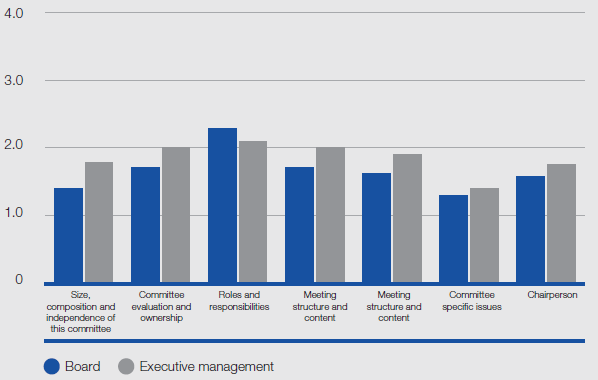
360° Audit and risk committee evaluation results
|
|
| Key | Assessment | |
| 1 to 1.5 | No limited or insignificant observations noted. Minor or no adjustments required to processes and practices. | |
| 1.5 to 2.5 | Specific observations noted. Some adjustments required to processes and practices. | |
| 2.5 to 4 | Significant and/or a large number of observations noted. Significant adjustments required to processes and practices. | |
The Committee was satisfied that good governance was practiced and that the Committee was effective in fulfilling its mandate and providing oversight of the Finance, ICT, Internal Audit and Risk. The members encouraged more ICT related discussions, particularly to Cyber and Information security.
During the period under review the Committee focused on oversight over cyber security matter.
The Committee has subsequently commenced the process of Self Evaluation assessment. The Committee was satisfied that it had performed all the functions required by its mandate and approved work plan.
Khwa Ttu San Culture and Education Centre
Khwa ttu was established as a 50/50 joint undertaking between the San, as presented by the organisations WIMSA and UBUNTU, a Swiss charitable organisation dedicated for San development in Southern Africa.
The organisation was formed in 1999 and registered as NPC in 2004. NLC supported the organisation from its initiation, starting in year 2004 and is continuing to support all their programmes. The San culture and education centre do the following;
 |
Educate the general public about the world of the San. |
|
Restitution and display the heritage of the San as contained in their culture, history, folklore visual arts, cosmology and language. |
|
Provide training to the San in entrepreneurship, tourism, health, community development, craft production/marketing and gender issues. |
The organisation has been training, developing and creating employment for San people particularly from the Northern Cape in Upington, Ashkhan, Andriesvale, Welkom, Rietfontein, Kimberley and Platfontein. The organisation provided a 7-month San Community-based tourism program under the San Sustainable Livelihoods Programme which include nature guiding, environmental training, cultural guiding, computer and rock art. There are also additional workshops provided which includes; table attendant, first aid and life skills. After completing these courses and workshops the participants receive the following certificates;
|
Nature Site Guide Skills Programme Level 2 (CATHSSETA aligned) |
|
CATHSSETA table attendant Skills Programme Level 2 |
|
Cultural Site Guide Skills Programme Level 2 (CATHSSETA aligned) |
|
Khwa Ttu San Community-based Tourism Training Certificate |
Funding by NLC
In 2004 Khwa ttu applied for funding and received the amount of R996 400.00 from NLDF for mostly operational costs expenditure. In 2011 the organisation was funded again with the total amount of R2 213 200.00. The bulk of these funds were for Research and Development of the organisation. The current funding of the organisation was approved in 2018 with the amount of R3 753 722.00 going towards solar system, water purification system and operational costs. The organisation has been continuously providing compliant reports to NLC for all the funded projects.