Research and development
During the year under review, the unit co-ordinated activities to leverage the NLC’s knowledge management capabilities. The unit developed collaborative partnerships with Statistics South Africa and the Human Science Research Council pursuant to improvement of the units research capacity.
Over the years several studies were conducted as detailed in the table below:
| Year | Studies | Key outcomes | Informed decision |
| 2011 | The South African National Lottery: Participation and Attitudes |
|
|
| 2013 | National Lottery Distribution Trust Fund Impact Study |
|
|
| 2015 | Impact of Illegal Lotteries to the National Lottery in South Africa |
|
|
| 2016 | Organisational Study for the National Lotteries Commission (NLC) |
|
|
| Year | Studies | Key outcomes | Informed decision |
| 2017 | Impact evaluation studies in five provinces |
|
|
| 2017 | Grant making related research – Funding for worthy causes |
|
|
| 2018 | Grant making related research – Funding for worthy causes |
|
|
| 2018 | Player participation study |
|
|
| 2018 | Research study on defaulting projects |
|
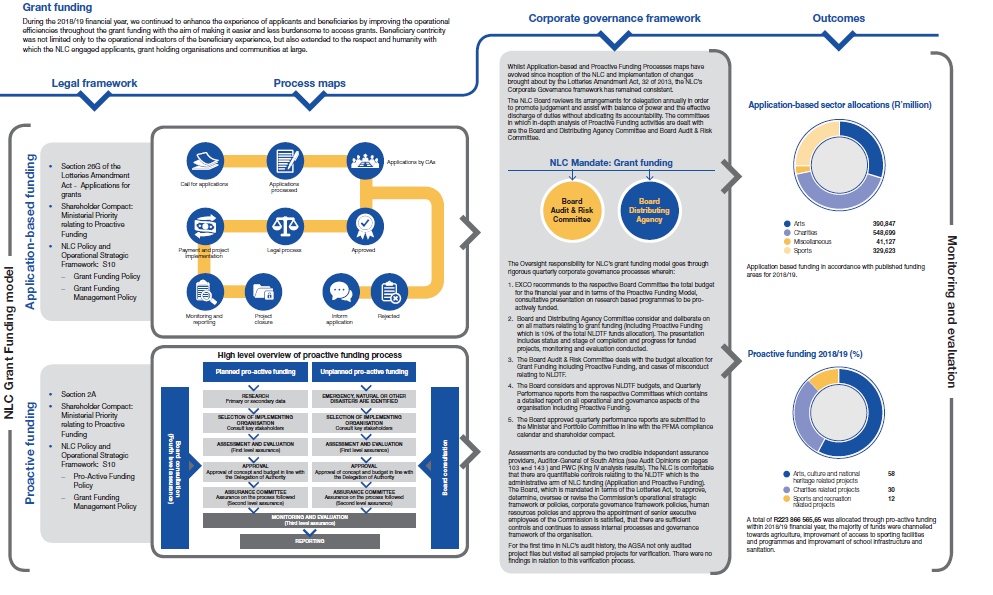
During the 2018/19 financial year, we continued to enhance the experience of applicants and beneficiaries by improving the operational efficiencies throughout the grant funding with the aim of making it easier and less burdensome to access grants. Beneficiary centricity was not limited only to the operational indicators of the beneficiary experience, but also extended to the respect and humanity with which the NLC engaged applicants, grant holding organisations and communities at large.
Monitoring and evaluation outcomes
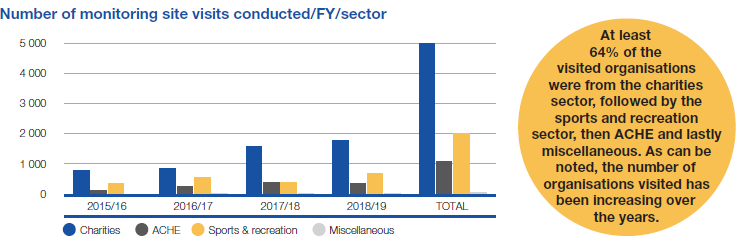
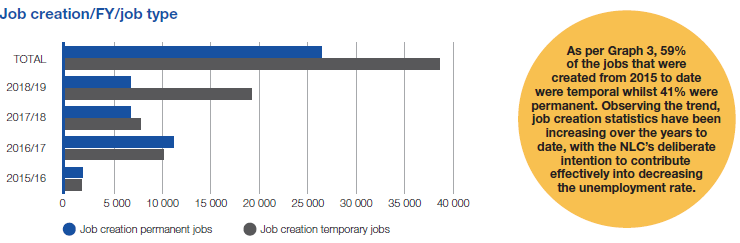
Continuous improvement in monitoring evaluation tools have resulted in a total of 2 847 monitoring site visits being conducted. A total of 25 943 jobs were created during the financial year of which 19 200 were permanent jobs and 16 743 temporary employments. In terms of social groups, 20 238 were Adults, 5 077 Youth and 429 jobs were created for people with disabilities. The Arts sector had the highest number of jobs created at 13 148. NLC funding has yielded economic benefits to our direct and secondary beneficiaries.
The monitoring and evaluation unit of the NLC not only measures the impact of funding and appropriate utilisation of funds also focuses on capacitation of beneficiaries assisting them to properly implement their projects.
The NLC relies on services of independent engineers to monitor and provide quality assurance on proactively funded projects.
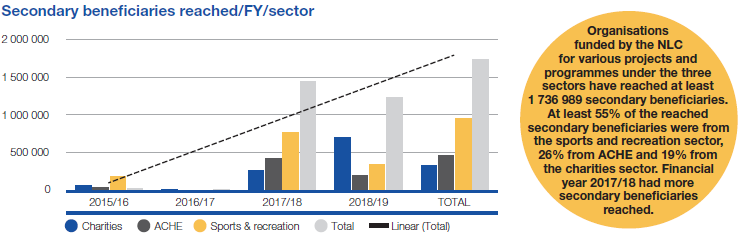
Secondary impact beneficiary statistics for 2018/19
| Sector | Total | Male | Female |
| Charities | 504 016 | 313 303 | 190 713 |
| Arts and culture | 153 520 | 64 788 | 88 732 |
| Sports and recreation | 230 819 | 110 669 | 120 150 |
| Total | 888 355 | 488 760 | 399 595 |
Stakeholder Relations, Marketing and Communications
By its very nature, the work of the NLC is entrenched in partnerships. Rooted in the vision ‘To be the Catalyst for Social Upliftment’, strategies and activities within the area of Stakeholder Relations, Marketing and Communication are geared at catalysing action to fulfil the dual mandate of the NLC.
Positioning the NLC as a regulator
Recent surveys on the NLC’s brand awareness have consistently revealed that the funding mandate is more prominent in the eyes of the public, as well as the NGO sector - than the regulatory mandate. This is due to various reasons, not limited to the level of need for funding of good causes in South Africa’s NGO sector.
However, regulation forms the foundation of the NLC’s operations. Research reports such as the study into the impact of illegal lotteries on the National Lottery reveal the monetary cost of these schemes on the pool of funds intended for good causes.
From April 2018, programmes have been put in place to enhance the brand awareness of the regulatory mandate of the NLC, and to publicise products and services that will not only benefit competition organisers, but also NGOs who seek to raise funds – thus reducing dependency on NLC funding. This was achieved most notably through radio interviews at all Post Indaba Stakeholder Engagements with special emphasis on community media, and television features and interviews on SABC’s Morning Live, and current affairs show Yilungelo Lakho (panel discussion to distinguish lotteries from gambling).
Enhancing awareness of the NLC as a funder
A notable hangover from the amendment of the Lotteries Act is confusion on the application of regulations and their impact on the funding process.
While these issues form part of the Education and Awareness programmes rolled out by provincial offices, they also form an integral part of the Post Indaba Stakeholder Engagement programme, which also serves to monitor trends in prevailing issues among beneficiaries and strategic stakeholders.
As an additional measure, the regulations that featured most prominently in frequently asked questions at various stakeholder engagements were packaged into a document – ‘Legislative Interpretation of the Regulations to the Lotteries Act’ - to explain their implementation in specific detail (in conjunction with the dti). The information brochure was translated into the 11 official languages and distributed through provincial offices.
Translation of NLC information sources from English is a future consideration to widen the reach of services, while improving access to funding by removing barriers to entry.
Media relations
The 2018/19 financial year also saw media relations become a focal point for the NLC.
Media is a key stakeholder group in achieving the ends of the organisation’s mandate and has been identified as being instrumental to brand positioning through advertising, reputation building through engagement, and education and awareness through structured campaigns.
In the period under review, proactive measures were put in place to empower this stakeholder group to enhance the impact of Marketing and Communications programmes.
Education and Awareness & Structured Capacity Building Training Programme
Education and awareness programmes are primarily rolled out at provincial level through the hosting of pre-application workshops.
A future consideration is the standardization of the workshop programme to ensure that information is consistent, and the use of social media and digital platforms as educational tools to widen the reach of the workshops.
The Structured Capacity Building Training Programme for 2018/19 was implemented in five (5) provinces, namely the Eastern Cape, Gauteng, KwaZulu-Natal, Limpopo and the Western Cape.
Training in all five provinces commenced in October 2018, accompanied by mentoring sessions inclusive of site visits to beneficiaries’ organisations.
Assessment and verification has continued into the new financial year, and results from a post-training survey are expected in that time as well.
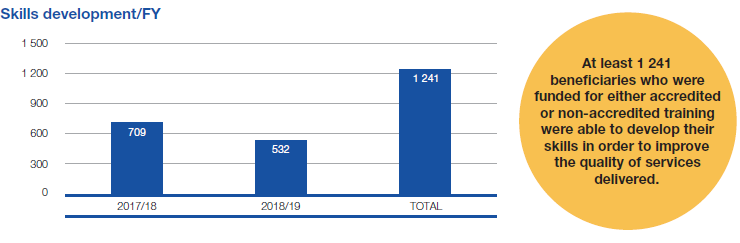
The table below is a summary of the training programme:
| Province | Number of organisations | Training and mentoring status |
| Limpopo | 18 | Training completed Mentoring completed Portfolio of evidence collected |
| Gauteng | 17 | Training completed Mentoring completed |
| KwaZulu-Natal | 12 | Training done Mentoring done Portfolio of evidence collected |
| Western Cape | 16 | Training done Mentoring done Portfolio of evidence collected |
| Eastern Cape | 16 | Training done Mentoring done Portfolio of evidence collection incomplete |
Going forward, the primary objectives of the NLC’s integrated strategic communications program will continue to revolve around raising awareness about the mandate and generate interaction with the stakeholders.