
Risk management
Our priority in managing risk is that lotteries and sports pools be conducted properly and responsibly, ensuring participants are duly protected. However, certain risks, by their nature, are largely unpredictable, and it is the strategic focus of the organisation to ensure resilience and business continuity in the face of adverse risk effects.
Overview
Risk management is an integral part of our governance model and daily operations. We focus on reducing uncertainty by minimising the downside effects of risk. Where feasible, we also actively seek and capitalise on the potential upside presented by strategic and operational opportunities that support the achievement of our strategic objectives. We are a learning organisation and embrace learnings and opportunities inherent in specific risks that may arise from time to time.
We recognise that our work directly impacts particular areas of shareholder value, risk, and, in some cases, reputation. We prioritise ensuring that any adverse effects on the shareholder are minimised, detected early, and duly resolved at the most optimal cost-benefit ratios. Through ongoing shareholder interface by the Board and from an operational perspective by the executive management team, we continue to build and maintain a value-building and mandate-centric relationship between the organisation and the shareholder.
Crisis readiness and organisational resilience
For the material part of the period under review, the organisation had to navigate the effects of the COVID-19 pandemic declared in 2020. As a result, adjusted alert level 1 was put in place from 1 October 2021 up to the financial year-end, with further easing of restrictions expected in the period after year-end. In addition, the organisation has formally adopted key learnings presented by the pandemic in building upon its general crisis readiness and resilience programmes, with the primary intent to ensure organisational readiness and capability to respond to various forms of operational disruption.
Our risk management policy
The organisation’s risk management efforts are directed by an enterprise risk management policy, which the Board approves after receiving inputs and recommendations from the Audit and Risk Committee and the executive management team. This policy provides clear and measurable principles that will be achieved by the risk management programme and that shall be observed by all officials within the organisation.
Structure and accountability management
To realise effective governance over risk and align with the organisational risk policy, the organisation has implemented the following structure:
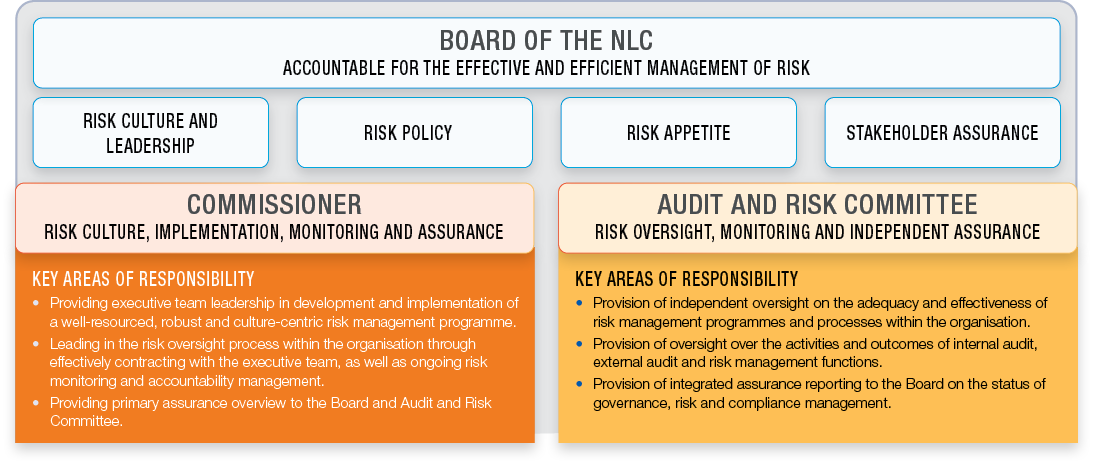
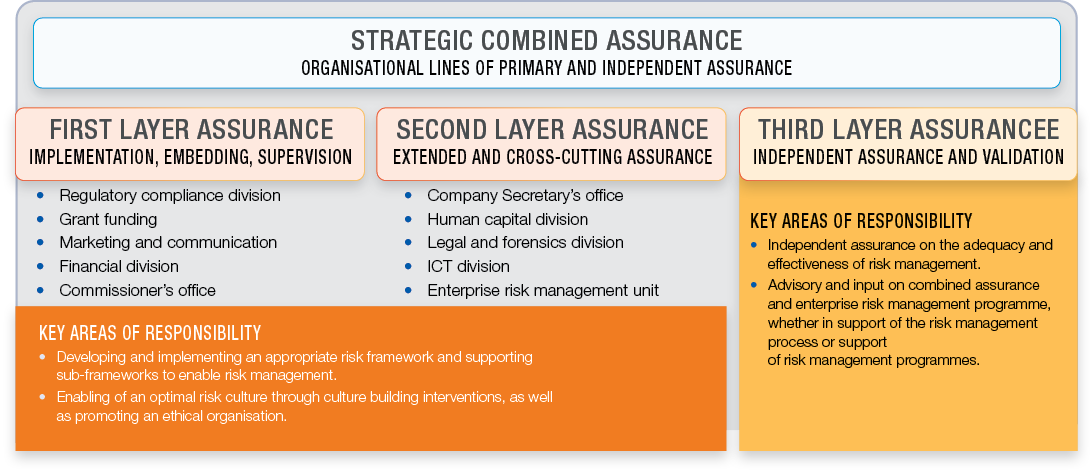
Our risk appetite position
The risk appetite position of the organisation is formally recorded in an approved risk appetite framework and statement. The organisation also formalises its risk tolerance thresholds related to each risk appetite theme, reflecting upon the degrees of variance in performance arising because of risk and the relative acceptability thereof. Risk tolerance limits are also beneficial in promoting the prevention and early detection of potential risk appetite breaches. During the year, the organisation manages and tracks a range of strategic key risk indicators related to the stated risk tolerance thresholds and strategic risks.
Although positive outcomes were achieved in all such indicators, the organisation did experience significant risk exposure arising from adverse media coverage. This strategic risk impact was escalated to the Board for resolution in line with the risk governance protocols of the organisation as well as our formal reputational risk framework.
Managing reputational risk
The NLC has a formalised zero-tolerance policy for incidents and actions that compromise the integrity of the National Lottery, sports pools, the NLC, and the shareholder. In addition, we have a formal marketing and communications policy and strategy that includes a stakeholder management programme. Our approach to reputational management includes active management of media and social media. However, we also recognise that a poor reputation is a symptom of an underlying cause. For that reason, we continually assess the critical drivers of reputational risk, seek to understand and manage these and develop future risk management strategies.
A documented reputational risk framework is in place to respond to any reputational threats, but its underlying intent is the prevention of such reputational risk occurrences. Media coverage is actively monitored through media monitoring tools, where any negative media is investigated through the forensic department of the NLC. As a complementary initiative, continuous fraud and ethics awareness workshops are periodically conducted, targeted at staff members and key stakeholders.
Key strategic risks and responses
Our top strategic risks are diverse and consider issues that may directly impact the achievement of our strategic objectives, annual performance plans, regulatory mandate, and reputation, among other aspects. We have adopted a formalised and ongoing risk assessment process and identified emerging risks during the year as part of that culture. By implementing an agile and responsive emerging risk management process, we can ensure that our risk information, priorities, and responses remain relevant in the face of ever-changing circumstances. The core strategic risks of the organisation are as below:
STRATEGIC OUTCOME |
STRATEGIC RISK STATEMENT |
System does not provide for sufficient regulatory oversight |
We have formalised regulatory oversight structures and policies, supported by a continual drive to ensure that the organisation has the requisite skills to enable effective regulatory oversight. The Independent Verification System for independent verification of National Lottery ticket sales is a crucial risk response mechanism further augmented by our additional data analysis tools and competencies as an organisation. As an ongoing enhancement strategy, we work continually with the Department of Trade, Industry and Competition (shareholder) to enable a responsive and up to date legislative framework that ultimately enhances the protection of lottery participants and beneficiaries of the work of the NLC. The NLC has committed to developing a strategy to address inadequacies in independent monitoring of the National Lottery, sports pools, and other lotteries. This strategy, it is envisaged, shall consider emerging technologies that optimise the effectiveness and reliability of oversight outcomes. |
Ineffective enforcement and prohibition action |
Our focus on preventing, detecting, and combating illegal lottery operations is not only empowered by legislation but is also further enhanced through collaboration with other regulators, law enforcement agencies and stakeholders in the market and internationally. We seek to prevent illegal lottery activity through active media monitoring, formal registration criteria, and an easy registration process for compliant lotteries. In addition, ongoing education is a tool relied upon to inform the public of lotteries and sports pools regulations and how they can best be protected as participants. One of the main challenges is a lack of awareness regarding the nature of illegal lotteries amongst participants and those conducting them, which is managed through structured and ongoing awareness campaigns. |
Impaired organisational sustainability |
The NLC has implemented a formal sustainability strategy providing guidelines and objectives for sustainability under various themes. The annual and ongoing budget preparation and monitoring processes ensure that the organisation remains in touch with its financial health and implements required financial mitigations timeously. In addition, the organisation implements a reserving strategy to absorb the economic effects of uncertainties and disruptions. This is combined with ongoing cost containment measures and revenue maximisation strategies that are reviewed formally at least annually. Cost containment is supported by awareness sessions with staff members designed to build a cost saving culture through seeking out cost efficiencies while ensuring that the NLC’s organisational mandate is achieved. The revenue generation model continues to be reviewed, and as part of that process, the revenue maximisation strategy was developed during the financial year under review, pending Board approval. |
Failure by the Executive Authority to appoint a National Lottery Operator on time |
Through the request for proposal (RFP) management process, the NLC assists the Executive Authority in reaching a conclusion on the National Lottery Operator. This supports a considered and balanced RFP process that is informed by a formal RFP strategy and considers pertinent procurement laws and regulations. In addition, a reserving strategy is in place to protect business continuity and ensure that the NLC is less affected by key business disruptions should these arise. |
Critical business continuity disruptions |
Formal business continuity planning is supported by robust crisis management and emergency planning. Such supporting contingency management practices include a pandemic mitigation strategy, off site backup solution, a disaster recovery policy and structured health and safety management in terms of an occupational health and safety policy. Moreover, there are additional interventions in the form of an employee wellness programme and crisis communications management to deal with the fallout resulting from certain business disruptions. We have placed heightened emphasis on third party or strategic partner impacts on business continuity by formally reviewing key third party business continuity arrangements and ensuring effective alignment between the organisational business continuity plans and relevant third party plans. The NLC additionally ensures ongoing monitoring of the National Lottery Operator’s business continuity arrangements to ensure operational continuity is not impaired by significant adverse occurrences at the National Lottery Operator. |
Ineffective management of information |
Formal business continuity planning is supported by robust crisis management and emergency planning. Such supporting contingency management practices include a pandemic mitigation strategy, off site backup solution, a disaster recovery policy and structured health and safety management in terms of an occupational health and safety policy. Moreover, there are additional interventions in the form of an employee wellness programme and crisis communications management to deal with the fallout resulting from certain business disruptions. We have placed heightened emphasis on third party or strategic partner impacts on business continuity by formally reviewing key third party business continuity arrangements and ensuring effective alignment between the organisational business continuity plans and relevant third party plans. The NLC additionally ensures ongoing monitoring of the National Lottery Operator’s business continuity arrangements to ensure operational continuity is not impaired by significant adverse occurrences at the National Lottery Operator. |
Non-optimal human capital structure and skills to meet the organisation’s mandate and strategic obligations |
A formal human capital strategy informs the NLC’s human capital management initiatives in support of the organisational strategy. Additional wellness interventions are a crucial risk management measure that works with the health and safety policy. Performance management and related development is a formalised process within the NLC designed to drive performance through recognition, incentivisation and consequence management regarding individual and team performance. A detailed review of the current organisational structure and alignment thereof has been conducted, and as the needs, technology, and work of the NLC continue to evolve, the organisation will ensure any required reskilling of staff members is implemented in line with formal change management processes. |
Ineffective shareholder relations |
The NLC is committed to delivering on its mandate in a manner that ensures sound strategic outcomes and builds shareholder value. A non-functional relationship between the NLC and the shareholder would significantly impair performance and service delivery with the potential effect of reputational harm and loss of integrity of the National Lottery, sports pools, the NLC, other lotteries, and the shareholder. In meeting the intents of formal shareholder compacting, there are ongoing shareholder interface and communication processes in terms of a formal stakeholder management process that are bi-directional and whose primary focus is to ensure the efficient implementation of the NLC mandate. In addition, the Board engages periodically with the shareholder on critical strategic matters. |
Ineffective governance and succession planning |
The Minister of the Department of Trade, Industry and Competition periodically appoints Board members and distributing agencies. The organisation has supplemented its succession plan with a comprehensive knowledge management strategy. The NLC has also prioritised the development of a Board succession strategy, including a handover process to ensure continuity and lesser disruption of the oversight work of the Board. The expiry of contracts for key positions within the NLC is a significant risk to overall governance and succession management. Therefore, the organisation has ensured ongoing communication with the shareholder where intervention is required to fill such critical vacancies. |
Fraud and unethical conduct |
The organisation holds a zero tolerance policy toward any acts of fraud, corruption, and related misconduct. The organisation will therefore not condone such actions, whether known or unknown and expects the highest standards of ethical conduct of its officials and related parties. Driven by a formal anti-fraud and corruption policy, the organisation enables timely fraud reporting, investigation and resolution through a range of related standard operating procedures. The organisation performs a periodic review of its fraud risks through a formal fraud risk assessment. We support openness and transparency through a set of organisational values, a clearly communicated whistleblowing policy and channels thereof, and protecting the rights of whistle blowers in terms of legislation. An ethics policy underpins our approach to ethics, overseen by the Human Resources, Ethics and Social Responsibility Committee. A periodic conflict of interest assessment is conducted in various areas of the organisation, and the findings thereof are resolved and included in future organisational process improvements. Through adequate segregation of duties, awareness building and consequence management, we give priority to the management of fraud risks within the organisation not only as a cause of financial losses but a fundamental cause of reputational risk as well as a direct cause of loss of value and protection for lottery participants and beneficiaries. The NLC prioritised and rolled out an organisational compliance framework and an ethics awareness programme during the period under review. |