Operations division
Overview of activities achieved in line with our values

|
The adjudications of applications were fair, and all decisions taken were communicated to the applicant, with 98% of these communications within 30 days from the date of adjudication. |

|
The commitment that the division showed to serve the public despite the challenges of COVID-19 demonstrated extraordinary courage. The division continued their work with competence and care, resulting in positive impacts on thousands of lives. |

|
The Operations Division across all provinces heeded the call to support the community’s needs and distributed personal protective equipment (PPE) to remote communities to assist in curbing the spread of COVID-19. |

|
The ability of the division to move with speed in the face of the virus ensured that NGOs stayed afloat, and 12 887 households received food parcels and PPE. |

|
In responding to the COVID-19 virus, the NLC contributed R50 million towards the Solidarity Fund, R10 million toward supplying PPE and food parcels to households and R150 million towards a COVID-19 Relief Fund. |
The Operations Division serves as an enabler for the smooth running of the organisations’ operations with the ultimate goal of ensuring that set organisational objectives are accomplished efficiently and economically.
The Operations Division is headed by the Chief Operations Officer and comprises nine provincial offices: Grant Funding, Stakeholder Relations, Marketing and Communications and Business Development. The Operations Division is a cornerstone of the organisation that serves as a strategic enabler for the smooth running of the organisations’ operations with the ultimate goal of ensuring that set organisational objectives are accomplished efficiently and economically.
R&D Unit
The NLC Board resolved the establishment of the R&D Unit in fulfilment of its responsibility to “conduct research on appropriately deserving worthy causes that may be funded or recipients that may be funded without lodging an application”. Additionally, the Board of the NLC may “determine or direct or order the performance of research intended to enhance the optimum functioning of the Board and the distribution of grants”.
The R&D Unit was therefore created within the Operations Division of the NLC. The unit is charged with overseeing and coordinating the research activities of the NLC, including the commissioning of research projects. The R&D Unit develops an annual research agenda and conducts relevant research to support evidence-based decision-making with a primary focus on the two core mandates of the organisation (i.e., regulation and grant-making).
M&E Unit
The M&E Unit was established in 2014 as one of the functions under the Regulatory Compliance Division. The primary purpose of the unit is to monitor and report on funding outcomes, and on overall impact of funding through the commissioning of external evaluations. Over the past eight years, the unit has commissioned or conducted five impact evaluation studies and two data quality assessments.
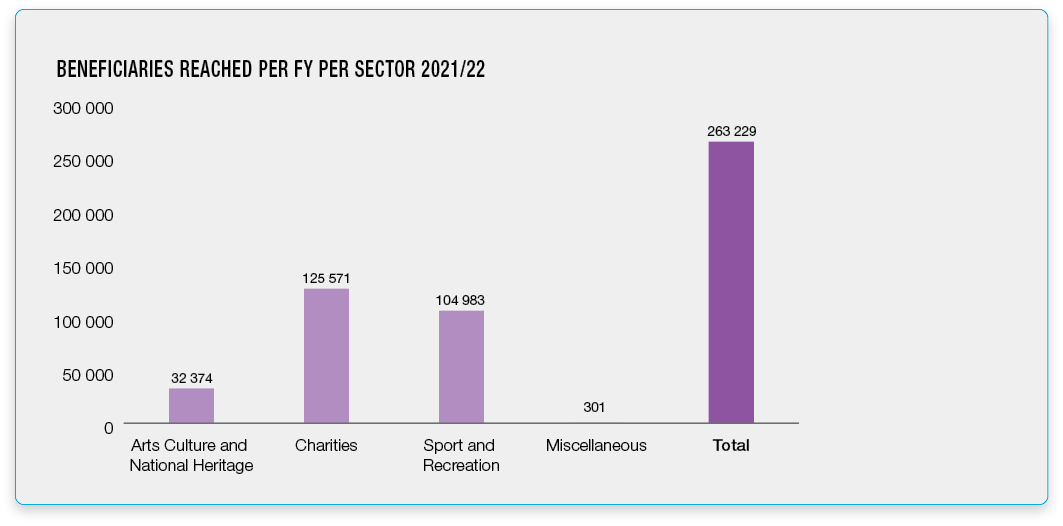
The unit routinely monitors funded projects, collecting and reporting on various outcomes indicators such as job creation, skills development and beneficiaries reached with services by NLC grantees as they implement various projects and programmes.
Since its inception, the unit has conducted close to 16 000 monitoring sessions, where they also assist grantees on understanding the grant agreement conditions, reporting requirements, record keeping, and any other areas related to monitoring and reporting as required.
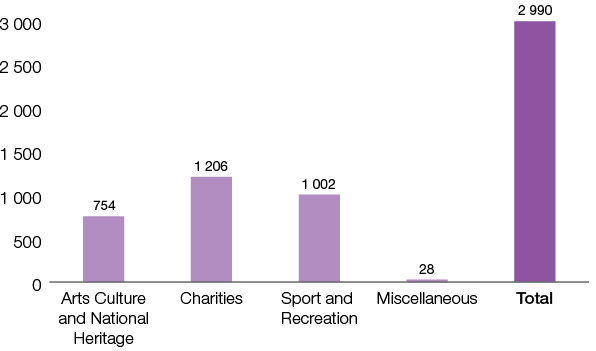
THE SITE VISITS CONDUCTED PER FINANCIAL YEAR PER SECTOR
A total of 8 959 jobs were created. In terms of social groups, 4 167 were adults, 4 039 youth and 162 jobs were created for people with disabilities. The Arts, Culture and National Heritage sector had the highest number of jobs created.
JOB CREATION PER FINANCIAL YEAR PER SECTOR
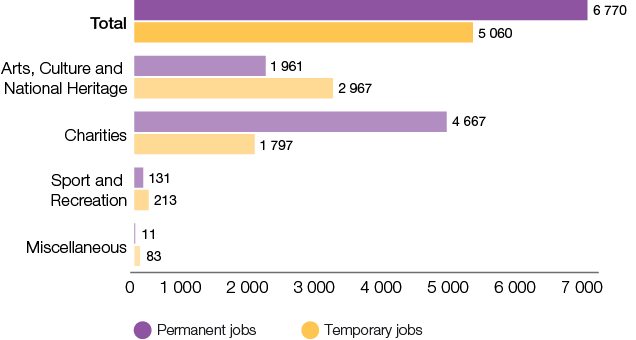
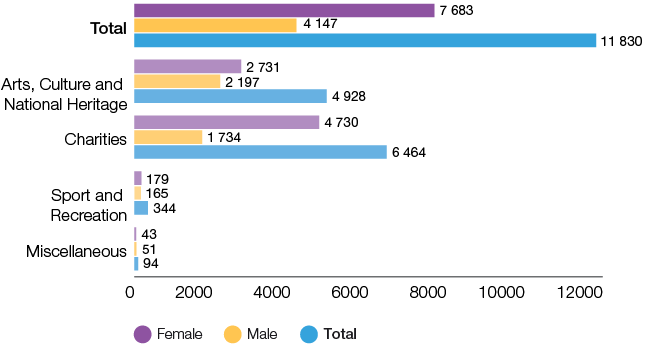
Graph below shows the distribution of job creation among the three sectors. More jobs were created under the Charities sector, followed by Arts, Culture and National Heritage and Sport and Recreation sectors. A total of 94 jobs were created in the miscellaneous sector. A total 7 683 jobs (64%) were created for women.
During the year under review, 2 990 monitoring reports were completed. The NLC adopted a strategy of conducting virtual and physical monitoring due to alert level restrictions imposed under the national state of disaster declared in March 2020.
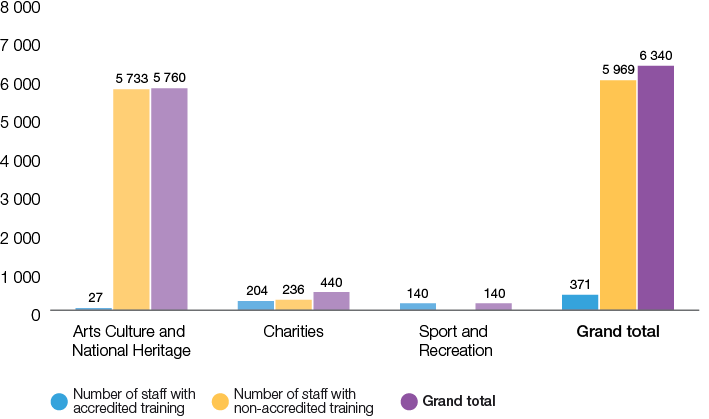
ILLUSTRATES THE NUMBER OF PEOPLE WHO BENEFITED FROM SKILLS DEVELOPMENT PROGRAMMES FUNDED IN 2021/22