Grant funding
ENABLING CATALYTIC CHANGE THROUGH OUR GRANT FUNDING ACTIVITIES
Like many international development agencies and grant-making organisations across the globe, the NLC finds itself in a place where it is required to do more with less, as demand for funding outstrips availability.
Our context has demanded a more systematic and considered approach to grant-making, with our revised philosophy and strategic positioning based on the core concept of funding for impact.
This approach moved the NLC from merely focusing on distributing funds to being more deeply involved and engaged in managing and understanding the impact that our funding has on funded communities and grant holders. It repositioned the NLC to become more purposeful in ensuring that it is indeed a catalyst for social upliftment, changing lives for the better and contributing to the development of the most impoverished and marginalised communities.
Beyond the immense social impact of the NLC’s grant funding work, the National Lottery has also, over the years, had a significant impact through job creation, localisation and B-BBEE, as well as through the overnight winners it has produced.
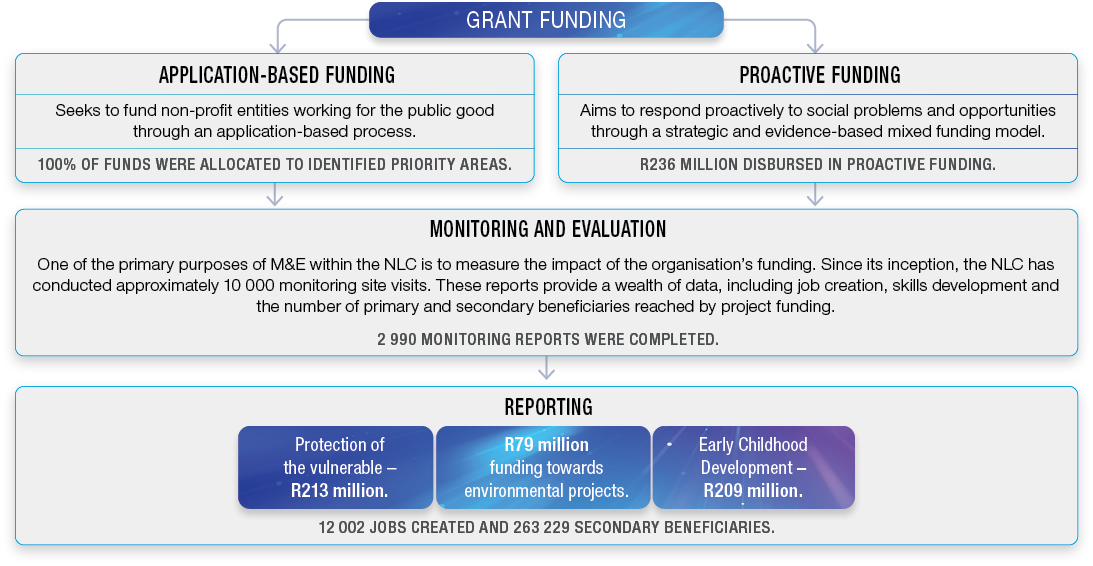
PROACTIVE FUNDING is the vehicle that allows the NLC to fund worthy causes aligned with the country’s developmental agenda and respond to emergencies and disasters across South Africa outside of the application-based funding.
RESPONDING PROACTIVELY TO SAVE LIVES AND LIVELIHOODS
In the wake of the unprecedented impact of the July 2021 civil unrest on the economy and day-to-day life of many South Africans, the NLC delivered R5 million in aid to the KwaZulu-Natal province. The handover took place on Thursday, 29 July 2021.
With hundreds of thousands of jobs at risk and approximately 50 000 informal traders also estimated to be adversely impacted, five non-profit organisations in KwaZulu-Natal were identified as the NLC’s implementing partners to roll out aid to all 11 districts of the province. Initiatives included relief programmes, such as delivering essential goods and food parcels for vulnerable members of the community.
This initiative followed similar funding for communities in Soweto and a grant to assist community radio station Alex FM in purchasing broadcasting equipment after their studios were also affected during the unrest.
RESPONDING WITH UBUNTU IN THE FACE OF LOSS
In April 2021, devastating fires tore through the Mother City, and the University of Cape Town bore the brunt of the disaster. Parts of their esteemed Jagger Library were lost to the blaze, resulting in the loss of irreplaceable literature and artefacts from across the continent, including the first black-owned South African newspaper, Imvo Zabantsundu, which was founded in 1884, along with thousands of materials from the African Studies Collection.
The NLC’s proactive funding toward disaster relief for UCT in May 2021 included the disbursement of R4 million to assist in rebuilding.
“This generous contribution by the NLC will go a long way towards assisting the university as we continue with our recovery efforts. In addition, it will benefit the student-centric initiatives we are putting in place, not only as a direct response to the fire but also to continue ensuring that our students are optimally cared for.”
UCT Vice-Chancellor Prof Mamokgethi Phakeng
OVERVIEW OF GRANT FUNDING ACTIVITIES ACHIEVED IN LINE WITH OUR VALUES

|
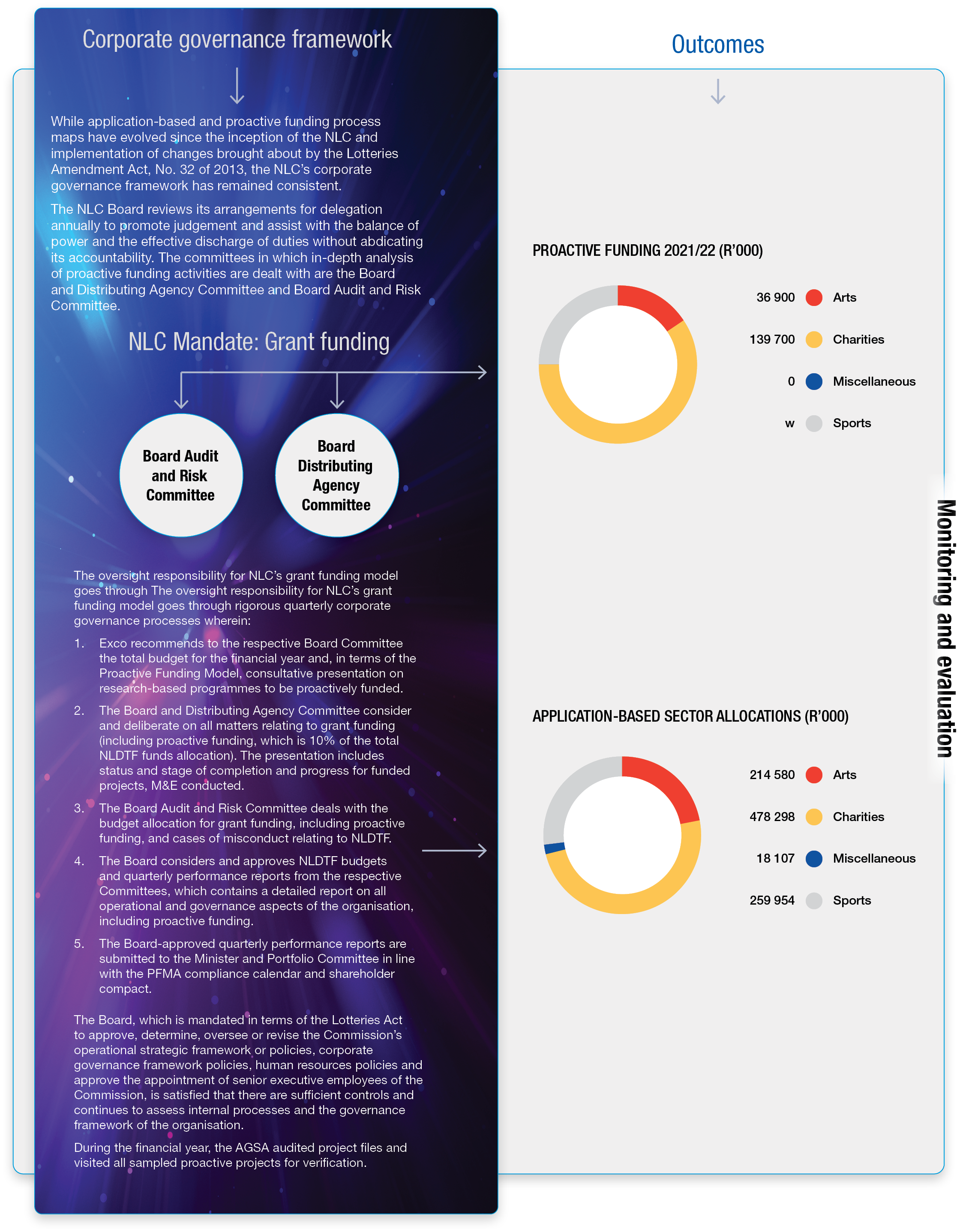
The oversight responsibility for NLC’s grant funding model goes through rigorous corporate governance processes. |

|
We continued to enhance the experience of applicants and beneficiaries by improving the operational efficiencies throughout the grant funding process to make it easier and less burdensome to access grants. |

|
Beneficiary-centricity was not limited to the operational indicators of the beneficiary experience, but also extended, to the respect and humanity with which the NLC engaged applicants, grant holding organisations and communities at large. |

|
The review of the grant funding model was undertaken to determine how to streamline the funding process and eradicate unnecessary bureaucracy in the system. Notwithstanding legislative impediments to improvements, the identified changes were aligned to ensure efficiency. The new financial period will herald the implementation of the enhanced model. |

|
The NLC values service excellence and is constantly innovating to provide the best possible grantmaking solutions. During the year, the revised grant funding model was approved by the Board. |
The Grant Funding Department is responsible for ensuring that grants are administered efficiently and economically. Like many international development agencies, public sector organisations, and grant-making organisations across the globe, the NLC currently finds itself in a place where it is required to do more with less, as demand for funding outstrips what is available.
In the context of the NLC, the organisation has noted a decline in revenue from the National Lottery Operator. This required a much more systematic and considered approach to grant-making. The NLC also enhanced beneficiaries’ experience by improving the operational efficiency of the NLC, making it easier and less burdensome to access grants. Beneficiary-centricity was not limited only to the operational indicators of the beneficiary experience, but also extended to the respect and humanity with which the NLC engaged applicants, grant holding organisations and communities at large.
Activities
The funding of grants to good causes is the second mandate of the NLC and includes:
Funding for impact
For some time, the revenue received from the Operator has been stagnant while the number of NPOs has grown considerably since 2010. In response, we have revised the underpinning philosophy of our funding model to be based on funding for impact. This calls for a more systematic and deliberate approach to grantmaking that enables the NLC to fund more effectively.
It is the provision of funding to targeted projects and programmes that are catalytic in nature and lead to measurable, positive social change and community upliftment
Pursuing beneficiary-centricity
Apart from developing a better understanding of local needs, the NLC is committed to optimising beneficiary support. To achieve impact in funding organisational capabilities such as a programmatic approach, as well as results-based management, are being developed. A programme approach recognises that development takes place through interconnected actions within a specified geographical location. It further recognises that there may be multiple needs that are often better addressed by numerous actors.
Development is not a linear occurrence but a cross-pollination of multivariate factors coalescing to produce the desired change. A programme approach is better positioned to impact various socioeconomic and political factors, which produce a “defective” social system in a specific environment. Adopting a programming approach goes some way in unearthing the underlying factors that enable the social conditions that grant funding aims to address.
The conceptual relationship between funding for impact and beneficiary-centricity is a causal one. Beneficiary centricity is one of the critical interventions that, if undertaken successfully, will enable more impactful funding in the context of the NLC. Therefore, beneficiary-centricity is one of the strategic and operational capabilities that the NLC should develop to achieve impact in funding. The NLC’s vision is to be a catalyst for social upliftment with a brand promise of changing lives.
The broad societal impact that we aim to achieve extends beyond financially sustaining the organisations that we fund to changing the lives of the beneficiaries that benefit from our funding, as well as the communities in which they live.
Proactive funding
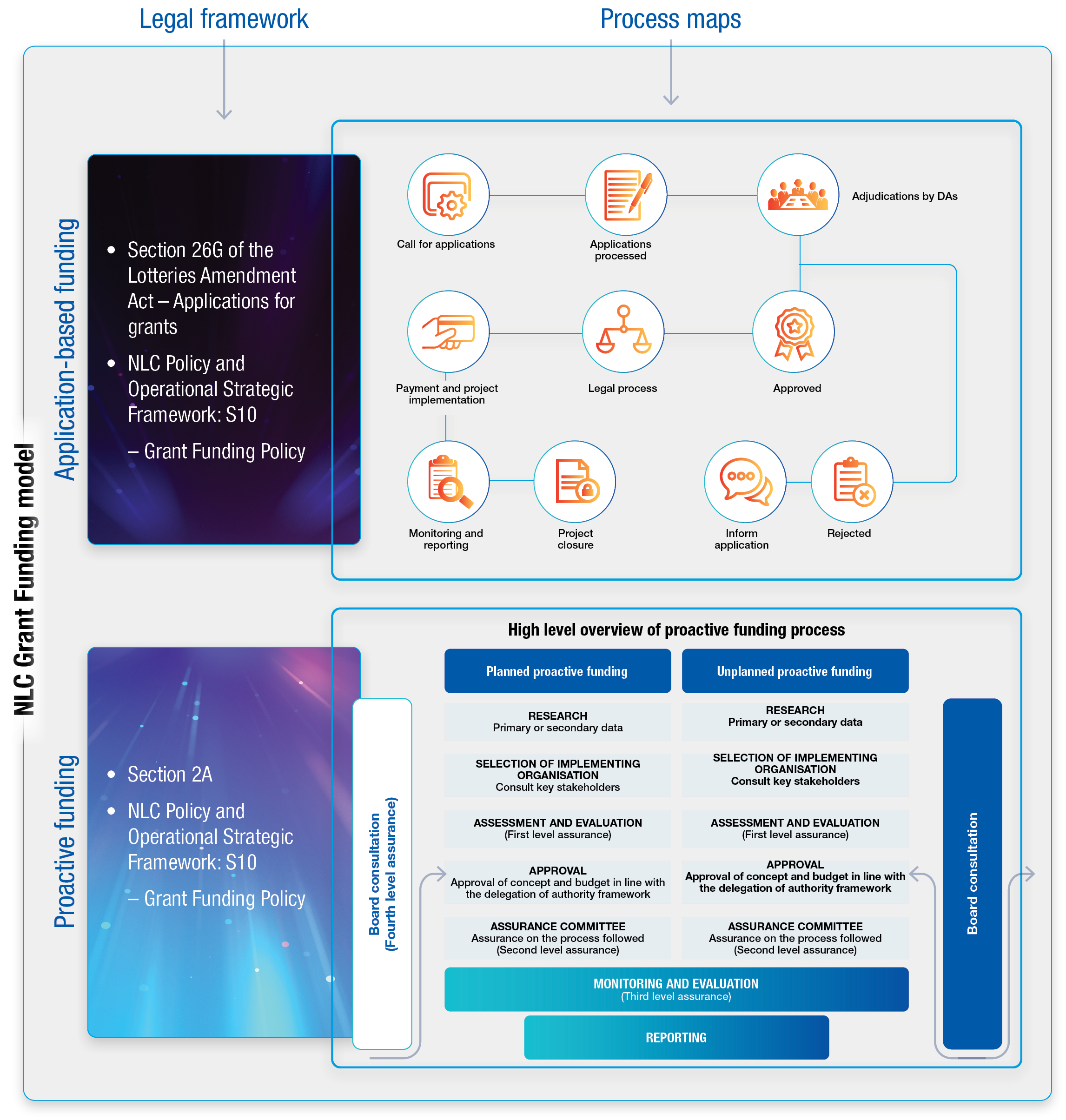
One of the strategies introduced to address the shortcomings in priority areas, in general, is the introduction of the funding model, which aims to respond to social problems and opportunities through a strategic and evidence-based mixed funding model. The amended legislation made provision for proactive funding (research-based funding), which can emanate from three sources: the Minister, the Board, or the Commission. The NLC has already successfully implemented several proactive funding projects.
Education and awareness
Education and awareness constitute a critical component in the NLC’s strategy to empower beneficiaries holistically. The programme’s primary aim is to develop informational measures to educate the public about lotteries and provisions of the Lotteries Amendment Act, No. 32 of 2013 and explain the process, requirements, and qualifications for grants.
Stakeholder engagements
The overall objectives of stakeholder engagement include:
- Understanding stakeholder realities and challenges to enable the NLC to improve the service delivery of its mandate.
- Educating the NLC’s stakeholders regarding its regulatory mandate and funding good causes aligned with the government priorities of poverty alleviation and job creation.
- Encouraging and ensuring beneficiaries’ sustainability by facilitating effective corporate governance, as well as the development and implementation of norms and standards for funding for the NLC’s beneficiaries.
- Ensuring beneficiaries uphold effective risk management and fraud prevention.
- Continuing to recognise beneficiaries complying with corporate governance through beneficiary awards.

OVERVIEW OF THE GRANT FUNDING MODEL
During the 2021/2022 financial year, we continued to enhance the experience of applicants and beneficiaries by improving the operational efficiencies throughout the grant funding with the aim of making it easier and less burdensome to access grants. Beneficiary centricity was not limited only to the operational indicators of the beneficiary experience, but also extended to the respect and humanity with which the NLC engaged applicants, grant holding organisations and communities at large.