
NLC corporate governance framework
The NLC’s corporate governance framework embodies the Lotteries Act No. 57 of 1997 as amended, the PFMA, principles contained in the Companies Act and King IV code, as well as best practice processes and systems that enable the Commission to meet corporate governance expectations, as well as provide direction and control while supporting accountability.
The Minister of Trade and Industry, in his capacity as the Executive Authority of the NLC, exercises oversight in accordance with provisions of the PFMA. The NLC complied with all reporting requirements of the PFMA and Treasury Regulations Compliance Schedule through the submission of quarterly reports, management accounts, income and expenditure statements with projections, the AFS, budget of estimated revenue and expenditure, strategic and annual performance plans, a fraud prevention plan and a risk management plan within the stipulated periods as indicated under the PFMA and Treasury Regulations Compliance Schedule.
Parliament, through the Portfolio Committee on Trade and Industry (Portfolio Committee), exercises oversight of the service delivery performance and commitments made in terms of the NLC’s strategy and APP. There were no engagements with the Portfolio Committee during they year under review. The NLC continued to respond to Parliamentary Questions.
The Board Charter
The Board Charter was reviewed in March 2021 with an effective date of 1 April 2021. The Board Charter guides the Board with respect to their functions, powers and responsibilities. The comprehensiveness and effectiveness of the Charter was put to the test in the current financial year when the term of office of the Chairperson came to an end on 30 November 2020. In the absence of a Chairperson, the Board continued to navigate its activities through election of one of its own members present at meetings to preside over Board meetings.
Overview of the Board’s statutory duties
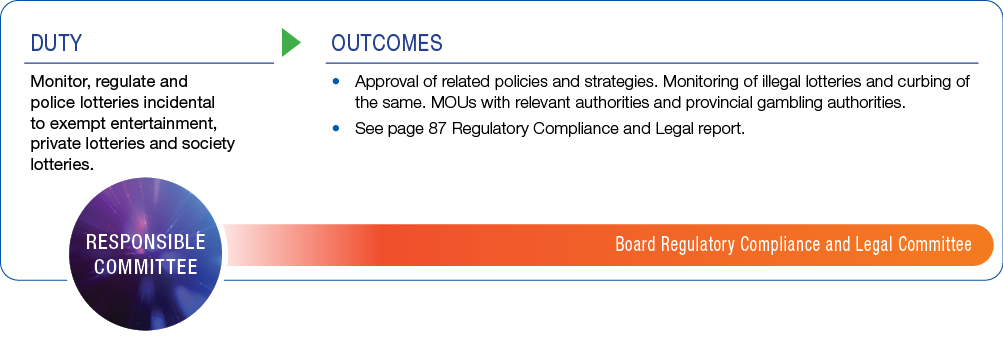
Over and above the responsibility for setting the strategic direction of the NLC, finance and performance objectives, the Board has applied the principles of openness and transparency in fulfilling its statutory duties to:
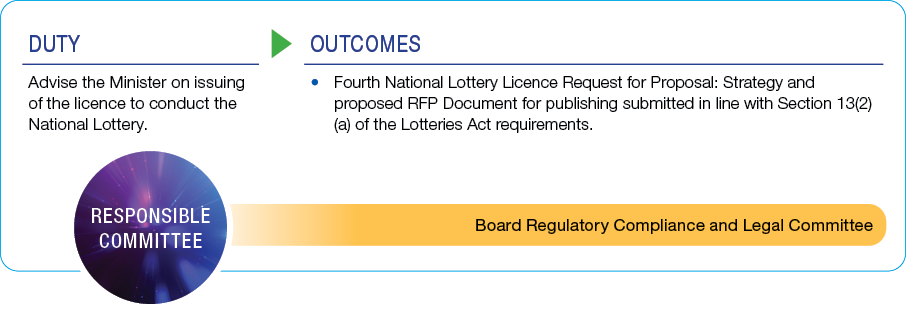
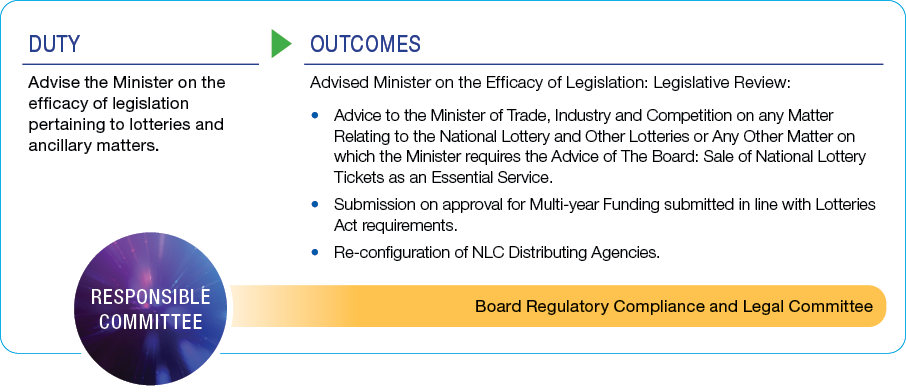
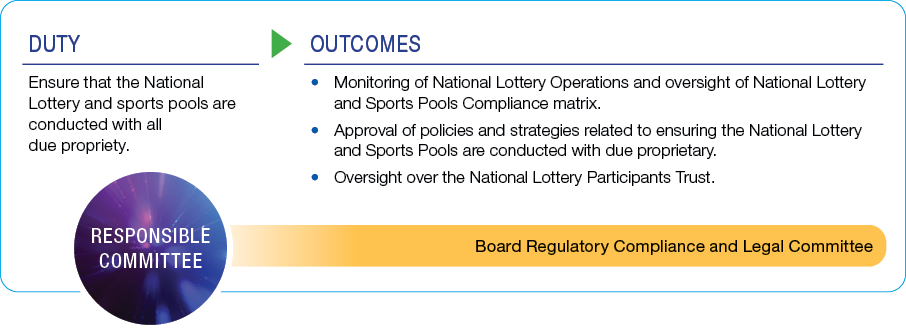
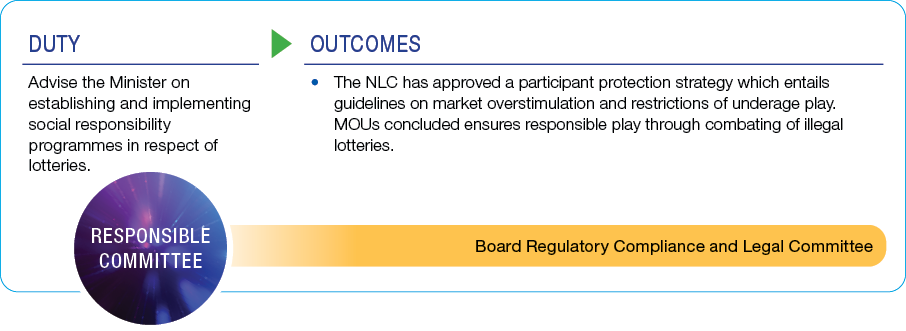
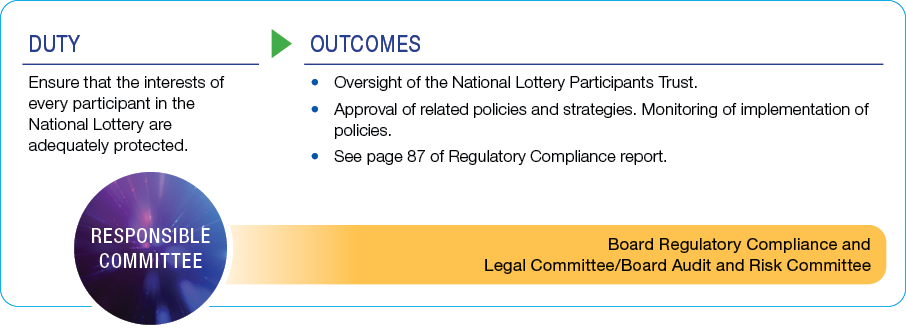
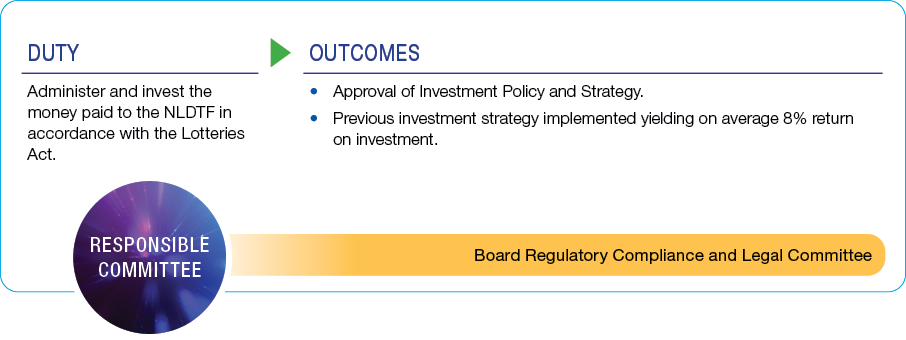
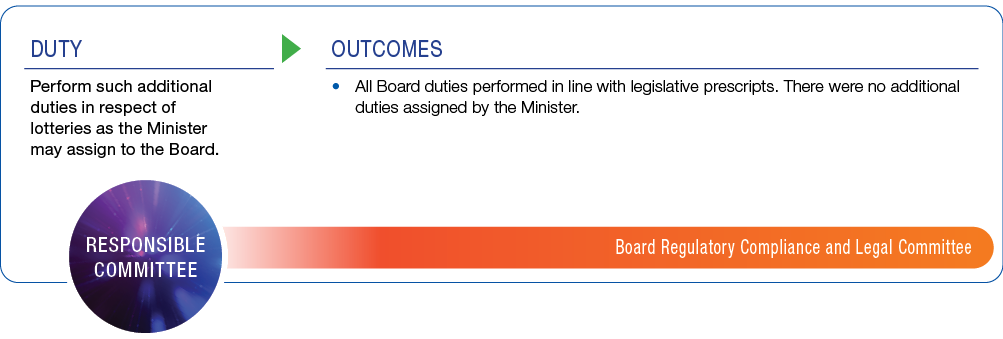
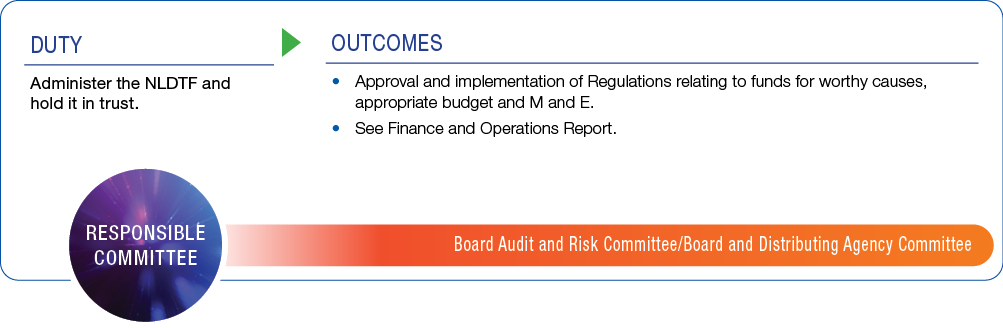


Board appointments
All Non-executive Board members are appointed by the Minister of Trade and Industry, in accordance with section 3 of the Lotteries Act as amended. The Minister appoints a Chairperson, who shall be a person with relevant knowledge or experience with regard to matters connected with the functions of the Board. Furthermore, one member designated by the Minister and not more than five members who have proven business acumen or applicable knowledge or experience with regard to matters connected with the functions of the Board, and of whom at least one should be a legal practitioner admitted to practice in the Republic and at least one a chartered accountant in the Republic. The Lotteries Act further stipulates that at least four members shall be persons who are not in the service of any sphere of government. The Board currently has two vacant positions. The NLC welcomed four Board members on 26 March 2022.
The Commissioner is an ex-officio member of the Board and is a member of the IoDSA. The approved organisational succession plan continued to be implemented and monitored during the year under review.
Independence
All Non-executive Board members are considered to be independent as they have no material interest in the NLC, the National Lottery Operator, beneficiaries or suppliers. Members are required to complete an annual disclosure of interest and required to disclose interest at every meeting to ensure that circumstances that may give rise to a conflict of interest are managed and monitored effectively.
There were no conflicts of interest identified during the reporting period.
Board induction and continuous development
Board development sessions were convened during the year to ensure that all Board members are appraised on the functions of the Board and operations of the NLC. The continuous development programmes aimed at enhancing the skill of the collective Board and assist the Board in its strategic focus and that of the NLC were rolled out quarterly.
The Board is satisfied that the arrangements in place for accessing professional corporate governance services are effective as members are subscribed to the Corporate Governance Body of Knowledge® and are full members of the IoDSA, the South African Institute of Chartered Accountants, Law Society of South Africa and The Public Sector Committee Forum.
Governance structure
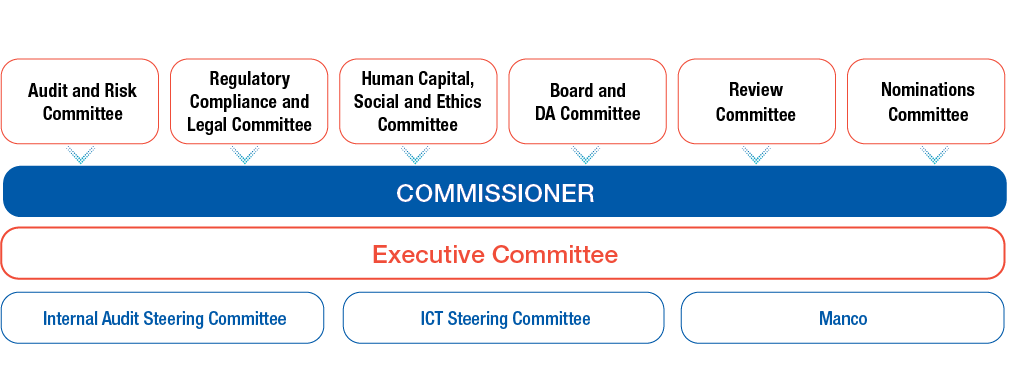
The Board reviewed its approach and arrangements for delegation to promote independent judgement and assist with the balance of power and the effective discharge of duties without abdicating its accountability. Delegation arrangements were in accordance with the Lotteries Act, as amended, which stipulates that the Board may appoint committees to assist it in efficiently and effectively performing its functions and exercising its powers. Committees consist of such members of the Board as the Board may designate, with the Board appointing the Chairperson of every committee. Every committee performs its functions in accordance with the provisions of this Act and such directives of the Board that are not in conflict with such requirements. Any delegated function so performed shall be deemed to have been performed by the Board.
As such, the Board comprised six committees, which included two statutory committees and five standing committees as depicted below:
Board evaluation and effectiveness
The independent Board and Board Committee effectiveness for the year under review is underway. The outcomes and recommendations from the review will be considered for implementation by the Board.
Company Secretary
The Board reviewed and were satisfied that the skills, competence and experience of the Company Secretary adequately support the performance of the required duties of the Board and that the office of the Company Secretary is empowered, with the position carrying the necessary authority. The Company Secretary is not a member of the Board and has unfettered access to the Board while maintaining an arm’s-length relationship with the Board and its members. As at 31 March 2022, the Board comprised of six members. In terms of Board Charter, the Board must meet at least four times a year. The table below shows meeting attendance during the financial year ended 31 March 2022.
| Board member | Role | Quarterly meetings |
|---|---|---|
| Ms A Brown* | Member | 16/26 |
| Ms DLT Dondur | Member | 21/26 |
| Prof YN Gordhan | Member | 19/26 |
| Adv WE Huma@ | Member | 2/26 |
| Dr MA Madzivhandila% | Member | 19/26 |
| Ms B Ferguson | Member | 2/26 |
| Dr CR Lubisi | Member | 1/26 |
| Ms PK Mvulane | Member | 2/26 |
| Mr W Hofmeyr | Member | 2/26 |
@ Resigned October 2022
% Departed February 2022
Meetings included:
- Statutory Meetings
- Special Board Meeting (AFS Approval, National Lottery Matters and Urgent Reports)
- NLC and Ithuba RF (Pty) Ltd Joint Boards meetings
- Board Strategy Sessions
- Board Risk Workshop
Review Committee
Overview
The Review Committee is established in terms of Section 26H of the Lotteries Act. The Committee is chaired by the Chairperson of the NLC Board and reviews decisions of the Distributing Agency concerning applications for grants, only on application by an aggrieved applicant in the manner prescribed: Provided that such review shall be adjudicated by a Board Committee set up for such purpose without delay.
If the Board overrules the decision of the Distributing Agency, the Board may either order the Distributing Agency to re-evaluate the application, taking into consideration matters raised by the Board or set aside the decision of the Distributing Agency and substitute it with an order the Board deems appropriate.
Outcomes
During the year under review, the Board Review Committee considered a total of 381 review applications.
| BRC outcomes | Charities | Sport | Arts, culture and national heritage | Miscellaneous purposes | Covid-19 | Total | Total amount allocated by the BRC |
|---|---|---|---|---|---|---|---|
| 7 | 20 | 2 | 1 | ||||
| Reviewed DA decision | R6 019 466 | R4 190 080 | R3 527 222 | – | R58 000 | 30 (8%) | R11 094 768 |
| Referred back to the DA | 1 | 1 | 1 | – | – | 3 (1%) | – |
| Upheld DA decision | 169 | 16 | 146 | 16 | 1 | 348 (91%) | – |
| Total | 177 | 37 | 149 | 16 | 2 | 381 | R11 094 768 |
The number of review applications upheld demonstrates consistency and fairness in the application of regulations relating to applications for grants, related policies and guidelines by the DAs.
Membership and attendance
The Board Review Committee comprises of six members, including the chairperson. The table below shows meeting attendance during the financial year ended 31 March 2022.
| Committee member | Role | Meetings |
|---|---|---|
| Ms A Brown* | Member | 7/8 |
| Ms DLT Dondur | Member | 8/8 |
| Prof YN Gordhan | Member | 8/8 |
| Adv WE Huma@ | Member | 1/8 |
| Dr MA Madzivhandila% | Member | 5/8 |
| Ms B Ferguson | Member | 1/8 |
| Dr CR Lubisi | Member | 0/8 |
| Ms PK Mvulane | Member | 1/8 |
| Mr W Hofmeyr | Member | 1/8 |
@ Resigned October 2022
% Departed February 2022
BOARD AND DISTRIBUTING AGENCY COMMITTEE
Overview
The Lotteries Act, as amended, stipulates that Chairpersons of the DAs may only attend meetings of the Board per invitation or if matters relating to the adjudication of applications for grants or distribution of grants are to be discussed.
In view of provisions stipulated in section 3(1)(d) of the Lotteries Act and the nature of matters for discussions, the Board and DA Committee was constituted to deal with DA matters relating to the adjudication of applications for grants and the operations of the DAs as matters relating to the grant funding mandate of the NLC.
The Committee considered the funding priority areas for the ensuing year. It provided oversight of activities of the Operations Division, particularly the number of grant applications received, performance against legislated timeframes, M and E methodology and outcomes and funding implemented under Section 2A of the Lotteries Act (please see page 99 for more information).
Outcomes
During their engagements, the Committee reviewed its Charter and policy framework. The Committee’s oversight over the Operations Division and Distributing Agencies ensured NLC’s strategic objectives and related outcomes were achieved. The Committee continues to ensure the efficient and effective performance of the NLC through the Operations Division as well as ensure the fair and equitable distribution of funds through independent and objective adjudication.
The Committee noted negative media reports as a result of the identified risk of conflicting beneficiaries and well as misunderstanding of the Proactive Funding model. The NLC’s funding model as ensured that the NLC fulfils its mandate of equitable distribution and addressed identified priorities in our communities. (Refer to Operations Report and Performance highlights)
The Committee was satisfied that it had performed all the functions required by its mandate and approved work plan.
Membership and attendance
The Board and Distributing Agency Committee comprises of four members and the Chairpersons of the Distributing Agency. The table below shows meeting attendance during the financial year ended 31 March 2022.
| Committee member | Role | Meetings |
|---|---|---|
| Ms A Brown* | Member | 7/7 |
| Ms DLT Dondur | Member | 2/7 |
| Prof YN Gordhan | Member | 7/7 |
| Adv WE Huma@ | Member | 2/7 |
| Dr MA Madzivhandila% | Member | 1/7 |
| Ms M Letoaba | Ex-Officio Member: Chairperson – ACNHDA | 6/7 |
| Mr T Ramagoma | Ex-Officio Member: Deputy Chairperson – ACNHDA | 5/7 |
| Ms NP Loyilane | Ex-Officio Member: Chairperson – CDA | 6/7 |
| Mr E Ncula | Ex-Officio Member: Chairperson – SRDA | 6/7 |
| Dr J Adams | Ex-Officio Member: Deputy Chairperson – SRDA | 6/7 |
| Mr J Du Preez | Ex-Officio Member: CDA | 2/7 |
| Ms C Mofet-Mubu | Ex-Officio Member: CDA | 4/7 |
@ Resigned October 2022
% Departed February 2022
During their engagements the Committee reviewed its Charter and policy framework. The Committee’s oversight over the Operations Division and Distributing Agencies ensured NLC’s strategic objectives and related outcomes were achieved (icons refer to Operations Report, Performance Highlights). The Committee continues to ensure the efficient and effectively performance of the NLC through the Operations Division as well as ensure the fair and equitable distribution of funds through independent and objective adjudication.
The Committee was satisfied that it had performed all the functions required by its mandate and approved work plan.
Regulatory Compliance and Legal Committee
Overview
The Regulatory Compliance and Legal Committee is a Committee charged with the duty to ensure that the Board advises the Minister on issuing the licence to conduct the National Lottery as well as ensure that the National Lottery and sports pools are conducted with all due propriety and strictly in accordance with the Constitution, the Lotteries Act, all other applicable law and the licence for the National Lottery together with any agreement pertaining to that licence. The Committee is also expected to provide assurance to the Board that the NLC is fulfilling its primary regulatory mandate, that is to ensure that the interests of every participant in the National Lottery are adequately protected.
Outcomes
The Board Regulatory Compliance Committee comprises of six members. In terms of Board Regulatory Compliance and Legal Charter, the Committee must meet at least four times a year. During the financial year ended 31 March 2022, Committee convened on five occasions.
Compliance with laws and regulations
The Board recognises the role that compliance with applicable regulatory requirements plays in the governance and sustainability of the Commission and undertakes to subscribe to fundamental principles to ensure compliance with relevant legislation. In discharging its duties of ensuring that the Commission complies with legislation, the Board has committed that the Commission shall conduct its business in accordance with applicable regulatory requirements and ensure that appropriate policies and frameworks are committed to, promoting a culture of compliance within the NLC. The Board Regulatory Compliance and Legal Committee is charged with a duty to ensure organisational compliance is maintained at an acceptable level and ensure that all instances of non-compliance are adequately followed up and resolved with sound and practical business recommendations.
Organisational compliance monitoring was conducted, whereby Act owners (divisional liaisons where the Act is applicable) provided controls and processes with which the NLC ensures compliance with the requirements of relevant acts. These controls and procedures were assessed for correctness and validity through corroboration of supporting documents such as reports, policies, matrices, etc., and through enquiry with the relevant Act owners.
Continuous monitoring of organisational compliance takes place every quarter and as determined by the organisational compliance and governance unit to ensure that the NLC maintains acceptable levels of compliance with these critical pieces of legislation.
Policies developed internally were also subjected to alignment by oversight committees, including the Board, to ensure that they do not conflict with laws and regulations relevant to the NLC. Organisational processes and operations were carried out in such a way as to ensure compliance with applicable legislation in the areas of grant funding, lotteries compliance and enforcement, human resources management, financial management, as well as information and communication technology.
There were no material or repeat regulatory penalties, sanctions or fines for non-compliance with statutory obligations, and there were no environmental regulator inspections conducted during the period.
The Committee was satisfied that the NLC has complied with primary legislation governing the public entity, which are the Lotteries Act, as amended, and the PFMA. Other applicable laws and regulations were complied with during the year under review.
Membership and attendance
The Committee comprises five members. In terms of the Board Regulatory Compliance and Legal Charter, the Committee must meet at least four times a year. The table below shows meeting attendance during the financial year ended 31 March 2022.
| Board member | Role | Meetings |
|---|---|---|
| Ms A Brown* | Member | 5/5 |
| Ms DLT Dondur | Member | 5/5 |
| Prof YN Gordhan | Member | 5/5 |
| Adv WE Huma@ | Member | 1/5 |
| Dr MA Madzivhandila% | Member | 3/5 |
@ Resigned October 2022
% Departed February 2022
BOARD HUMAN CAPITAL, SOCIAL AND ETHICS COMMITTEE
Overview
The Board Human Capital, Social and Ethics Committee is constituted to ensure that the NLC has a clearly articulated recruitment and remuneration philosophy and the design and implementation of remuneration structures that are market-related, consistent, fair, legally compliant and equitable and the Board fulfils functions relating to its social and ethical environment, transformation objectives and employment equity as contemplated in relevant legislation and best practice.
Outcomes
Click here to see our human capital discussion and the remuneration report to follow.
Membership and attendance
The Board Human Capital, Social and Ethics Committee comprises of four members, including the chairperson.
In terms of Board Charter, the Committee must meet at least four a year. The table below shows meeting attendance during the financial year ended 31 March 2022.
| Board member | Role | Quarterly |
|---|---|---|
| Dr MA Madzivhandila% | Chairperson | 10/15 |
| Ms DLT Dondur | Member | 2/15 |
| Prof YN Gordhan | Member | 15/15 |
| Adv WE Huma@ | Member | 15/15 |
% Departed February 2022
Board Human Capital, Social & Ethics Committee Meetings include Quarterly Meetings and Committee Policy Review Session.
DRIVING PERFORMANCE THROUGH REWARD
At the NLC, we are committed to ensuring good corporate governance and ethical leadership. We take our role in contributing to the prevention of financial crime seriously and believe in the transparent disclosure of our responsible remuneration policies and practices, as well as our approach to the responsible management of our tax affairs.
The challenges of unprecedented events over the last two years have significantly impacted our organisation and employees. However, we have made significant progress on our reward journey since the COVID-19 pandemic began. Furthermore, to ensure our reward strategy is fit-for-purpose and supports the delivery of our organisational objectives, we have listened to and sought feedback from our shareholder and broader stakeholder group.
Pleasingly, we are starting to see green shoots across our business, and we remain optimistic that we are gaining momentum in our recovery journey. Likewise, we seek to progress our employee value proposition. We strive to create an environment where our employees feel deeply connected and aligned with our purpose and vision. This is demonstrated by their relentless focus on delivering at every stage of our journey. We want our employees to feel empowered and motivated to be part of an organisation that rewards and recognises high performance.
OUR REMUNERATION COMMITTEE
“Creating and preserving value through aligned reward.”
Our reward roadmap outlines the NLC’s reward journey since 2014, including those areas that will be actioned in the next year and feedback on our engagements with stakeholders. Furthermore, the roadmap outlines the committees’ focus areas during 2022 and its forward-looking focus areas for 2023.

REMUNERATION POLICY
We manage our remuneration fairly, responsibly, and transparently. In addition, we strive to ensure that remuneration practices support the NLC’S strategic objectives, encourage value creation and preservation while protecting against value erosion, and advance the people agenda as an employer of choice as part of our long-term sustainability strategy.
We seek to align with the requirements of the King Report on Corporate Governance for South Africa, 2016 (King IV™)1.
Efforts toward alignment include:
- Implementing SOE’s guidelines on remuneration and incentives.
- Ensuring that the remuneration and incentive philosophy aligns with the shareholder compact to drive individual and organisational performance.
- Ensuring adherence to the DPE’s guidelines for the remuneration of executives, prescribed officers, and nonexecutive directors. Our remuneration policy has been submitted to the Dtic (Department of trade, industry and Competition) and our future-fit strategy will be finalised based on feedback from the Board.
- Addressing the alignment of the remuneration of managerial and bargaining unit employees.
Our reward philosophy underpins our strategy in supporting a high-performance culture that rewards engaged employees that make meaningful contributions to achieve the NLC’s purpose, vision, and values. Our core reward principles support the philosophy. Our reward elements are delivered through core financial remuneration elements and design principles.
NLC core reward principles:
- Internal equity
- External competitiveness
- Annual remuneration adjustments
- Reward for performance
REMUNERATION OBJECTIVES
Through our remuneration policy, we seek to achieve the following objectives:
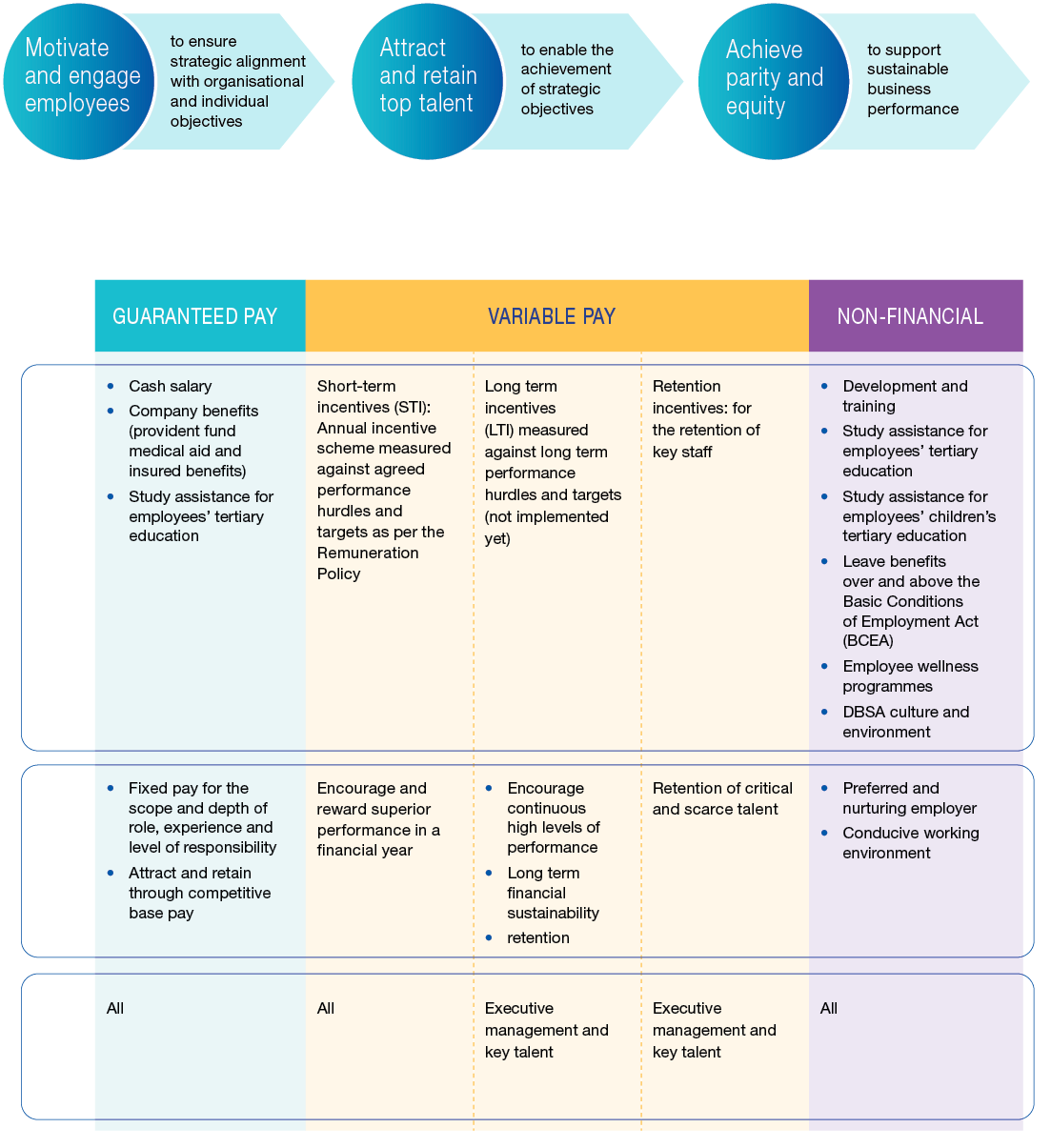
ALIGNING STRATEGY AND INCENTIVE STRUCTURES
Our strategy underpins the decisions taken in selecting our shortterm incentive with metrics to ensure that our pay arrangements support the delivery of the organisation’s strategy and the fulfilment of our potential for long-term sustainable growth.
NLC is subscribed to RemChannel's for benchmarked and salary survey.
REMUNERATION PHILOSOPHY FOR EXECUTIVES
Our remuneration policy’s structure for directors, executives, and other salaried employees reflects the different levels of responsibility and market practices. The essential difference is increased emphasis on incentives or variable performance-related pay in senior roles.
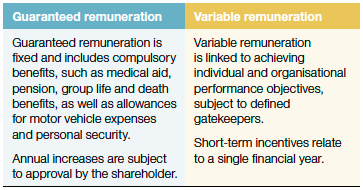
We aim to attract and retain executive management in a competitive market through fair and equitable remuneration. Furthermore, our approach to remuneration strives to reward performance that exceeds expectations and supports the achievement of organisational objectives. Executive remuneration is designed to demonstrate a clear relationship between performance and remuneration and comprises the following:
REMUNERATION ARRANGEMENTS FOR OTHER EMPLOYEES – BARGAINING UNIT
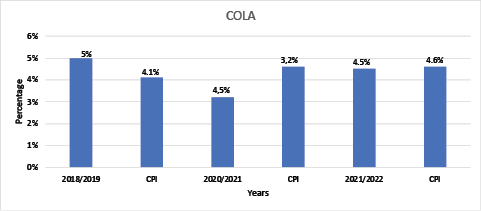
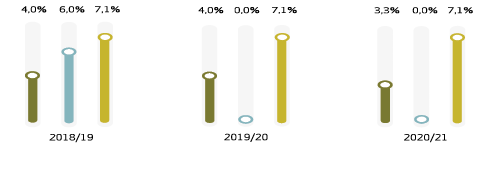
Increases for the bargaining unit are negotiated annually with NEHAWU, the recognised labour union, considering various internal and external factors such as affordability, market conditions, and benchmark information.
A total increase pool of 4.5% was agreed upon for the bargaining unit. Retrospective salary increases will apply for the 2020/21 financial year, with back-pay effective 1 April 2020 to 1 April 2021.
DRIVING EQUITY, DIVERSITY AND INCLUSION
We believe a diverse workforce representing the vibrant communities operate in promotes innovation and drives transformational growth. We are therefore committed to attracting and retaining a diverse workforce to serve our stakeholders.
The Employment Equity Act sets out the principle of equal pay for equal value, encouraging employers to make strides in addressing inequality in pay outcomes. The gender pay gap is one such matter to consider, with legislation being introduced in many countries worldwide, and South Africa, too, has taken steps to remedy the situation. We aim for balanced remuneration outcomes that are fair and responsible to all stakeholders, with a clear pay-for-performance link to remuneration outcomes and stakeholder value creation and preservation over the long term. The NLC seeks to offer similar benefits to all employees in the same professional levels of work. However, harmonisation may be gradual to account for the NLC’s financial situation and other such factors.
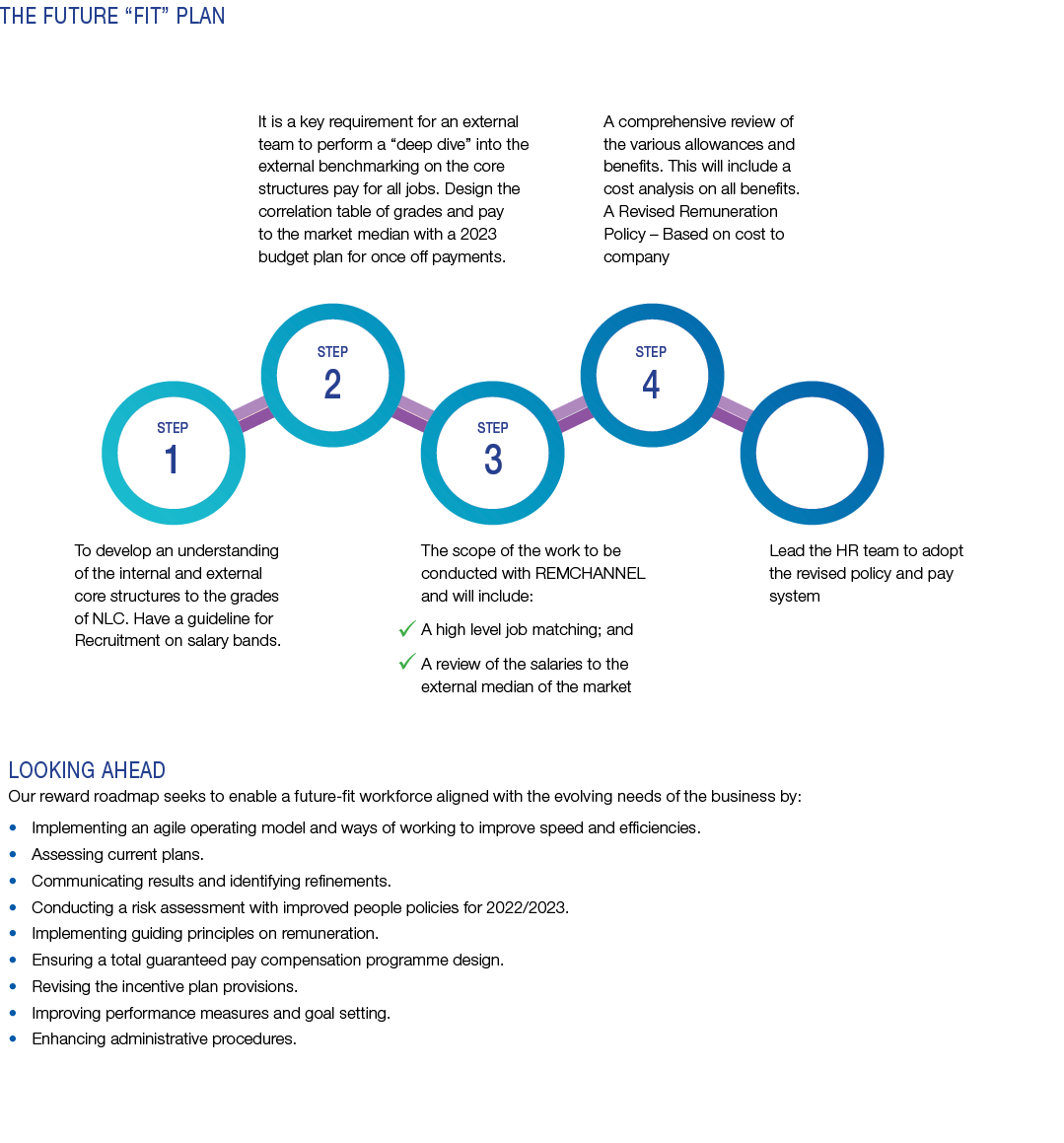
STRATEGIC OUTLOOK – FUTURE FOCUS AREAS
We want our people and reward strategy to be focused on building a future-fit workforce, culture, and people experience that enables the business to respond effectively to the needs of the organisation and its impact on the environment.
Ethics management
At the NLC, we aim to grow and preserve relationships of trust with our stakeholders by conducting our business ethically and protecting the public funds (received from the Operator and distributed to NPOs for good causes) against fraud and corruption. We believe that leadership based on ethical foundations results in a culture of ethical and moral behaviour and compliance with laws, rules, codes and standards. The Board exercised its responsibility to establish and maintain a culture of honesty, transparency, fairness, responsibility and accountability to position the NLC as regulator and funder of choice. Our internal stakeholders are guided by policies that facilitate ethical decision-making during the ordinary course of business. The offering of favours to gain unfair commercial advantages is strictly prohibited.
The composition of the Human Capital, Social and Ethics Committee is included on page 79 of the same report. The Committee meets quarterly and during the current financial year met as outlined above.
During the current financial year, the Committee focused on and monitored NLC’s activities with respect to several matters including workplace, employee wellness, environment, preferential procurement and B-BBEE.
Integrity in Action
A strong ethics programme grounded in our values is critical to ensuring we remain a responsible and ethical organisation. The NLC continues to be transparent about the challenges we face, how we learn from them and how we use them as an opportunity to improve and push ourselves to do better. This report sets out the efforts that have gone into building our NLC Ethics programme, raising awareness of it, monitoring it, and continuously maintaining and tailoring it, to ensure it is fully embedded into our organisation. Ensuring our programme is implemented in every office and business unit requires significant ongoing effort. By openly communicating on our programme, we hope we can contribute to the continued development and evolution of ethics programmes and the promotion of responsible business practices.
Ethics Management Framework:
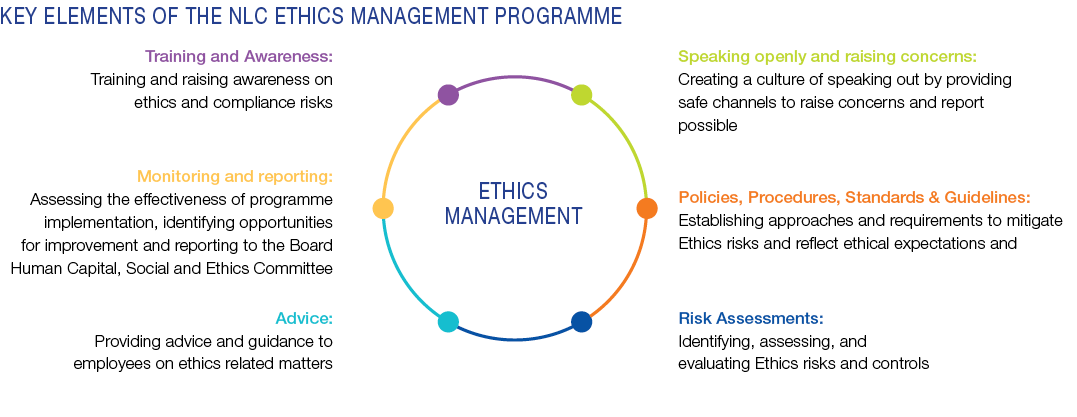
The NLC adopts the the Governance of Ethics Framework, as developed by The Ethics institution and endorsed by the Public Service Commission. The Ethics Office report focuses on the elements of the Governane of Ethics Framework. The NLC’s Ethics Programme includes risk assessments, policies, standards, procedures and guidelines, training and awareness, advice, monitoring, and reporting, as well creating platforms that encourage speaking openly on possible misconduct. The key elements of our Ethics Management programme establish a riskbased approach.
1. LEADERSHIP COMMITMENT AND GOVERNANCE STRUCTURES
The Board of the NLC is committed to integrity-based performance that protects and enhances the value and reputation of the National Lotteries Commission. The NLC is committed to achieving sustainable growth through the practice of good corporate governance, provision of excellent service and sound regulatory practice.
The Ethics Office provides a comprehensive report of its activities to the Commissioner, Exco, the Board Human Capital, Social & Ethics Committee on a quarterly basis. The reporting structure is aligned to the adopted Ethics Management framework.
2. INSTITUTIONALISATION OF ETHICS IN THE WORKPLACE
NLC employees are guided by the ethics and conduct policy and gift and donations policy (code). An abridged version of this is included in all supplier’s contract, grant agreements and the National Lottery operator licence. These stakeholders are expected to abide by the same level of ethics.
The NLC code is available on the NLC intranet for all employees to access. The ethics office rolled out quarterly organisational ethics interventions and subsequently considered - findings or outcomes of these initiatives. The code is currently under review by the Board. In the coming - financial year, the NLC will continue implementing its ethics strategy, which will be aligned with the NLC sustainable business strategy. All divisions and business units attended organisation-wide interventions with the themes indicated below:
-
Living Our Values
The value activation campaign is aligned to prominent days of the calendar; where events of significance aligning to each of the five values of the NLC, are used to launch each value activation. The campaign seeks individual understating of each employee of the NLC of its value system. Employees were invited to interactive sessions. These sessions maximum participation from staff maximised participation in the campaign through dialog and questions and answers sessions. An independent and external service provider was sought to facilitate these sessions with the aim of creating a platform that is not bias, and independent. -
Diversity in the workplace
The Ethics Office and the NLC advocates for an environment that is free from discrimination based on gender, race, sexuality, etc, in its Ethics and Conduct Policy. Staff were reminded to familiarise themselves with the policy to ensure that they understand the NLC’s expectations when it comes to ethical conduct. The intervention was rolled out during women’s month as part of the commemoration country wide. -
Ethics of Mental Health in the Workplace: Mental Health Awareness Conference
Pursuant to the Commisions statutory obligations to promote public knowledge and awareness by, amongst others developing and implementing educational and informational measures to educate the public about the lotteries and educating the public by explaining the process, requirements and qualifications relating to the application for grants in terms the Act, the Division continued with its values awareness programme and focused on the Ethics of Mental Health in the workplace, in observance of Mental Health Month. The conference was dedicated to creating awareness around Mental Health and the Ethics Office took it upon itself to educate staff and its external stakeholders about mental health in the workplace to reduce the stigma and discrimination that people with mental health issues are subjected to. This intervention enabled staff and stakeholders to learn from mental health professionals and engage on issues relating to mental health. The intervention also assisted the Ethics Office in its quest to empower staff and stakeholders on the expectations and standards of ethical behaviour within the NLC pertaining to mental health issues, especially in the workplace. -
Quarterly Media Monitoring
As part of Ethics Risk Monitoring the Ethics Office has procured the services of Ethics Media monitoring services which will assist the Ethics Office as well as the Legal and Investigations Division to proactively respond to media reports. Quarterly Ethics Media Reports provide greater insight that centres on ethical or unethical criteria. The overall breakdown was that 66% of the coverage was ethical and 34% was unethical. This is a sound outcome, and an improvement relative to the previous year. (In the annual period from 1 April 2020 to 31 March 2021, 40% of the coverage was ethical and 60% was unethical.) -
A Respectful Working Environment
This was a landmark session where different experts from different areas of business were invited to a panel discussion and discussing pertinent workplace dynamics such as, sexual harassment in the workplace, bullying in the workplace, tribalism in the workplace, equality, and discrimination in the workplace. The Ethics Office continued with the publication relating to the event NLC Social Media platforms and through paid partnership with the Sunday World featuring various articles covering the theme of the event. National Lotteries.
3. DECLARATIONS OF INTEREST
During the 2021/22 financial year, all Board members and employees lodged their disclosures of interest. The disclosures were assessed internally by the Ethics Office and subsequently sent for external verification by an external service provider. No material conflicts of interest were identified.
Internal and External Stakeholder Vetting
Grant Funding Applicants
During the 2021/22 financial year, the Ethics Office reported on the assessment of Conflict of Interest conducted for the Grant Funding division. The purpose of this assessment was to provide feedback on conflict-of-interest assessment for funding applications submitted. The NLC is always committed to conducting business ethically and thereby ensuring fairness and transparency.
The NLC Conflict of Interest Barometer is used to get a conflict-of-interest score for respective applicants. The score then determines the COI category under which an applicant falls. Where an organisations conflict-of-interest score is 16 or greater, the application is referred for external review. On external review, the applicant’s information is verified against the following databases:
- Companies and Intellectual Property Commission.
- CSD registration verification.
- 2 x Company Credit verification at different Credit Bureaus.
- Separate bank account verification (where needed).
- Regulatory bodies (if applicable).
- Deeds Office (if applicable).
The score is determined by the following two factors:
1. Association with an employee of the Commission
2. Association with any other organisation that has received or applied to receive funding from the Commission.
Conflict of Interest Status for Grant Funding Applicants
| No/Potential Conflict of Interest or Circumstance/Duty |
Managed Conflict of Interest or Circumstance/Duty |
Fundamental Conflict of Interest or Circumstance/Duty |
|---|---|---|
| 98% | 2% | 0% |
| Assessment concluded; no further assessment required. |
Refer for External Assessment with Vetting Agency. |
Refer to Legal for Investigation. |
| NLC continue to monitor compliance with Grant Agreement. |
Supplier Vetting
During the current financial year, the Ethics Office conducted vetting of suppliers who submitted proposals for business, from the SCM office. Our independent external service provider conducted the vetting and provided reports which were advanced from the SCM office. Feedback in terms of reports was shared with Supply Chain Management unit with findings and recommendations.
Staff Vetting
During the FY2021/22 a total of 280 employees out of a total of 304 had disclosed their interests on the MyDisclosure system. This represents 92% compliance with the Ethics and Conduct Policy. Employee files of the 8% non-compliant members of staff were submitted to HCM for sanctions in line with relevant policy. The following internal assessment, all staff declarations received by the Ethics Office were referred for external verification.
The Ethics Office continues to ensure that the vetting process becomes an ongoing process to address and manage the risk of conflict of interest that the NLC may be exposed to.
STRATEGIC CONSIDERATIONS
While the NLC continues to be a catalyst for social upliftment – our commitment to running an organisation that is rooted in ethics and integrity will never change. The introduction of our internal and external vetting process is yet another way we continue to ensure that we uphold the highest ethical standards. In the coming financial year, the NLC is embarking on an exciting Integrity Enhancement Programme for external and internal stakeholders. This programme will see the enhancement of our vetting processes and includes integrity testing for staff, management and board and a Corporate Governance Development Programme for our beneficiaries.
The NLC employees are guided by the ethics and conduct policy and gift and donations policy (code). An abridged version of this is included in all suppliers’ contracts, grant agreements and the National Lottery Operator licence. These stakeholders are expected to abide by the same level of ethics. The NLC code is available on the NLC intranet for all employees to access.
The ethics office rolled out quarterly organisational ethics interventions and subsequently considered findings or outcomes of these initiatives. The code was reviewed and approved by the Board during March 2021. In the coming financial year, the NLC will continue implementing its ethics strategy, which will be aligned with the NLC sustainable business strategy. The NLC did not incur any fines during the year.
All divisions and business units attended organisation-wide interventions, and interventions utilised the themes indicated below.
In the case that a Distributing Agency member being an employee or serving on the Board or equivalent governing body of an applicant for NLDTF, the application from that applicant will be referred to another DA for adjudication. The table of interests declared by the respective Distributing Agency members is indicated here.
In the period under review, Board members and employees lodged their disclosures of interest, and no material conflicts of interest were identified.
Gift declarations
In terms of the donations policy, employees are required to electronically disclose all gifts received from suppliers, from any person who received a grant or intends to apply or has applied in terms of section 13, for a licence to conduct the National Lottery. The ethics office recorded a total of 15 gifts during the period.
Health, safety and environmental issues
The NLC places the utmost importance on the health and safety of its employees and the public. The Committee was satisfied with the assurance of the compliance division and internal audit that the Commission complied with all the applicable health, safety and environmental laws and regulations. A building condition survey, which included fire rationale and detection, electrical networks reticulation, ceiling condition, internal and external air quality testing, air-conditioning/HVAC condition and hydrocarbon testing, as well as water quality sampling was undertaken to evaluate the compliance of NLC head office.
To comply with the provisions of the Occupational Health and Safety (OHS) Act to provide for the health and safety of personnel, visitors, consultants and contractors, the NLC has an approved OHS policy and OHS implementation plan. An OHS Committee was appointed in line with the Act to monitor and foster compliance on health and safety issues and recommend appropriate steps to be taken to address risks and threats. Adherence to the Act has been monitored through a compliance register and risk register, which are presented to the Board periodically.
Energy-saving, light switching systems were successfully installed. The Board approved the acquisition of provincial office accommodation, and the Committee is looking forward to the green initiatives that will emanate from these acquisitions. During the period under review, there were no fatalities, and eight minor injuries were recorded. The NLC has appointed Safety, Health and Environment (SHE) representatives, of which 100% attended SHE representative functions training.
Social responsibility
The NLC’s core objectives speak to the promotion of social upliftment. Social responsibility is therefore an inherent part of the NLC’s daily activities. Furthermore, in support of being catalysts for social upliftment, employees voluntarily donated and participated in several initiatives driven by the office of the Commissioner.
BROAD–BASED BLACK ECONOMIC EMPOWERMENT
During the current financial year, the Committee focused on and monitored NLC’s activities with respect to several matters including workplace, employee wellness, environment, preferential procurement and B-BBEE. Information pertaining to the , Transformation and Skills, is elaborated here.
BOARD NOMINATIONS COMMITTEE
Overview
The Board Nominations Committee was established to ensure that the Board comprise of the appropriate balance of knowledge, skills, experience, diversity and independence for it to discharge its governance role and responsibility objectively and independently.
Outcomes
The Committee developed the Board’s code of conduct as well as code of ethics policies to enhance ethical leadership within the organisation. An independent Board skills review was commissioned, and the process of enhancement of the Board’s skills and capacity initiated.
Membership and attendance
The Board Nominations Committee comprises of five members, including the chairperson. In terms of Committee Charter, the Board must meet at least twice a year. During the financial year ended 31 March 2022, the Committee convened on three (3) occasions. The table below shows the attendance of these meetings.
| Board member | Role | Meetings |
|---|---|---|
| Ms A Brown* | Member | 3/3 |
| Ms DLT Dondur | Member | 3/3 |
| Prof YN Gordhan | Member | 3/3 |
| Adv WE Huma@ | Member | 1/3 |
| Dr MA Madzivhandila% | Member | 2/3 |
@ Resigned October 2022
% Departed February 2022
BOARD AUDIT AND RISK COMMITTEE
The Audit and Risk Committee (“the Committee”) is established as an independent statutory committee in terms of the PFMA. The Committee functions within approved terms of reference and complies with relevant legislation, regulation and governance codes.
The Committee submits this report for the financial year ended 31 March 2022, as required by Treasury Regulation 27.1.10 issued in terms of Sections 76(4)(d) and 77 of the PFMA.
REPORT OF THE AUDIT AND RISK COMMITTEE
The Audit and Risk Committee (“the Committee”) is established as an independent statutory committee in terms of the PFMA. The Committee functions within approved terms of reference and complies with relevant legislation, regulation and governance codes.
The Committee submits this report for the financial year ended 31 March 2022, as required by Treasury Regulation 27.1.10 issued in terms of Sections 76(4)(d) and 77 of the PFMA.
Audit and Risk Committee Membership
The Committee consists of three Independent Members and was chaired by Ms Doris Dondur.
The audit committee comprises four members, including the chair, Ms Doris Dondur. In terms of section 77(b) of the PFMA, the audit committee must meet at least twice a year. The Committee Charter makes provision for a minimum of four meetings per year. During the financial year ended 31 March 2022, the audit committee met on twenty-nine (29) occasions. The table below shows the attendance of these meetings.
Audit And Risk Committee Responsibility
The Audit and Risk Committee reports that it is satisfied that it has complied with its responsibilities as outlined in Sections 76(4)(d) and 77 of the PFMA and Treasury Regulation 27.1.10. The Committee also reports that it has adopted and reviewed formal terms of reference as its Audit Committee charter and has discharged all its responsibilities as contained therein. The table below shows meeting attendance during the financial year ended 31 March 2022.
| Committee member | Role | Qualifications | Meetings |
|---|---|---|---|
| Ms DLT Dondur | Chairperson | See page 57 | 29/29 |
| Prof YN Gordhan | Member | See page 58 | 29/29 |
| Adv WE Huma@ | Member | See page 58 | 2/29 |
| Dr MA Madzivhandila% | Member | See page 57 | 24/29 |
| Ms K Singh | Representative from the dti | B.Comt (Hons), CTA (Certificate of theory in Accounting), CIA (Certified Internal Auditor – through IIA Global), Post-graduate Diploma in Executive Development |
0/29 |
| Mr D Kekana | Representative from the dti | Bcom
degree Certified Information Systems auditor (CISA) |
2/29 |
| Ms A Brown (By invitation) | Board Member | Certified Ethical Hacker Computer Hacking Forensics Investigator Appointment date: January 2019 |
4/2924/29 |
| Adv T Nevondwe (By invitation) | NLPT Chairperson | See page 92 | 29/29 |
| Ms T Ramuedzisi (By invitation) | NLPT Trustee | See page 92 | 29/29 |
@ Resigned October 2022
% Departed February 2022
Meetings include: :
- Special Meeting (AFS Approval, NLPT Workshop)
- Board Policy Review Session
- Investigation Reports
- Mainly 2021/2022 External Audit matters
A summary of the responsibilities discharged is as follows, with the detail of the specific sections after the summary:
| Task | Frequency | Status |
|---|---|---|
| Review Audit Committee charter and recommend to the Board for approval | Annually | Complies |
| Approve Audit Committee annual work plan | Annually | Complies |
| Agree process for assessment of performance of the Committee | Annually | Complies |
| Review the performance of the Committee and its members and report back to the Board | Annually | Complies |
| Insurance Review and Renewal | Annually | Complies |
| Consider proposed approach to summarised annual results and to the annual report | Annually | Complies |
| Review policies, estimates and assumptions to be used in financial statements | Annually | Complies |
| Approve Audited Annual Financial statements | Annually | Complies |
Overview of financial results YTD including:
|
Quarterly | Complies |
Updates on accounting and compliance matters, including:
|
Annually | Complies |
| Aproval of Annual Budgets | Annually | Complies |
| Approval of Annual Report | Annually | Complies |
| Review the actual revenue and expenditure of the quarter | Quarterly | Complies |
| Review the APP | Annually | Complies |
| Review of delegation of authority matrix | Annually | Complies |
| Note Financial Management Division’s Functional Strategy | Annually | Complies |
Approval of Policies
|
Annually | Complies |
| Review and approve the Internal Audit charter and recommend to the Board for approval | Annually | Complies |
| Approve the Internal Audit plan and resources | Annually | Complies |
| Evaluate the performance of the Internal Audit function and the requirement for an independent quality review | Annually | Complies |
| Consider the Internal Audit formal documented review of the design, implementation and effectiveness of the system of internal controls | Annually | Complies |
| Review whistle-blowers arrangements to enable employees and outside whistle-blowers to report, in confidence, their concerns | Quarterly | Complies |
| Note Internal Audit Functional Strategy | Annually | Complies |
| Review risk management strategy | Annually | Complies |
| Review combined assurance model, progress and risk reports | Quarterly | Complies |
| Note Risk Functional Strategy | Annually | Complies |
| Assessment of Risk Registers | Annually | Complies |
| Review of the ICT strategy | Annually | Complies |
| Review ICT Charter and Policies | Annually | Complies |
| Review of ICT internal control framework | Annually | Complies |
| Review of ICT business resilience arrangements for disaster recovery | Annually | Complies |
| Review of Information Security strategy and management system | Annually | Complies |
| ICT Quarterly Reports | Quarterly | Complies |
| Note ICT Division’s Functional Strategy | Annually | Complies |
| Consider legal and regulatory requirements to the extent that they may have an impact on the financial statements and annual report. | Annually | Complies |
| Review the effectiveness of the system for monitoring compliance and the results of management’s investigation and follow up of any instances of non-compliance | Annually | Complies |
| Review Compliance Risk Register | Annually | Complies |
| Approve the terms of engagement of the external auditor, including remuneration | Annually | Complies |
| Review and approve the annual external audit plan | Annually | Complies |
| External audit report feedback | Bi-annually | Complies |
| Assess the quality, effectiveness and performance of the external audit process | Annually | Complies |
| Review Auditors’ Report | Annually | Complies |
The effectiveness of internal controls
The PFMA requires the Accounting Authority to ensure that the organisation has and maintains effective, efficient and transparent systems of financial, risk management and internal control, while it is the Committee’s role to review the effectiveness of internal controls and oversee risk management. Reviews on the effectiveness of the internal controls were conducted and they covered financial, operational, compliance and risk assessment.
In line with the PFMA, Internal Audit provides the Committee and management with reasonable assurance that the internal controls are appropriate and effective. This is achieved by evaluating internal controls to determine their effectiveness and efficiency, and by developing recommendations for enhancement or improvement. The Committee’s review of the findings of the Internal Audit work, which was based on the enterprise risk assessments conducted, revealed certain control weaknesses, in mitigating those risks mainly on:
- ICT environment and
- Procurement processes not in accordance with supply chain management and National treasury prescripts.
These control weaknesses were brought to the attention of the Management team.
Through the Committee’s analysis of the Internal audit reports and engagement with the management team, the Committee reports that the system of internal controls for the period under review was inadequate with room for improvement around ICT environment and supply chain management and to reduce the risk to an acceptable level.
THE QUALITY OF THE QUARTERLY MANAGEMENT REPORTS
The Audit and Risk Committee has reviewed the quarterly management reports and is satisfied with the quality thereof.
ENTERPRISE RISK MANAGEMENT
The enterprise risk management (ERM) function has in consultation with the Committee, embarked on a multi-year journey to implement an integrated risk approach, adapting the key learnings from the King IV Report on Corporate Governance™ for South Africa, 2016, COSO ERM Framework 2017 and the ISO 31000 Standards.
The Committee is satisfied with the scope and direction taken by ERM to ensure the organisation develops and implements an appropriate integrated and proactive risk management approach, consistent with the needs, mandate and strategy of the organisation and designed to strengthen decision-making capabilities at all levels of the organisation. The committee is satisfied with the management of key risks and progress on implementation of mitigation plans to manage risks to an acceptable level, except for the following critical risks that are outside the control of the organisation but have a bearing on the NLC’s operations and execution of its mandate and strategy, namely:
- Ineffective shareholder relations.
- Failure to timely recommend the appointment of the Fourth National Lottery Licence Operator.
- Ineffective succession management for the Board and members of the Distribution Agency.
As part of integrated reporting and to complement and improve risk management, the organisation has adopted a combined assurance model with the objective of providing a basis for identifying areas of potential assurance gaps by bringing identified specific level of assurances to ensure that all risk gaps are dealt with accordingly. The Committee is satisfied with:
- The level of assurance received.
- That there were no assurance gaps or duplication of efforts by assurance providers.
THE EFFECTIVENESS OF INTERNAL AUDIT
Internal Audit is responsible for reviewing and providing assurance on the adequacy and effectiveness of the internal control environment across all the significant areas of the organisation and its operations.
The Committee is responsible for ensuring that the organisation’s internal audit function is independent and has the necessary resources, skills, standing and authority within the National Lottery Commission to enable it to discharge its responsibilities effectively. The Internal Auditors have unrestricted access to the Committee.
The Committee reviews and approves the internal audit plan annually. Internal audit’s activities are measured against the approved internal audit plan and the Chief Audit Executive tables progress reports in this regard to the Committee.
In the year under review, the Internal Audit Activity developed and implemented a risk-based strategic and operational coverage plan in accordance with the IIA standards and the Internal Audit Methodology. This coverage plan was approved by the Committee and quarterly reviewed. The table below summarises the internal audit overall opinion for the financial year ended 31 March 2022 which was determined based on the audit results for the financial year under review:
| Audit area | Overall rating |
|---|---|
| Information Technology | Adequate and partially effective (room for improvement) |
| Audit Financial, Operations and compliance audits | Adequate and effective |
| Risk management audit | Adequate and effective |
The Audit and Risk Committee is satisfied that Internal Audit has properly discharged its functions and responsibilities in the year under review. Internal audit has undertaken a quality assessment review performed by independent firm and has achieved a Generally Conforms rating to the International Standards for The Professional Practice of Internal Auditing.
Even with this rating a number of significant improvement opportunities were identified in 2021/22 financial year, mainly relating to the management of and quality assurance of audit engagements. A Partially Conforms overall rating was consequently achieved in the following series of International Internal Audit Standards:
- 2000 – Managing the Internal Audit Activity
- 2100 – Nature of Work
- 2300 – Performing the Engagement
- 2400 – Communicating the results
The outcome of file reviews also received a Partially Conforms rating.
The Committee is quarterly monitoring the implementation and resolution of the findings related to this Quality Assessment Follow-Up Review and progress has been made in this regard.
EVALUATION OF AFS
The Committee reviewed the AFS of the organisation and is satisfied that they comply with the applicable Accounting Standards and that the accounting policies used are appropriate. The AFS were reviewed with the following focus:
- Significant financial reporting judgements and estimates.
- Clarity and completeness of disclosure and whether disclosures made have been set properly in context.
- Changes in the Accounting Policies and Practices.
- Significant adjustments resulting from the Audit.
- Compliance with accounting standards and legal requirements.
- Explanation for the accounting treatment adopted.
- Reasons for year-on-year fluctuations.
- Asset valuations and revaluations.
- Re-assessment of the useful life of the assets.
The review of the AFS and the Annual Report for the 2021/22 Financial Year was done at the Committee’s meeting held on 31 July 2022.
EXTERNAL AUDIT: AUDITOR-GENERAL SOUTH AFRICA
The Committee noted the terms of the Auditor-General South Africa’s engagement letter, audit strategy and audit fees in respect of the 2021/22 financial year.
The Committee also monitored the implementation of the action plans to address matters arising from the Management Report issued by the Auditor-General South Africa for the 2020/21 Financial Year.
The Committee confirms that it was kept informed as to the progress made with the external audit process and the challenges; on a regular basis and by all involved.
The Audit Committee has also had several in committee meetings with the Auditor-General of South Africa.
The Committee concurs and accepts the conclusions of the Auditor-General on the AFS and is of the opinion that the audited AFS be accepted and read together with the report of the Auditor-General South Africa.
General
The Committee strongly recommends that the organisation implements the recommendations made by its assurance providers, both internal and external audit, relating to procurement and especially the Information Technology recommendations.
Conclusion
The Committee has reviewed the Auditor-General of South Africa’s management and audit reports for the financial year ended 31 March 2022 and concurs with their conclusions. The Committee therefore accepts the audit opinion and conclusion expressed by the Auditor-General of South Africa on the AFS, annual performance report and annual report.
Signed on behalf of the Audit and Risk Committee by:

Ms Precious Mvulane
Board Audit and Risk Committee
Date: 31 July 2022