
Regulatory compliance
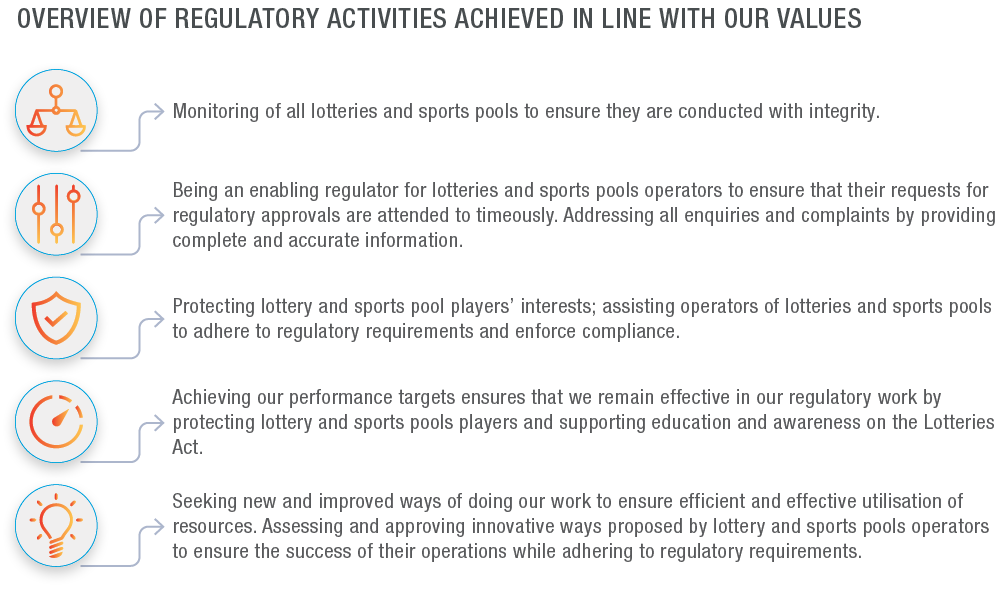
Overview of regulatory activities achieved in line with our values
Regulatory value chain
The NLC’s regulatory compliance value chain is based on the core regulatory activities of a well-functioning lotteries and sports pools regulator.
- National Lottery and sports pools RFP.
- Society lottery application.
- National Lottery bid evaluation and adjudication.
- Society lottery application processing.
- Other lotteries exempt application.
- Issuing of National Lottery and sports pools licence.
- Certification of society lotteries and schemes.
- Participants protection.
- Education and awareness.
- Enforcement.
- National Lottery and sports pools compliance monitoring/ regulation.
- Society lotteries compliance monitoring/ regulation.
- Other lotteries regulation.
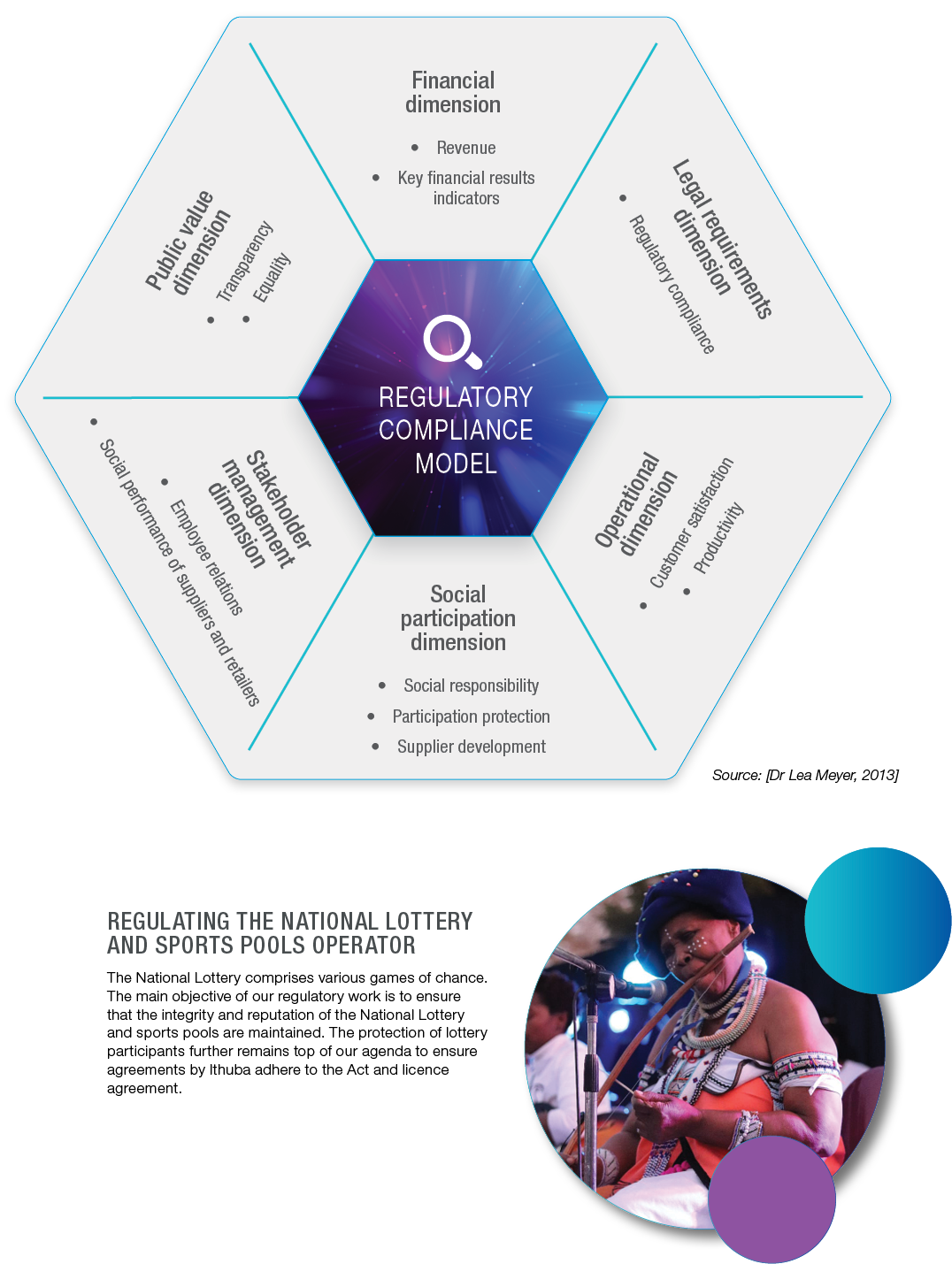
The NLC’s mandate to regulate all lotteries and sports pools with integrity and ensure the protection of all participants is realised through the activities of the Regulatory Compliance Division. The NLC’s regulatory mandate continues to be one of the organisation’s main priority areas, focusing on regulating and monitoring the compliance and performance of the Operator with the Lotteries Act and licenses to conduct the National Lottery and sports Pool. The NLC ensures optimum and balanced regulation of lottery operators through the regulatory compliance model depicted here
In accordance with the Board’s directive to ensure that the NLC is positioned and recognised as a regulator, the following must be implemented:
- Developing a strategy that will influence the direction of the legislation by advising the Minister.
- Aligning the structure to the regulatory mandate of the NLC.
- Introducing programmes that give effect to section 2B that stipulates that the Commission must ensure that the interests of participants in the National Lottery are adequately protected.
- Exploring and recommending to the Minister innovative ways to combat illegal lotteries, including licensing certain illegal lotteries, i.e., Fafi and online activities.
- Exploring opportunities in private lotteries as contemplated in the Lotteries Act.
REGULATORY ACTIVITIES
Central to the mandate of the NLC is the regulation of the National Lottery. A licence to operate the National Lottery was awarded to Ithuba in 2015, in terms of the Lotteries Act, No. 57 of 1997, as amended. As part of the ongoing regulatory work and delivering on the APP target for the period under review, the following was conducted in regulating and ensuring the Operator’s compliance with and performance against the licence agreement and the Act:
1. Vetting persons that run or are associated with running the National Lottery
All directors and staff of the Operator are vetted, together with retailers who sell National Lottery tickets. The NLC also ensures that contractors that conduct business with the Operator are also vetted to ensure that the integrity of the National Lottery is maintained, and players are protected.
2. Providing regulatory approvals and ministerial advice
The NLC receives proposals from the Operator for new games or changes to existing games, the introduction of alternate channels of play and amendments to game rules and prize pay-out structures. These proposals are assessed and approved by the Board as required in the Act and the licence agreement. The Operator submitted various proposals during the year under review, and the necessary approvals were granted once compliance with the Act and licence agreement were verified.
3. Ensuring player protection
Protecting players is central to our regulatory mandate. The following are some of the critical activities we perform to protect players:
Ensuring that the Operator pays prizes promptly by conducting regular reviews of payments to prize winners.
Protecting players against possible fraud by ensuring the Operator implements appropriate security measures to verify the identity of winners who claim prizes.
Conducting reviews to ensure that the Operator protects the anonymity of winners, in line with licence requirements.
Approving and monitoring descriptions and procedures for key processes (e.g., draws and prize payments).
Ensuring that clear information is available to players, including information on games available, how to play and claim prizes.
Handling complaints from players regarding service from the retailer or the Operator after exhausting the handling procedures.
Ensuring that there are controls in place to protect players against excessive play.
Ensuring that there are controls in place to protect against underage play.
4. Safeguarding the fairness of the National Lottery draws
Through inspections, reviews, certification and testing, we have ensured that all draws are fair, number selection is random, and results are accurately recorded. Approved procedures govern how the National Lottery draws are carried out, and every draw is overseen by independent auditors who also provide assurance that the draw is carried out correctly in line with approved procedures. Furthermore, the Operator is required to carry out periodic tests and re-accreditation of draw equipment/systems to ensure the randomness of draw results. The recently adopted Random Number Generator is independently tested and accredited for randomness and independence.
5. Monitoring operator computer gaming systems through the Independent Verification Systems
The NLC monitors the reliability, security and efficiency of the National Lottery’s central gaming system and network of terminals to ensure that every National Lottery ticket bought is appropriately recorded and included in the relevant draw. The system allows the NLC to agree sales figures and prize shares and make certain that the number of winners and prize amounts are accurate after each draw. The system also enables the NLC to confirm that monies due to good causes are correctly determined.
6. Monitoring of protection and payment of prize winners
During the period under review, we monitored and verified that:

The correct prize allocation has been made and paid across all games.

The operator transferred prize money won, but not yet claimed, into the Participants Trust Fund, to keep it secure for future prize claims.

Unclaimed and expired prizes are transferred to the NLDTF. These are prizes that have not been claimed within 365 days after the draw date.

One of the critical regulatory tools for ensuring the protection of participants is the NLPT.
7. PROTECTING THE NATIONAL LOTTERY BRAND AND INTEGRITY OF THE NATIONAL LOTTERY
We have monitored the National Lottery website and other media to ensure the integrity of the National Lottery information displayed therein. We also verified that Trademarks, Copyright and National Lottery logos correctly appear on all National Lottery materials available to the public. This ensures that players can tell the difference between the National Lottery and other gambling products available in the market. Retailer inspections were regularly conducted to ensure that retailers comply with regulatory requirements.
8. MONITORING THE IMPLEMENTATION OF SOCIAL RESPONSIBILITY PROGRAMMES, B-BBEE, SUPPLIER DEVELOPMENT INITIATIVES, LOCALISATION AND ECONOMIC EMPOWERMENT REQUIREMENTS
The Act and licence agreement stipulates that the Operator will initiate and support opportunities for social and economic empowerment, affirmative action, employment equity and representation, training and skills development, promotion of small businesses and job creation, advancement of women in business, as well as winners counselling and financial advice. The Operator is also required to show commitment to and comply with all B-BBEE legislation and localise its procurement of goods and services to the extent that it is reasonably possible, without having a detrimental effect on the running of the National Lottery. The Operator has submitted the required progress reports on the above initiatives, and the NLC has verified the information reported.
9. HANDLING COMPLAINTS ABOUT THE NATIONAL LOTTERY
The NLC has also handled complaints raised in connection with the National Lottery. Complaints are reported to the NLC as escalation after exhausting the Operator’s complaints handling processes. However, the NLC accepts all complaints and forwards all those that require preliminary handling by the Operator. A follow-up is conducted to ensure that all complaints are adequately handled in line with licence requirements.
10. ENSURING COMPLIANCE AND ENFORCEMENT
Society lotteriesThe Act permits NPOs to raise funds through lotteries. Interested NPOs are required to register with the NLC. As a result of our education and awareness initiatives, we have noted an increase in organisations registering as societies. On registration, a society is eligible to submit a lottery scheme to the NLC for registration. The Act allows an NPO to operate up to six schemes in a year, raising a maximum of R2 million per scheme.
During the period under review, the division implemented a model for society lotteries. The Act authorises the NLC to conduct inspections to determine that society lottery activities are undertaken in line with the Act. The summary of society-lottery-related activities conducted during the year is indicated below: and The summary of revenue generated by the 74 schemes is reflected below:
| Society lotteries | Statistics |
|---|---|
| Number of societies registered | 32 |
| Number of schemes registered | 88 |
| Number of compliance inspections conducted | 13 |
| Number of draw inspections conducted | 24 |
| Number of pre-approval inspections conducted | 33 |
| Number of exemptions granted | 6 |
| Number of compliance seminars held | 100 |
| Number of fundraising guidelines distributed | 9 063 |
| Number of lottery returns assessed | 74 |
The summary of revenue generated by the 54 schemes is reflected below:
| Month | Funds raised 2021–22 |
Funds raised 2020–2021 |
| April | R219 380 | R362 010 |
| May | R1 432 442 | R338 800 |
| June | R1 000 050 | R115 090 |
| July | R306 900 | R179 040 |
| August | R2 202 900 | R709 850 |
| September | R63 650 | R618 560 |
| October | R4 217 475 | R812 900 |
| November | R278 645 | R3 793 149 |
| December | R901 850 | R489 170 |
| January | R1 043 495 | R232 865 |
| February | R39 880 620 | R21 038 787 |
| March | R911 050 | R905 536 |
| TOTAL | R52 458 457 | R29 595 702 |
Our focus for the new financial year will be to continue creating awareness on society lotteries and assisting NPOs who wish to run such schemes in complying with the Act.
Illegal lotteries and schemesAs part of our enforcement mandate, we identified and were informed of various forms of schemes that were advertised requiring public participation. Through detailed legal analysis, we ascertain whether or not such schemes can be considered to be lotteries and whether they are permissible in terms of the Act. If such lotteries are conducted without prior approval of the Board, they are rendered illegal.
Society lotteries that were non-compliant with the Act were identified. We were successful in having such schemes declared illegal as they were contrary to the Act. These schemes were subsequently discontinued.
Competitions that were run as promotional competitions, but not in compliance with requirements of the Consumer Protection Act, were also identified as a form of illegal lottery, and the companies were instructed to discontinue competitions. These are considered key achievements for the NLC for the year under review in delivering our mandate of monitoring and regulating lotteries. Below is a table summarising the number of investigations conducted for the year:
| Lottery schemes investigated | Statistics |
| Number of illegal lotteries investigated and closed | 56 |
| Number of promotional competitions investigated and closed | 1 010 |
| Number of lottery schemes under investigation | 9 |
| Number of schemes investigated | 1 075 |
| Number of arrest operations for illegal lottery operators | 2 |
| Financial impact on illegal lotteries investigated | 77 538 500 (R) |
11. MONITORING OF PAYMENTS TO THE NLDTF
We have ensured that the proportion of National Lottery ticket sales that go to good causes, as well as any other prescribed payments, are transferred from the Operator to the NLDTF in accordance with timelines specified in the licence. For the period under review, we verified that the Operator’s payments are complete and accurate.
THE NLPT
The NLPT is established in terms of the Trust Property Control Act, No. 57 of 1998. The NLPT was founded by Ithuba Holdings (RF) Proprietary Limited in accordance with the third licence to operate the National Lottery. The licence is a regulatory instrument provided for under the Lotteries Act to enable the NLC to fulfil its regulatory mandate of monitoring Ithuba’s operations and Ithuba’s obligations to procure a Trust to protect, amongst others, prize monies payable to National Lottery participants who have 365 days to claim their prizes. The duty of procuring the Trust is a critical element of the regulatory function of the NLC as set out in section 10(1)(j) of the Lotteries Act.
The NLC Board, in its capacity as regulator, exercises oversight in accordance with the provisions of the Lotteries Act, the licence and the principles contained in the King IV Code. The NLPT complied with all reporting requirements by submitting quarterly reports, management accounts, income and expenditure statements and AFS within the stipulated periods as indicated by the Board of the NLC.
Appointment of Trustees
The Board of Trustees comprises two nominee Trustees, who are representatives of the NLC and Ithuba, respectively, and three independent Trustees. The NLC, with consent from Ithuba, appoints a maximum of three independent Trustees. Trustees hold office for three years and are eligible for re-appointment at the end of the three-year period.
Independence
All independent and nominee Trustees are deemed to be independent, having adhered to King IV Code principles of independence and criteria for connected persons as defined in the Income Tax Act. A majority of the Trustees are independent as they have no material interest in the NLC, interest in the National Lottery Operator, beneficiaries or suppliers. Trustees of the NLPT have fiduciary duties to the Trust and its beneficiaries. The primary beneficiaries of the NLPT are participants in the lottery who are secured of their prize money as well as the NLDTF as a secondary beneficiary of interest on the funds that are paid to the NLPT as well as unclaimed and expired prize money.
Trustees are required to complete an annual disclosure of interest. In addition, they are required to disclose interests at every meeting to ensure that circumstances that may give rise to a conflict of interest are managed and monitored effectively. There were no conflicts of interest identified during the reporting period.
Trust administrator
The Trust administrator is appointed to service the Trust for the duration of the third licence to operate the National Lottery. The Trust administrator is accountable to the NLPT Board of Trustees for the performance of all financial, administrative, secretariat and clerical functions, as well as any duties that the Board of Trustees may delegate.
Members and attendance
The Board of Trustees comprises five members, including the Chair, Adv Nevondwe. The Deed of Trust makes provision for a minimum of four meetings per year. During the financial year ended 31 March 2022, the Board of Trustees met on eight occasions.
The table below shows the attendance of these meetings:
| Committee member | Role | Qualifications | Date of appointment | Quarterly meetings |
|---|---|---|---|---|
| Adv LT Nevondwe | Chairperson | LLB (University of Venda) LLM (University of Venda) LLD (University of Limpopo) |
1 April 2016 | 9/9 |
| Mr PR Letwaba, CA(SA) | Member – NLC Representative | BCom Accounting CTA | 28 May 2015 | 0/9 |
| Adv BE Mabuza | Member – Ithuba Representative | BProc (NWU) LLB (Wits) LLB (Georgetown University) |
22 July 2015 | 8/9 |
| Ms MT Ramuedzisi CA(SA) | Member | BBusSc (UCT) HDipAcc (Wits) MCom (Computer Auditing) (UJ) RA |
1 April 2016 | 9/9 |
| Mr A Mahlalutye | Member | BSc Quantity Surveying (UCT) Masters in Business Leadership (UNISA) Masters in Financial Management (University of London) |
1 February 2018 | 9/9 |
| Ms XS Ntuli | Member | BAccounting (UP) HDipAcc (Wits) |
1 February 2018 | 9/9 |
The NLPT Chairperson appeared before the NLC Board Audit and Risk Committee to report on the performance and financial information, and other relevant matters concerning the Trust.